Malta's newly unveiled €2.8B light rail system has sparked intense debate over whether the island nation can afford a 15-year wait for relief from today's traffic crisis. The ADPD – The Green Party is demanding comprehensive answers on financing, route design, and integration strategy—and questioning whether a faster, cheaper Bus Rapid Transit (BRT) alternative might serve residents better.
Why This Matters
• Timeline friction: Construction won't start until 2031, with full completion pushed to 2041—a 15-year wait that critics say ignores today's gridlock crisis affecting daily commuters.
• Fiscal exposure: The €2.8B price tag raises serious questions about debt sustainability and whether spending will deliver timely relief to residents stuck in traffic now.
• Alternative overlooked: The Green Party insists a Bus Rapid Transit (BRT) system could deliver faster results at a fraction of the cost, with dedicated lanes operational within five years, not decades.
• Car dependency unchanged: Without aggressive policies to discourage private vehicle use, the rail line risks becoming underused while congestion persists on parallel roads.
The "La Valette Line" Vision
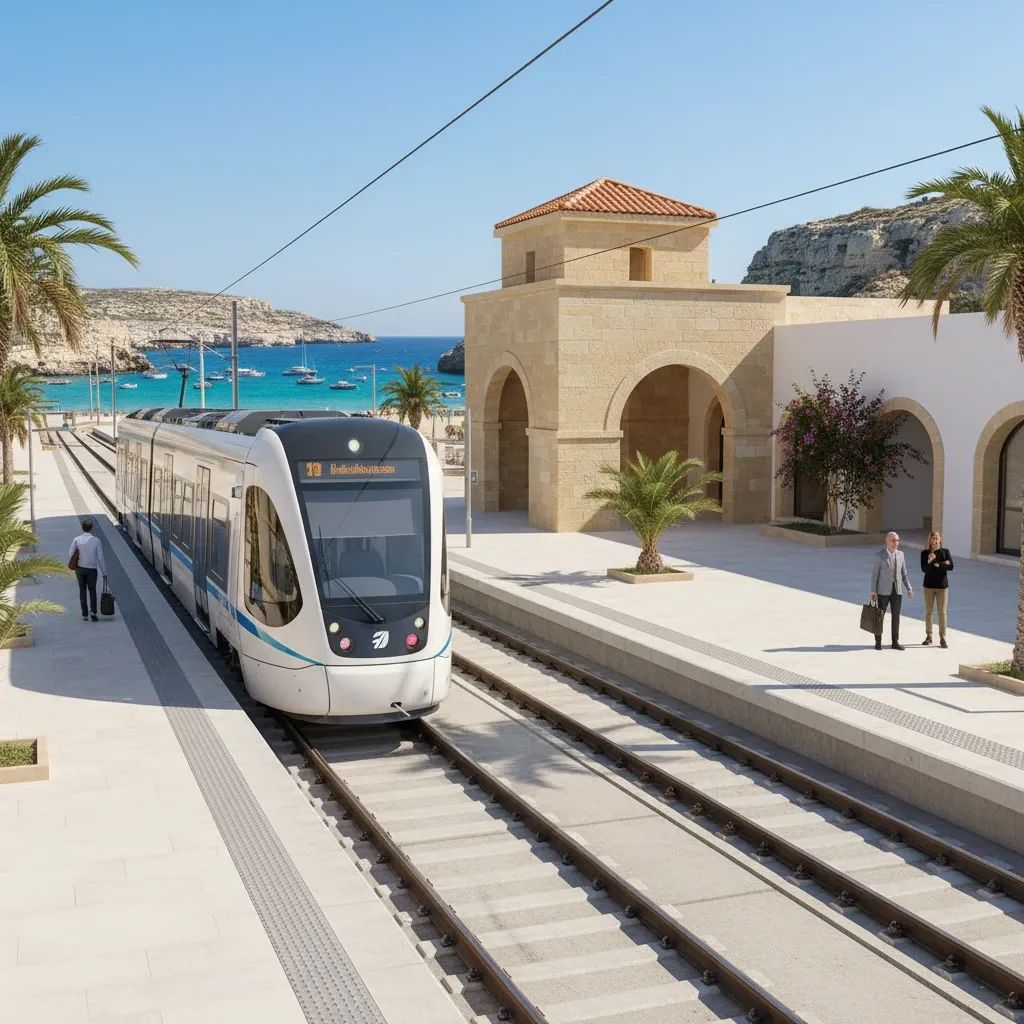
The Malta Ministry of Transport rolled out the "Malta in Motion" strategy on April 23, branding it as a 15-year integrated mobility revolution. At its core sits a 24-kilometer hybrid light rail linking Malta International Airport, Qormi, Mater Dei Hospital, Valletta, and St Paul's Bay—key employment hubs and residential centers that currently generate significant commute bottlenecks. The system will blend underground tunnels, street-level trams, and elevated sections—a design compromise aimed at reducing costs from an earlier, more ambitious €6.2B underground metro floated in 2021 and quietly shelved.
Of the total budget, €1.8B is earmarked for construction itself, while the remaining €1B covers planning, environmental assessments, land acquisition, rolling stock (the trains), and operational preparations. Journey times are projected at no more than 10 minutes between stops, with high-capacity trains running at frequencies designed to rival European capitals.
Yet the phased rollout betrays the project's complexity. The airport-to-Valletta segment won't open until 2036–2039, with the northern extension to St Paul's Bay trailing two years later. That means anyone buying property or planning a business today will wait a decade or more before seeing meaningful change. During these 15 years, the existing bus network will undergo its own restructuring, though details on how service cuts or changes will affect residents remain unclear.
Why Construction Doesn't Start Until 2031
The government has cited EU planning approvals, utility relocation assessments, and formal land acquisition procedures as reasons for the extended pre-construction timeline. Environmental impact studies, geological surveys for underground sections, and design refinements must be completed before ground-breaking—a process that EU co-financing requirements can lengthen significantly. This explains the gap but does little to comfort residents frustrated by current congestion.
The Stations and What They Mean for Daily Commutes
The proposed stations serve major employment and residential centers: Mater Dei Hospital (one of Malta's largest employers), Valletta (government, tourism, and financial services hub), Qormi (industrial and commercial zone), St Paul's Bay (residential expansion and emerging office district), and the Airport (growing employment and tourism anchor). For a typical resident commuting from Birkirkara to Valletta today—a journey that can take 30-45 minutes in peak traffic—the rail system promises a 15-minute journey and freed-up road capacity for those who must drive. However, this benefit remains conditional on 2036+ implementation.
Green Party Pushes Back: "Show Us the Details"
Sandra Gauci, chairperson of ADPD – The Green Party, has publicly called on the government to release comprehensive documentation before ground is broken. Her party's core criticisms center on four unanswered pillars:
Route alignment and land acquisition: Which streets face closure? What compensation will property owners receive for underground access rights or surface disruption?
Passenger capacity modeling: Has the government conducted rigorous demand forecasting, or is the 24-kilometer spine based on political optimism rather than transport economics?
Financing structure: Will the project rely on EU co-financing, public-private partnerships, or straight sovereign debt? What happens if ridership projections fall short?
Integration with existing modes: How will the redesigned bus network—set to shift to a hub-and-spoke model when the current concession expires in 2029—connect with rail stations? Will ferry schedules sync with train arrivals?
Gauci has also questioned the timing, noting that the announcement landed just months before a potential election cycle, complete with immediate plans for geological studies to create the appearance of momentum.
The BRT Alternative: Faster, Cheaper, More Flexible
For years, ADPD has championed a different path: a Bus Rapid Transit (BRT) network built around dedicated lanes, signal priority, and high-frequency service. The party argues this model could be operational within five years at a cost well under €1B, delivering immediate relief to commuters now while preserving fiscal headroom for other priorities like housing or healthcare.
BRT systems in cities such as Curitiba, Bogotá, and Istanbul have demonstrated that bus-based rapid transit can rival rail in speed and reliability when lanes are protected and enforcement is strict. In Malta's compact geography, where the longest possible journey spans just 45 kilometers, a BRT network could theoretically serve the entire island with 15-minute headways and seamless transfers. The critical question: Would residents actually switch from private cars to buses, regardless of speed?
The Green Party warns that without strong disincentives for private car use—such as congestion pricing, reduced on-street parking, or higher fuel taxes—any transit system risks underperformance. "If someone can still drive door-to-door and park for free," one ADPD spokesperson noted, "they won't choose a train that requires a transfer and a 10-minute walk."
Malta's Track Record on Infrastructure
One practical concern underpinning skepticism is Malta's experience delivering large-scale projects on time and budget. Recent infrastructure initiatives have faced delays and cost revisions—a pattern that makes the 15-year timeline credible but the 2031 start date feel optimistic. The government's own financing minister has already signaled that budget figures may need revision, hinting at fiscal uncertainties ahead.
What This Means for Residents
For homeowners and businesses along the proposed corridor—Valletta, Qormi, Birkirkara, Mater Dei, and St Paul's Bay—the next five years will bring geological surveys, utility relocation, and prolonged street closures. Construction zones will disrupt foot traffic, parking, and deliveries, with compensation mechanisms still undefined.
Commuters won't see meaningful change until the mid-2030s, meaning anyone under 40 today will spend much of their prime working years navigating the same congested arterials and enduring current fuel costs and commute times (averaging 40-60 minutes each way for long-distance routes during peak hours). The government projects a 30% increase in public transport usage and a 25,000-ton annual reduction in CO₂ emissions once the system is live—gains that translate to cleaner air and marginally shorter commutes—but those remain speculative until ridership data materializes.
Investors and developers face uncertainty around zoning changes near future stations. Transit-oriented development could unlock value, but only if the rail line opens on schedule and attracts riders. Given Malta's infrastructure track record, many are adopting a wait-and-see posture.
Political Fallout and the Opposition's Counter-Proposal
The Nationalist Party (PN) has seized on the project's vulnerabilities, with spokesperson Alex Borg labeling the plan incomplete and questioning how a 15-year timeline addresses urgent needs. The PN has pledged to unveil its own transport blueprint, promising faster implementation timelines—a claim that raises questions among engineers familiar with rail procurement timelines.
Critics within the Malta business community have also voiced concern about implementation risk, with some questioning whether the primary beneficiaries will be international consultants billing millions for feasibility studies, environmental assessments, and design work—while Maltese taxpayers shoulder project delivery risk.
The Broader "Malta in Motion" Framework
Beyond rail, the "Malta in Motion" strategy envisions a multimodal ecosystem: expanded maritime ferry services to bypass road congestion, active travel routes for cycling and walking, a revised parking policy, and accelerated electromobility adoption across the public fleet. Ride-hailing platforms like Bolt, Uber, and eCabs already provide flexible alternatives, while electric scooter rentals (Whizascoot) serve short-hop trips.
The government insists this holistic approach aligns with the National Transport Strategy 2050 and the Transport Master Plan 2030, both prioritizing modal shift over road expansion. Yet skeptics note that previous master plans have languished in bureaucratic limbo, and Malta's car ownership rate continues to climb despite official rhetoric favoring public transit.
The Verdict: Ambition or Overreach?
Malta's light rail proposal represents a genuine attempt to rethink mobility on an island where traffic congestion imposes significant economic and personal costs on residents. But the ADPD's call for transparency reflects a deeper anxiety: that the government is prioritizing a prestige project over pragmatic, incremental solutions that could deliver relief within this decade.
Whether the "La Valette Line" becomes a transformative spine or a cautionary tale in infrastructure planning will depend on three factors: political continuity across multiple election cycles, disciplined fiscal management, and willingness to impose unpopular measures that make driving less attractive. Until the government releases detailed feasibility studies, demand models, and financing agreements, residents are left with a glossy vision—and a 15-year wait to see if it materializes.