
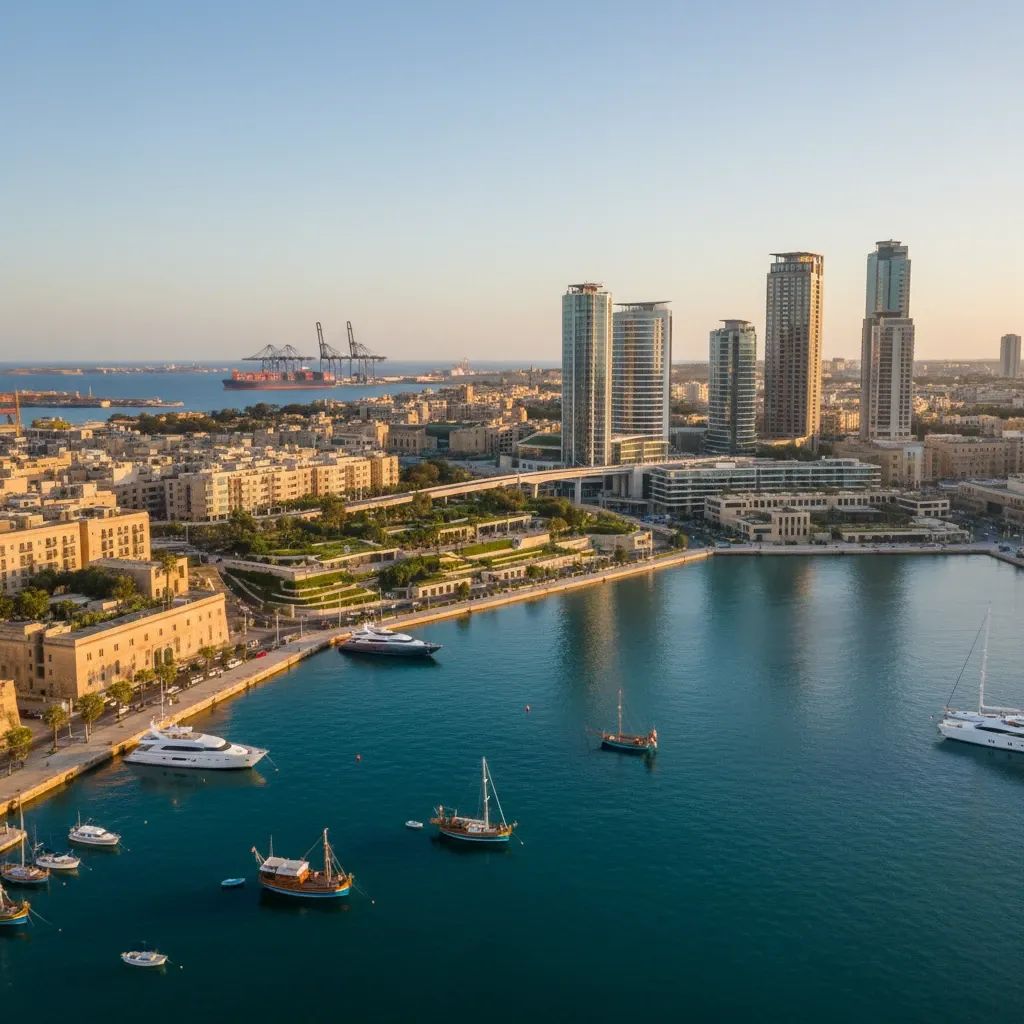
Prime Minister Robert Abela launched Malta's new national identity "Shine Here" on February 26 at Ħaġar Qim, marking the official start of Vision 2050's implementation—a strategic pivot away from construction toward seven high-value sectors. For residents, this signals immediate and tangible changes: fewer development permits, tighter planning controls, and a deliberate restructuring of the job market over the next decade.
The Breaking News: What the Government Actually Committed To
The "Shine Here" branding isn't just a slogan. It anchors a formal economic restructuring with specific targets: €18 billion in combined value from seven priority sectors by 2035 (compared to roughly €7 billion currently), deliberate contraction of the construction industry, and a shift from measuring success by GDP to measuring quality of life. A dedicated Programme Management Office (PMO) will track progress with public checkpoints in 2030 and 2035.
The seven priority sectors are: shipping and maritime, aviation and aerospace, financial services and fintech, high-end manufacturing (semiconductors, pharmaceuticals, precision engineering), reimagined tourism (luxury and cultural experiences rather than mass-market), gaming and digital entertainment, and blue and green economies (renewable energy, circular manufacturing, sustainable agriculture).
Construction is conspicuously absent. This isn't rhetoric—it reflects a policy decision to stop treating building as the default growth lever.
What's Changing Immediately for Residents
The physical landscape will stabilize—but with a timeline. Urban regeneration now takes priority over greenfield development. The government is shifting focus toward revitalizing vacant buildings and retrofitting older structures rather than demolition-and-rebuild cycles. Stricter planning controls aligned with EU sustainability standards will impose a "carrying capacity approach"—essentially, a maximum density threshold beyond which the island's infrastructure, water systems, and quality of life deteriorate.
When will permits actually decrease? The PMO dashboard, expected within months, will publish specific KPIs for construction reduction. Watch for this announcement—it's the first measurable test of whether the government follows through.
Housing costs and your property: Fewer new construction projects should ease pressure on land prices over time, but this unfolds gradually through 2035. Current homeowners face stricter renovation standards if they plan upgrades. Stricter enforcement of safety and environmental compliance may also increase project costs.
The labor market is restructuring now. Jobs in the seven priority sectors typically pay more and require technical qualifications—finance specialists, software engineers, aviation technicians, pharmaceutical researchers. For workers currently in construction, this signals a need for retraining. The government anticipates 140% growth in these seven sectors over the coming decade.
Where's the retraining support? This is the critical gap. The Vision document doesn't detail specific retraining programs, funding, or timelines for construction workers transitioning to related fields like green building retrofitting. Residents in the construction sector should expect government announcements on this in coming months—this is a pressing implementation question.
Quality metrics matter more than volume. Malta aims to rank in the top 20 globally on the Human Development Index and be among the top 10 EU countries for life satisfaction by 2035. Translated: investments in mental health services, education, environmental cleanup, and work-life balance become measurable policy priorities. On paper, this sounds positive. In practice, it depends on budget allocation and enforcement.
The Four Pillars Driving the Pivot
The government has anchored this rebranding on four operational principles:
Nimble by nature signals Malta's historic advantage: the ability to pass legislation and implement policy faster than larger EU members. The government points to its rapid adoption of blockchain regulation, financial services licensing, and gaming oversight as proof.
Bridges worlds leverages Malta's geography and multilingual workforce to position the island as an operational platform for companies serving European and African markets—not just a destination.
Focusing on what matters represents a deliberate rejection of volume-based metrics in favor of measurable quality—education standards, environmental resilience, life satisfaction.
Make it happen emphasizes national execution, acknowledging that many countries draft visions; fewer follow through.
What Happens Next: Milestones Residents Should Track
• Months 1-3 (by May 2026): The PMO publishes the national KPI dashboard with specific metrics for construction reduction, sector growth targets, and quality-of-life indicators. This is your first accountability checkpoint.
• 2030 Review: Mid-term assessment of progress. If construction hasn't contracted or the seven sectors haven't scaled as planned, the government will face pressure to adjust or acknowledge shortfalls.
• 2035 Final Target: Formal evaluation against all commitments. By this date, residents should see measurable differences in the built environment, job availability in priority sectors, and quality-of-life rankings.
The Reality Test
Vision documents are easier to draft than execute. Strong planning enforcement requires political courage to refuse development projects, especially those backed by influential investors or employing hundreds. Urban regeneration is slower and messier than new construction. Attracting high-end manufacturing demands competitive incentives and skilled talent—both costly. Achieving 5% annual GDP growth (above EU average) without construction as an engine requires simultaneous execution across all seven sectors, a complexity Malta has never managed.
For residents, the credibility of this entire effort depends on whether the government genuinely throttles construction permissions, enforces environmental standards, and channels resources toward the seven priority sectors while supporting workers transitioning out of building. A slogan without enforcement is just marketing noise.
The next 9 years will determine whether "Shine Here" becomes an organizing principle for national policy affecting daily life, or merely another campaign slogan that fades once political attention shifts. Implementation, not branding, is where Malta's true test begins—and residents will be watching.


