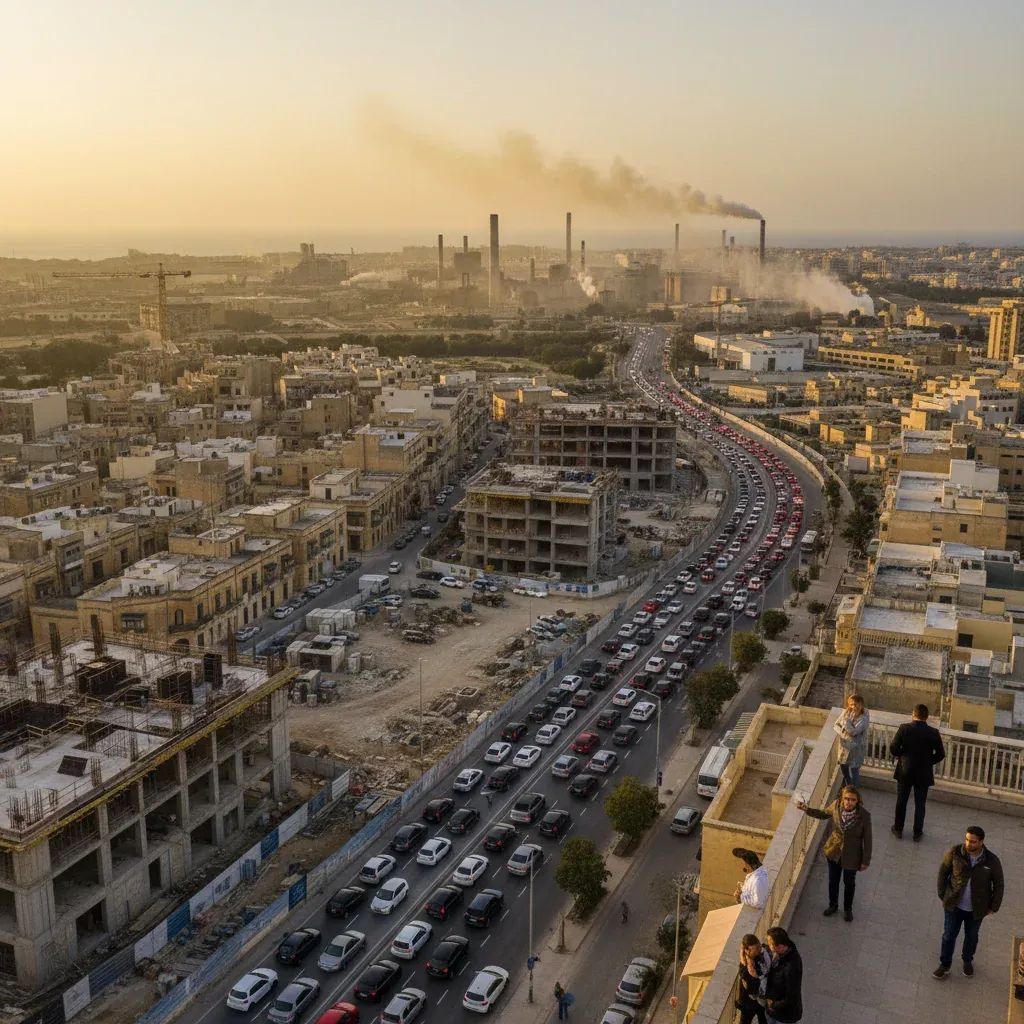
Air Quality Crisis Unfolds as Saharan Dust Blankets Islands
A mass of sand and mineral particles swept across the Mediterranean has settled over Malta and Gozo, delivering Monday's worst air conditions in recent months. The Environment and Resources Authority (ERA) began flagging dangerous pollution readings overnight, with some localities recording particle concentrations more than a dozen times beyond what international health agencies consider safe.
Why This Matters
• Health risk extends through Tuesday for vulnerable populations. Those with asthma, heart conditions, or chronic respiratory disease must stay indoors; outdoor activity multiplies exposure to microscopic particles capable of penetrating deep into lung tissue.
• Solar energy generation plummeted by roughly 50%, forcing utilities to activate fossil-fuel backup systems and raising grid costs just as the islands accelerate their renewable transition.
• Visibility restrictions affect maritime and aviation operations, complicating navigation and takeoff protocols through midweek.
The Geography Behind Today's Dust
A slow-moving depression positioned over Sardinia—with circulation extending as far south as Libya—has reversed the usual wind direction across the central Mediterranean. The result is the Xlokk, a powerful southerly flow that sweeps unobstructed across the Sahara Desert, lifting millions of tonnes of sand thousands of metres into the upper atmosphere. These particles don't settle; instead, upper-level winds carry them northward across open water, reaching Malta and Gozo within hours of their initial disturbance.
The Malta Meteorological Office confirmed overnight that this particular weather pattern also creates a secondary effect: the suspended dust layer acts like atmospheric insulation, trapping heat and preventing direct sunlight from reaching the ground. Paradoxically, this means air temperatures remain warm throughout the episode, hovering between 14°C and 23°C despite the pervasive grey haze blocking the spring sun.
Without rain to precipitate the dust downward, the particles remain suspended. Meteorologists call the wet version of this phenomenon blood rain—the muddy film that coats vehicles and windows after dust-laden precipitation. Today's dry conditions mean that airborne particles simply linger, creating the visual obscuring that characterized Monday morning across both islands.
The Scale of Contamination
Overnight readings from ERA monitoring equipment triggered multiple alarm flags. The local tracking platform arja.mt, which cross-references official measurements against World Health Organisation baselines, issued "extremely poor" air quality alerts for both islands early Monday.
In Żejtun, PM10 particles (coarse material roughly 7 times smaller than a human hair) exceeded WHO daily recommendations by more than 12 times. Attard recorded even sharper concentrations at 14 times the safe guideline. PM2.5 particles—the finer dust capable of entering the bloodstream—similarly soared beyond international safety thresholds.
The context matters: roughly half of all PM10 detected across Malta annually originates from natural dust intrusions. Construction sites, vehicle emissions, and fireworks from village celebrations account for the remainder. PM2.5 sources split similarly, with about one-third traced to Saharan events and two-thirds from urban and industrial activity.
Action Plan for Residents and Families
For Those Most at Risk
Anyone managing asthma, bronchitis, COPD, or heart disease should treat today and tomorrow as home-isolation days. Elderly residents and children face elevated vulnerability. Early warning signs include persistent coughing, throat scratching, chest tightness, watery eyes, and shortness of breath. Any symptom progression warrants immediate contact with medical providers or emergency services.
The practical response requires disciplined action. Close all windows and external doors. Switch air conditioning to recirculation mode, preventing outdoor air from infiltrating while cycling clean internal air. Households without climate control should deploy HEPA filtration systems in bedrooms and main living areas to capture fine particles drifting through unavoidable openings. Anyone stepping outside for essential errands requires a properly fitted N-95 or KN95 mask; standard cloth or surgical masks provide negligible protection against particles this fine.
Driving and Vehicle Safety
Motorists contending with compromised visibility must keep windows sealed and vehicle air vents set to recirculation. If dust density suddenly collapses visibility, the safest response is to exit the roadway safely, park, and turn off vehicle lights to prevent attracting other traffic in low-visibility conditions. Indoor driving with sealed systems is far preferable to outdoor travel.
After-Exposure Hygiene
Shower and change clothing after any outdoor exposure to remove dust particles settling on skin and fabric. Keep rescue inhalers and prescribed medications easily accessible; monitor yourself and family members closely for symptom changes over the next 48 hours. Particles can linger for several hours or, in certain atmospheric conditions, persist for up to 10 days.
Why This Keeps Happening—And Why It's Getting Worse
Saharan dust intrusions represent a permanent fixture of Malta's climate calendar, not an aberration. Peak frequency clusters around spring months—March, April, and May—with secondary surges in October and November. The archipelago typically endures multiple such events annually.
What concerns regional climate analysts is an emerging intensification trend. Dust concentrations measured across Mediterranean locations between 2020 and 2022 exceeded patterns documented from 2003 to 2019, with particles reaching higher atmospheric altitudes. Researchers attribute this shift to rising Mediterranean surface temperatures combined with persistent drought conditions across North Africa's Maghreb region. As climate patterns continue evolving, residents should anticipate both increased frequency and severity of these events in coming years.
February 2026 alone saw PM10 readings exceed WHO limits by more than sixfold when a massive plume crossed the Mediterranean, captured in satellite imagery by the EU's Copernicus Earth monitoring programme. April 2025 delivered another surge, with all five Malta air quality monitoring stations reporting elevated PM10 when southeasterly winds channeled dust across the islands. Today's event mirrors that precedent, though early indicators suggest potentially similar or greater intensity.
The Energy Sector's Hidden Vulnerability
Malta's accelerating transition toward photovoltaic generation has introduced a vulnerability most residents fail to recognize. Dust coating solar panels degrades efficiency by 25-40% during major intrusions, with extreme events capable of cutting output by half. During today's event, Mediterranean solar farms collectively expected to generate 3,500 megawatts but plummeted to approximately 1,600 megawatts. That 1,900-megawatt shortfall forces grid operators to activate fossil-fuel backup generators, simultaneously driving electricity costs upward and increasing carbon emissions—a bitter irony for an island investing heavily in renewable energy transition.
The University of Malta is pioneering technological response through its DustPV research initiative. Engineers have developed the Dust Related Power Loss (DRPL) sensor, which measures real-time efficiency degradation in operating solar installations. By integrating sensor readings with meteorological forecasts, industrial solar farm operators can determine optimal cleaning schedules that balance maintenance costs against power generation maximization. This approach proves especially valuable during Malta's characteristic long dry periods, when dust accumulation reaches critical levels without rain to naturally cleanse panels.
Complementary strategies under active consideration include advanced energy storage systems that buffer supply fluctuations when solar output crashes, dust-resistant coatings applied to photovoltaic cells to minimize particle adhesion, and enhanced forecasting models incorporating real-time aerosol data. These adaptive measures become increasingly critical as climate shifts potentially accelerate Saharan dust frequency, demanding that infrastructure resilience keep pace with geographic reality.
When the Haze Clears
The Malta Meteorological Office expects the worst of the haze to clear by late Monday afternoon, though air quality will remain compromised through Tuesday morning. The strong southerly winds currently driving the dust intrusion are forecast to shift direction overnight.
By Tuesday morning, a gentler northeasterly breeze classified as force 2 to 3 should begin dispersing suspended particles. This wind pattern will strengthen to force 3 to 4 from the east-northeast through midweek, fully clearing the atmosphere and restoring normal visibility. Skies will remain predominantly cloudy through Wednesday and Thursday, with scattered showers possible on both days—precipitation that may help settle any lingering dust particles still suspended aloft.
Residents should monitor arja.mt and official Environment and Resources Authority bulletins for real-time updates. Once winds shift and clear conditions establish, normal outdoor activity gradually becomes safer, though anyone with respiratory sensitivity should remain cautious through the transition period.