
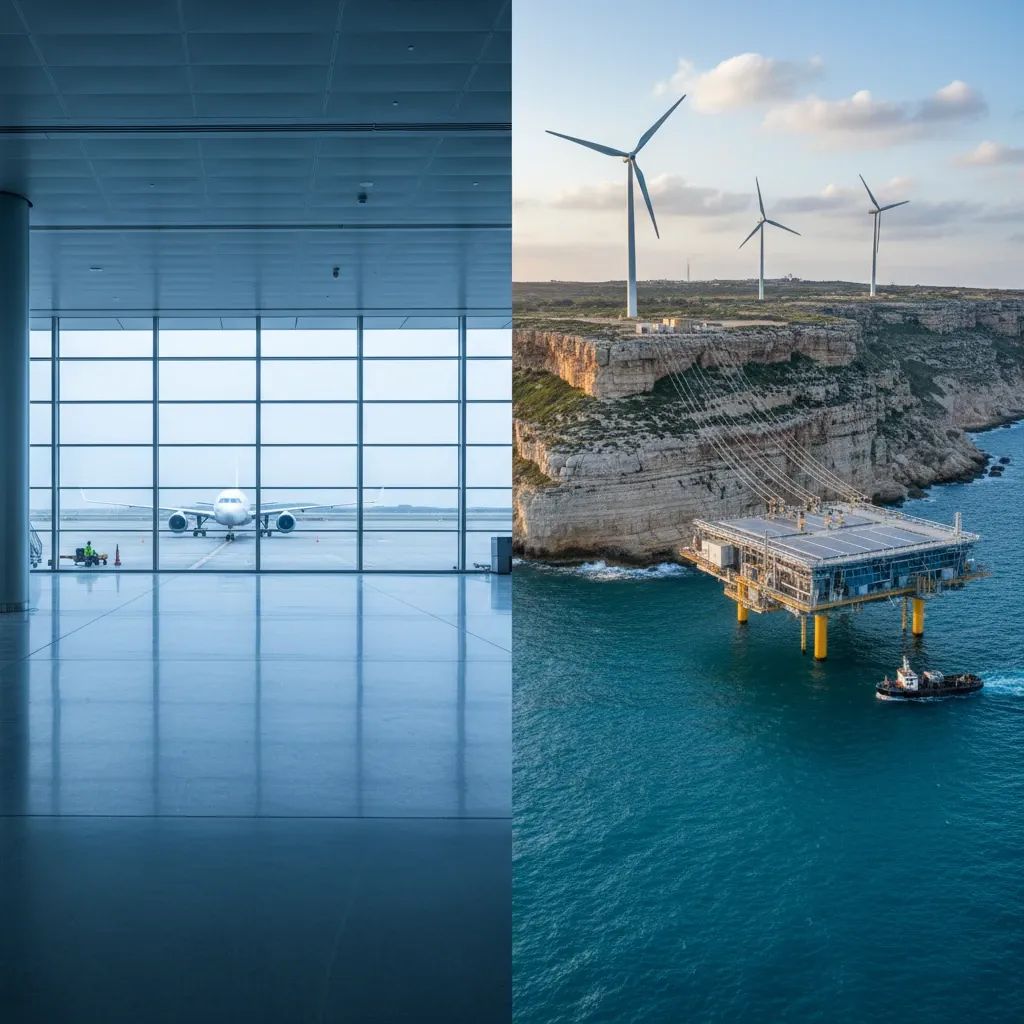
The Malta Parliament's Committee on Foreign Affairs, steered by Edward Zammit Lewis, is pressing for a fundamental reset in how Europe and its southern neighbors approach the Mediterranean—arguing the basin could evolve into a conduit for prosperity rather than remain a fault line for conflict. This policy push, articulated publicly this week, arrives as the region grapples with overlapping energy disputes, proxy wars, and a migration crisis that claimed thousands of lives last year.
Why This Matters
• Energy security: Eastern Mediterranean gas reserves remain contested, with Turkey, Greece, and Cyprus locked in maritime boundary disputes that could disrupt future electricity and gas links.
• Migration pressure: The central Mediterranean accounted for nearly 40% of irregular EU border crossings in the first nine months of 2025, placing frontline states like Malta under acute strain.
• Economic opportunity: The EU's Pact for the Mediterranean, launched in November 2025, promises scaled-up trade, clean energy investment, and talent mobility—but only if diplomatic frameworks hold.
A Policy Vision Rooted in Maltese Tradition
Zammit Lewis, a former Labour minister and current chair of the parliamentary foreign affairs panel, frames his call through the lens of Dom Mintoff's 1970s doctrine that European peace hinges on Mediterranean stability. The argument is straightforward: cooperation yields tangible dividends—shared energy grids, harmonized trade rules, joint security operations—while confrontation locks the region into cycles of arms buildups, border closures, and economic fragmentation.
Speaking at a policy forum this week, Zammit Lewis emphasized that multilateral dialogue platforms must move beyond ceremonial gatherings. He advocated for concrete investments in economic development, education, and governance within vulnerable North African states, positioning these as crisis prevention tools rather than reactive aid packages. His stance on migration is particularly pointed: treat it as a "reality to be managed with humanity" rather than a containment problem, addressing root causes through sustained development rather than enforcement alone.
The Pact for the Mediterranean: Architecture for Integration
The centerpiece of regional cooperation is the Pact for the Mediterranean, a European Commission flagship formally endorsed in Barcelona during the 30th anniversary of the Barcelona Declaration in November 2025. The initiative outlines three interconnected pillars designed to create what Brussels terms a "Common Mediterranean Space."
The People pillar focuses on youth mobility, skills alignment, and gender equality. Practical examples include Talent Partnerships with Morocco, Tunisia, and Egypt, designed to match vocational training programs with labor shortages in both origin and destination countries. The Economic pillar targets sustainable investment, clean energy trade, and water management, backed by the Trans-Mediterranean Renewable Energy and Clean Tech Initiative (T-MED). The Security and Migration pillar proposes a regional dialogue on internal security, covering terrorism, drug trafficking, and migrant smuggling, while exploring how Southern Mediterranean states might participate in EU defense missions.
An action plan is scheduled for release in the first quarter of 2026, translating political commitments into budgeted projects. The Union for the Mediterranean (UfM), which adopted its "Vision Statement 2025" last November, will coordinate much of the implementation. The UfM's 2025–2026 agenda includes the Mediterranean Initiative III under Horizon Europe, allocating roughly €410M for vaccine development, biodiversity, and renewable energy research, alongside the Partnership on Research and Innovation (PRIMA), which runs through 2027 with a focus on agro-food systems and water.
What This Means for Residents
For those living in Malta, the policy trajectory carries direct implications. The Great Sea Interconnector—an EU-backed electricity transmission project linking Greece, Cyprus, and Israel—could eventually expand to include Malta, diversifying energy supply and reducing reliance on diesel-fired generation. However, Turkey's formal objections to the interconnector, rooted in contested maritime boundaries, illustrate how regional disputes can delay or derail infrastructure that would lower energy costs and improve grid stability.
On migration, Malta's geographic position ensures it remains a primary landing point for central Mediterranean crossings. The Pact's emphasis on legal pathways, talent schemes, and return agreements aims to ease pressure on reception centers and create orderly alternatives to irregular sea crossings. Yet implementation depends on sustained EU burden-sharing, a perennial friction point that has left Malta and other frontline states shouldering disproportionate costs.
Trade modernization under the Pact could benefit Maltese exporters, particularly in services and digital commerce. The revised Pan-Euro-Mediterranean Convention, which entered force in January 2025, streamlines customs procedures. But the Carbon Border Adjustment Mechanism (CBAM), fully effective by 2026, will require Southern Mediterranean suppliers to meet EU sustainability standards—potentially disrupting supply chains for Maltese businesses reliant on North African inputs.
Persistent Flashpoints Threaten Progress
Despite the cooperative architecture, multiple conflict zones threaten to undermine diplomatic gains. The Eastern Mediterranean remains the most volatile theater. Turkey's "Blue Homeland" doctrine asserts expansive maritime claims that clash with Greek and Cypriot interpretations of UNCLOS, the UN Convention on the Law of the Sea. Ankara's 2019 memorandum with Libya's Tripoli government carved out an EEZ corridor that Greece views as legally invalid, while Turkey continues to issue NAVTEX warnings for seismic surveys in disputed waters.
In early 2026, the Israel-Iran rivalry escalated sharply. Joint US-Israel airstrikes on Iranian nuclear facilities prompted retaliatory missile barrages, disrupting shipping through the Strait of Hormuz and the Red Sea, which in turn choked traffic through the Suez Canal—a critical artery for Mediterranean commerce. Proxy conflicts in Syria and Lebanon spill into the sea itself: Hezbollah and allied groups have launched drones across the Mediterranean toward Israeli targets, raising the specter of attacks on offshore gas platforms.
In the western basin, Algeria-Morocco tensions have intensified. The two Maghreb powers are locked in an arms race, with economic ties severed and gas flows to Southern Europe disrupted. The dispute over Western Sahara, inflamed by Morocco's normalization with Israel and subsequent US recognition of Moroccan sovereignty, has Algeria framing the situation as strategic encirclement.
Long-Term Vision Versus Short-Term Realities
Zammit Lewis's call for cooperation over confrontation resonates with a tradition of Maltese neutrality and bridge-building, embedded in the island's constitutional identity. Yet the policy framework he champions requires reciprocal commitments from powers—Turkey, Egypt, Israel, Algeria—whose strategic calculus often prioritizes unilateral advantage over regional cohesion.
The 24th Meeting of the Barcelona Convention parties, held in Cairo in December 2025, adopted the Mediterranean Strategy for Sustainable Development (MSSD) 2026–2035 and a Regional Climate Change Adaptation Framework, alongside an Offshore Action Plan governing oil and gas extraction. These legal instruments provide the scaffolding for environmental cooperation, yet enforcement mechanisms remain weak when maritime boundaries themselves are contested.
The UfM's 10th Working Group on Environment, convening in April 2026, will assess progress under the 2030GreenerMed Agenda. A separate initiative launching the same month—"Women Leading Change"—aims to embed gender-responsive leadership in Mediterranean universities and municipalities, signaling an effort to deepen societal linkages beyond state-to-state diplomacy.
The Verdict: Infrastructure or Impasse?
Whether the Mediterranean evolves into a functional bridge or hardens into a militarized boundary will depend on decisions made in the next 12 to 18 months. The Pact for the Mediterranean offers a credible framework, but its success hinges on three variables: the willingness of EU member states to finance joint projects at scale, the capacity of Southern Mediterranean governments to implement governance reforms, and the ability of rival powers to compartmentalize security disputes from economic cooperation.
For Malta, the stakes are existential. A Mediterranean characterized by trade integration, energy connectivity, and managed migration flows would cement the island's role as a regional hub. A Mediterranean of naval standoffs, closed borders, and energy nationalism would leave Malta isolated, absorbing the costs of regional dysfunction without the leverage to shape outcomes. Zammit Lewis's advocacy reflects an understanding that the choice is not abstract—it will determine whether Malta thrives as a crossroads or struggles as a buffer zone.


