The Malta Transport Authority has committed €5 M in financial incentives and deployed over 80 enforcement officers across 33 zones to manage daily gridlock, even as the nation's long-awaited metro project inches toward a 2030s launch. For residents navigating the island's notoriously congested roads, the question isn't whether Malta needs a transformative mass transit system—it's whether interim measures can deliver relief before that system materializes.
Why This Matters
• Immediate relief tactics like peak-hour enforcement and off-peak roadwork scheduling are already active, with Transport Minister Chris Bonett reporting "improved" conditions since September 2025.
• Financial incentives now offer up to €25,000 for drivers who surrender licenses for five years, yet free public transport has failed to shift most locals away from private cars.
• Long-term infrastructure—a €2.8 B hybrid metro and autonomous bus trials—won't deliver full service until the mid-2030s, leaving a critical gap.
The Congestion Reality: Numbers That Matter
More than 43% of Maltese voters ranked traffic congestion as their primary concern in recent polling, a figure that underscores the daily friction residents face. The island's high car ownership rate, compounded by narrow urban streets and school-run peak hours, creates bottlenecks that ripple across commutes, deliveries, and emergency services. A University of Malta study found that small-scale traffic restrictions yield "negligible impact on air quality" and can even degrade overall traffic flow, suggesting piecemeal fixes risk making the problem worse rather than better.
Against this backdrop, the Malta Cabinet rolled out a six-pillar strategy in late 2024, targeting implementation between Q2 2025 and Q3 2026. The pillars span a 24-hour economy (shifting service operations to off-peak windows), vehicle-use incentives, parking solutions, public transport enhancements, roadwork coordination, and sustainable mobility promotion. Each pillar addresses a distinct pressure point, but their cumulative effect depends on widespread adoption—a hurdle given entrenched commuting habits.
What's Already on the Ground: Practical Changes for Your Commute
Enforcement and Scheduling (Now Active)
The "Back to School" traffic management plan, launched in September 2025, stations enforcement officers and 10 motorcycles at key junctions during morning (6:30–9:30) and afternoon (15:30–18:00) peaks. Local councils have been barred from issuing road-closure permits during weekday mornings in school buffer zones. Public services—waste collection, landscaping, road cleansing—now operate outside rush hours, and the government is negotiating with the private sector to shift some portion of 60,000 commercial vehicles off peak-time roads.
Financial Carrots: What's Available Now
The €5 M incentive package targets both current and potential drivers. Here's what you can access:
For current drivers:
• Adults who surrender their car and license for five years: €25,000 grant (equivalent to several months' wages for many households)
• Any adult driver who renounces a license: €1,500 annually for four years
• Buyers of low-powered motorcycles (under 200 cc): up to €1,000, plus an additional €1,000 if you scrap an old vehicle
For teenagers:
• Seventeen-year-olds who opt for scooters instead of cars: €1,500 annually for four years
The University of Malta now reserves carpooling spaces for vehicles carrying a driver plus at least two passengers.
Important note: Despite free public transport for Tallinja Card holders—in place since 2022—most residents have not abandoned private cars, suggesting that convenience, frequency, and route coverage matter as much as price.
Park-and-Ride Facilities: Where and When
Planned locations (check with the Transport Authority for current status):
• Paola-Tarxien (using the Addolorata Cemetery site)
• Ta' Qali
• Cospicua
• Pembroke
Government sites will open for public parking outside office hours, and digital solutions are being explored to optimize available spaces. Additional spots for motorcycles, scooters, and electric vehicles aim to accommodate the modal shift the incentives are designed to encourage.
Public Transport Upgrades: What's New on Your Streets
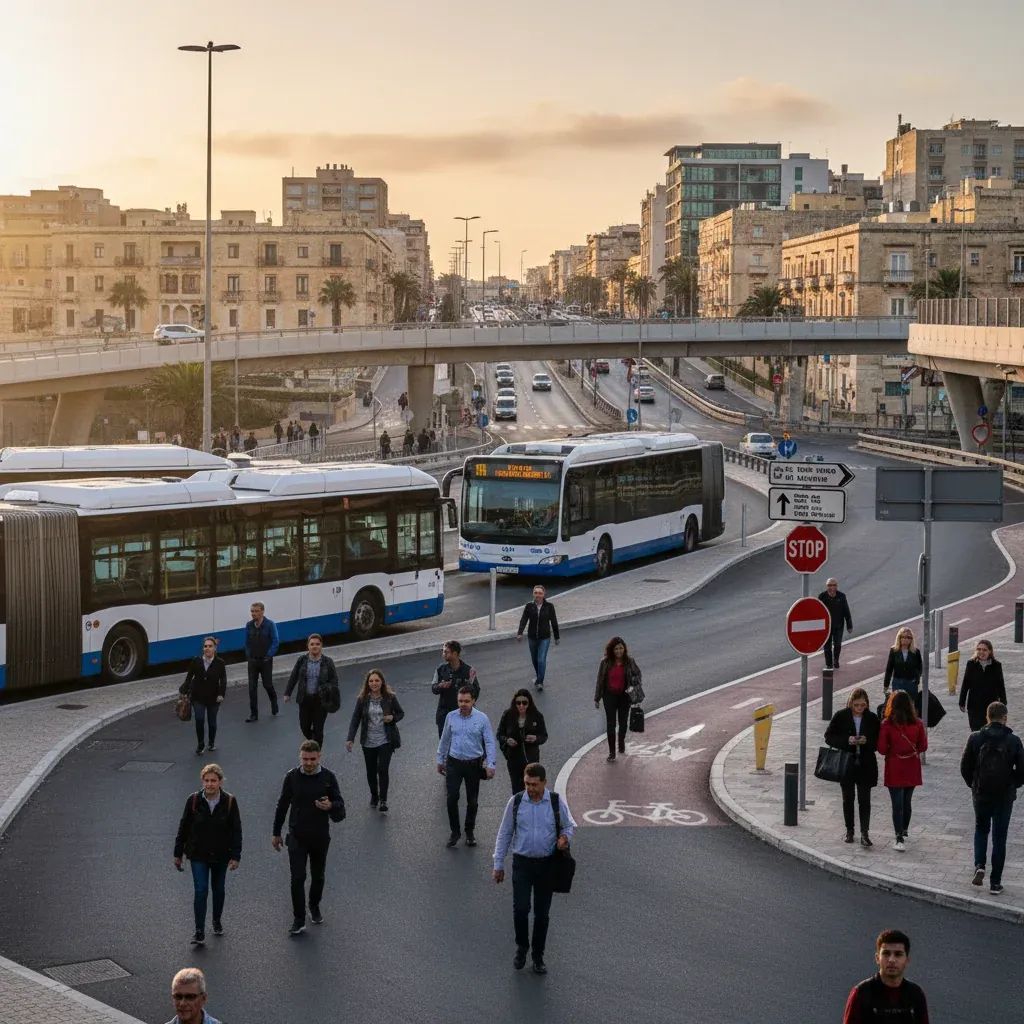
Malta Public Transport invested €28 M to replace 100 buses with models featuring modern camera systems, pedestrian collision warnings, blind spot monitoring, lane-departure alerts, USB charging ports, and two-door designs for faster boarding. Another 25 buses joined the fleet, and 400 daily journeys were extended in April 2025.
New and upgraded services operational now:
• Night bus routes launched on April 5, 2026, improving late-hour connectivity
• Industrial-zone routes launched on April 20, 2025, serving shift workers and manufacturing employees
• Summer 2025 service adjustments increased frequencies on Gozo and Malta routes and extended coverage to popular summer destinations
• Free harbour ferry service for Tallinja Card holders now links Valletta, Sliema, and the Three Cities, integrating waterborne transit into the broader network
• Short-term route additions include bus services to industrial estates, circular routes within large localities, and express lines with fewer stops
The operator aims for full electrification by 2030, with 36 to 42 electric buses currently operational out of a total fleet of 500.
The Long Haul: Metro, Autonomous Trials, and Future Planning
Malta's National Transport Master Plan 2030, published earlier this year, supersedes the 2025 version and lays the strategic foundation for a people-centered, sustainable system. The headline project remains the hybrid metro proposal—a blend of underground and overground lines with an estimated cost of €2.8 B, down from the original €6.2 B three-line plan deemed "too expensive." The earlier blueprint envisioned a 20-year construction period with phased openings by 2029, 2035, and 2040; the revised version compresses scope but extends feasibility studies. As of January 2026, technical studies by the international firm Arup (paid over €260,000) were ongoing, but no formal feasibility report had been published.
Opposition Leader Alex Borg has pledged to complete the first metro route within five years if elected, signaling rare cross-party consensus that the project must span multiple legislatures. Yet even under optimistic scenarios, full service remains a decade or more away.
In the interim, EU-funded trials of autonomous buses are scheduled to commence on pre-approved routes in Malta and Gozo during 2026. Malta Public Transport issued a call for proposals seeking a fully electric, Level 4 autonomous bus operational by April 30, 2026, as part of the Horizon Europe metaCCAZE project. The eight-month pilot will test driverless technology in real-world conditions, potentially offering a glimpse of future service models.
The Sustainable Urban Mobility Plan for the Valletta Region, published in December 2022 with full implementation anticipated by June 2025, emphasizes peripheral parking to encourage cycling and walking, local transport hubs, cycling infrastructure, car-sharing, on-demand services, and electric-vehicle charging expansion.
Learning from Mediterranean Peers: What Malta Is Adopting
Malta isn't developing these solutions in isolation. Rome's Zona a Traffico Limitato restricts vehicle access to historic centers, prioritizing pedestrians and liveability—a model Malta has partly adopted with Valletta's SUMP. Istanbul's smart traffic management uses AI-driven optimization and real-time communication, a technological layer Malta is exploring for parking and enforcement. Izmir's advanced tram system and Athens's Bus Rapid Transit corridors demonstrate that mid-sized solutions can deliver before a full metro materializes. Malta's challenge is unique: a densely populated island with limited space for surface rail or BRT corridors, making underground or elevated metro the most viable long-term option. Yet that same density makes short-term fixes—better bus frequencies, smarter parking, peak-hour management—disproportionately impactful if executed well.
What This Means for Your Daily Commute
For Maltese commuters, the next five years will be defined by incremental gains rather than dramatic transformation. The enforcement blitz and off-peak service scheduling offer modest relief during school runs and rush-hour choke points, but they don't fundamentally alter road capacity or modal split. The €25,000 license-surrender grant is generous—equivalent to several months' wages for many households—but uptake will depend on whether bus routes, frequencies, and coverage can genuinely replace car dependency for errands, school drop-offs, and leisure.
Park-and-ride hubs and integrated ferries may ease pressure on Valletta and the Three Cities, where street width and historic preservation limit road expansion. Yet residents in outlying localities or those with irregular work schedules may find the bus network still too sparse for daily reliance. The University of Malta study warning against small-scale restrictions underscores the risk: poorly coordinated measures can shift congestion rather than resolve it.
The metro timeline—even if accelerated—means today's secondary-school students will be well into their careers before they ride the first route. That reality makes the success of intermediate steps—electric buses, autonomous trials, financial incentives—critical not just for traffic flow but for public confidence that long-term infrastructure will eventually arrive.
What You Can Do Now: Practical Steps for Residents
Immediate actions available to you:
Explore the €25,000 incentive: If you're considering surrendering your car license, contact the Transport Authority to understand eligibility and application requirements for the five-year program.
Use the new night bus routes: Check your local schedules—night buses launched April 5, 2026, providing late-hour connectivity for shift workers and evening commuters.
Try the new ferry service: Tallinja Card holders can now use free harbour ferry links between Valletta, Sliema, and the Three Cities—ideal for commutes and reducing traffic pressure.
Look for industrial-zone routes: If you work in manufacturing or industrial estates, new dedicated routes launched April 20, 2025, are designed specifically for shift workers.
Register for park-and-ride access: Once facilities fully open at planned locations, you'll be able to park outside central areas and connect to bus routes—reducing both your driving time and congestion.
Join carpooling initiatives: The University of Malta's reserved carpooling spaces reward vehicles with a driver plus at least two passengers.
The Verdict: Incremental Gains, Decade-Scale Transformation
Short-term traffic solutions in Malta are not a substitute for a mass transit network, but they are essential scaffolding. The €5 M in incentives, 80 enforcement officers, and 100 new buses represent tangible investment in immediate relief. Whether they succeed depends less on the measures themselves than on their integration: park-and-ride hubs that connect seamlessly to bus routes, financial incentives paired with reliable alternative transport, roadwork coordination that minimizes disruption rather than merely shifting it.
For residents, the calculus is straightforward. If the daily commute improves measurably over the next 24 months—shorter delays, fewer bottlenecks, viable alternatives to the school run—these fixes will have justified their cost. If congestion persists or worsens, faith in the government's ability to deliver a metro by the mid-2030s will erode. The island's transport future hinges not on choosing between short-term fixes and long-term vision, but on ensuring both tracks run in parallel, each reinforcing the other's credibility.