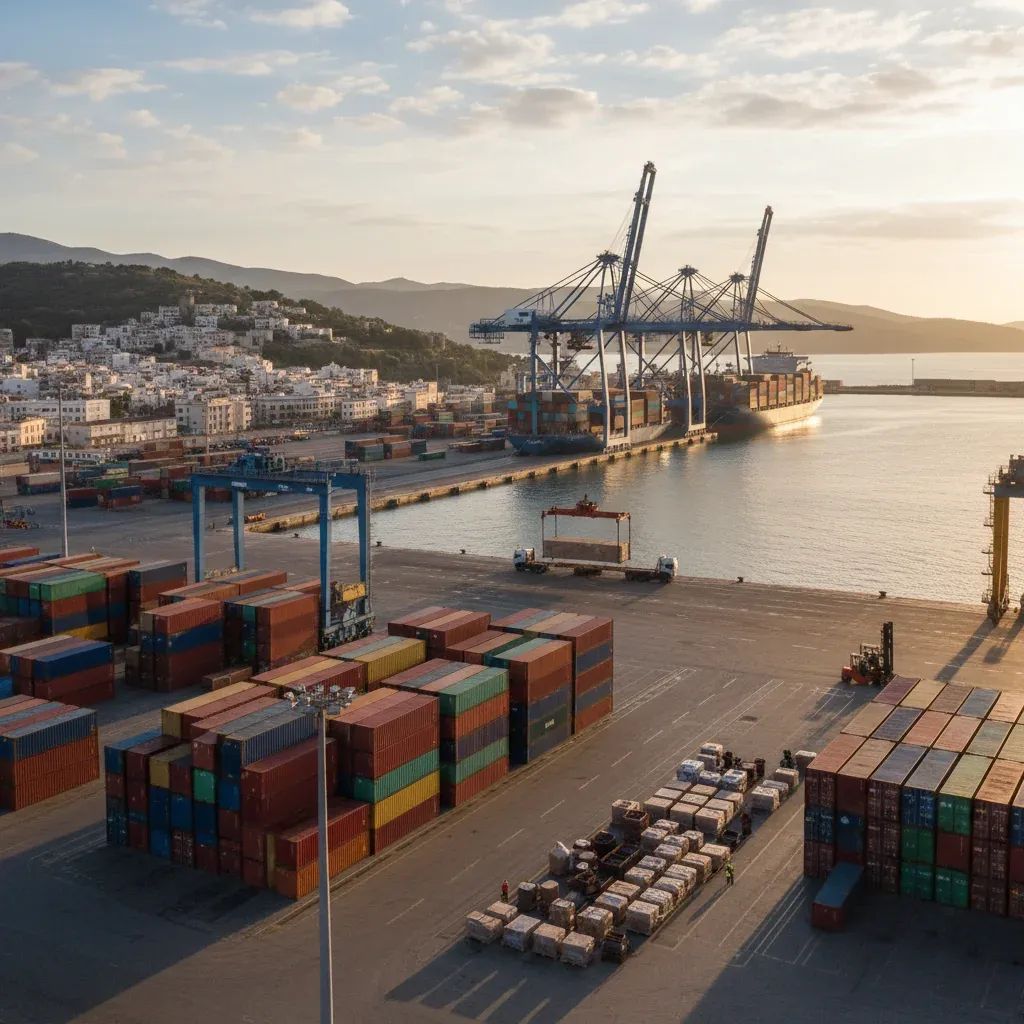
The Malta Revenue Department recorded a trade deficit of €4.3 billion in 2025—equivalent to 17.5% of national GDP—a structural vulnerability that exposes the island economy to global supply shocks, tariff wars, and energy disruptions heading into 2026. While the figure represents a narrowing from the previous year, the structural dependency on imports for everything from fuel to food means residents face mounting risks as geopolitical tensions escalate.
Why This Matters
• Import reliance: Malta imports more than double what it exports, with critical categories including mineral fuels, machinery, and vehicles—all vulnerable to price shocks.
• Tariff fallout: US tariffs on EU goods are redirecting Chinese exports toward European markets, potentially flooding Malta with cheaper products but also destabilizing local supply chains.
• Energy fragility: Malta's existing LNG contract expires in August 2026, and any disruption to fuel supplies would immediately impact electricity generation and transportation costs.
Small Island, Outsized Vulnerability
Among small EU economies, Malta's trade deficit ranks second only to Cyprus in terms of GDP exposure. Cyprus posted a deficit equal to 26.2% of GDP in 2025, while Estonia's stood at 9.2% and Latvia's at 7.4%. These four nations represent the EU's most trade-vulnerable small economies, all heavily dependent on imports due to limited domestic production capacity. The comparison underscores a fundamental reality: island states with limited domestic production capacity and narrow economic bases face what economists term "tail risk"—exposure to rare but catastrophic external shocks.
Malta's National Statistics Office reported that February 2026 imports totaled €534.3 million against exports of just €324.8 million, a gap of €209.4 million in a single month. Early 2026 figures suggest the pattern continues: the Malta National Statistics Office reported that the cumulative deficit for January and February 2026 reached €380.3 million, signaling that the structural imbalance persists despite modest improvements in late 2025.
The shift from manufacturing to services over the past two decades has exacerbated this dependency. In 2005, one year after EU accession, the trade deficit stood at €1.2 billion and represented 23.8% of total trade. Today, that share has climbed to 30.6%, reflecting a strategic pivot away from goods production—but also a surrender of resilience.
Trump's Tariff War Ripples Across the Mediterranean
The renewed wave of US protectionism under the Trump administration has reshaped global trade flows in ways that directly affect Maltese consumers and businesses. Washington imposed a 25% tariff on steel and aluminum in early 2025, alongside a baseline 10% levy on all imports and an additional 25% on automobiles. The European Commission estimates these measures will shave 0.1% to 0.2% off EU GDP, with European exports to the US falling roughly 5% in volume over a 12-month period through 2025.
The EU's response has been swift: Brussels activated countermeasures targeting €18 billion worth of US-origin products and deployed its Anti-Coercion Instrument. Yet the so-called Turnberry deal of July 2025, which temporarily de-escalated tensions, has since unraveled. New tariff threats emerged in early 2026, and analysts project a 4.6% slowdown in EU-US exports this year due to tariffs alone.
For Malta, the fallout is indirect but tangible. As US tariffs make Chinese goods less competitive in America, Beijing is redirecting exports toward European markets. Malta's imports from China surged by 20.4% in February 2026 compared to the same month in 2025, reaching $241 million. Over the full year 2025, Chinese imports to Malta hit a record €374 million, nearly double the total from a decade earlier. Categories include mechanical equipment, electronics, passenger and cargo ships, refined petroleum, iron structures, vehicles, furniture, and clothing.
This influx could lower consumer prices in the short term, but it also exposes local retailers and distributors to volatile supply chains. Moreover, the European Union is implementing a fixed €3 customs duty on low-value e-commerce parcels starting July 1, 2026, a measure aimed squarely at curtailing cheap imports from China. Maltese shoppers accustomed to bargain-priced goods from Chinese online platforms should brace for higher costs.
What This Means for Residents
The practical consequences of Malta's trade imbalance touch nearly every aspect of daily life. Fuel costs are the most immediate concern: Malta's existing LNG contract for power generation expires in August 2026. Any delay in securing a replacement agreement—or a spike in global LNG prices—would cascade through electricity bills and transportation expenses.
Imported food accounts for the vast majority of what Maltese households consume. Unlike larger European nations with substantial agricultural sectors, Malta cannot pivot to local production if shipping costs surge or supply routes are disrupted. Geographic isolation means that when connectivity is compromised by weather, geopolitics, or economic disruption, the island's supply chains face acute vulnerability.
The tourism industry, which underpins much of Malta's services-driven economy, is equally vulnerable. If the ongoing tensions in the Middle East escalate into a broader conflict, aviation fuel supplies could tighten, and airlines might reduce or reroute flights. Even absent a military crisis, a global recession triggered by trade wars or energy shocks would prompt travelers to cancel or postpone trips, hammering hotel occupancy and related spending.
Inflation remains a persistent threat. Shipping bottlenecks, tariff escalations, and currency fluctuations all feed into the cost of imported goods. Because Malta produces so little domestically, there is no buffer against these external pressures. Residents already contend with elevated living costs relative to income; further price increases would erode purchasing power and strain household budgets.
Strategic Plan: Semiconductors, LNG, and Renewables
The Malta Ministry of Energy, Enterprise, and Sustainable Development has rolled out a multi-pronged strategy to reduce vulnerability and diversify the economy. A flagship initiative for 2026 is the €8 million Competence Centre in collaboration with the University of Malta and European partners, building on the expansion of the STMicroelectronics Smart Factory. The aim is to establish Malta as a European hub for strategic technologies, particularly semiconductors, a sector with high value-added potential and lower import intensity.
On the energy front, a national nine-year plan launched in January 2026 commits to modernizing the electricity distribution system. The blueprint includes 12 new distribution centers and a second 132kV interconnector linking Malta and Gozo by the end of 2026. Officials are already exploring a third interconnector to further enhance grid resilience.
The Malta Vision 2050 strategy, unveiled in February 2026, sets a target of 25% renewable power by 2030. Grant schemes for households investing in photovoltaic systems and battery storage went live this year, alongside feed-in tariffs for small-scale installations and competitive bidding for larger renewable energy projects. The government is also investigating offshore wind farms and enhanced biofuel usage. While these measures won't eliminate dependence on imported LNG in the near term, they represent a long-overdue pivot toward energy independence.
Crucially, Malta secured an EU exemption from the mandatory 15% reduction in gas use, acknowledging the island's isolated network and total reliance on imported LNG. Even so, the clock is ticking on the current supply contract, and any hiccup in negotiations with LNG suppliers could trigger a crisis.
Comparing the Numbers
The Malta National Statistics Office reported that the 2025 trade deficit of €4.3 billion broke down as follows: imports totaled €9.2 billion while exports reached €4.9 billion. Provisional data for the first two months of 2026 show €1.1 billion in imports and €698.5 million in exports, producing a cumulative deficit of €380.3 million.
By comparison, Estonia's trade deficit stood at approximately €3.8 billion in 2025, or 9.2% of its €41.6 billion GDP. Lithuania's deficit was roughly €5 billion, equivalent to about 5.1% of its projected €97.6 billion GDP. Cyprus, with a smaller economy, posted a deficit of €8 billion in 2025, a staggering 26.2% of its €30.5 billion GDP.
Malta's position in the middle of this range offers little comfort. Unlike the Baltic states, which benefit from land borders and regional supply chains, Malta is an island with no fallback options. Unlike Cyprus, which at least shares certain vulnerabilities and strategic interests with nearby partners, Malta operates in relative isolation, dependent on air and sea links that can be severed by weather, geopolitics, or economic disruption.
The Isolation Factor
The pandemic exposed the acute risks of Malta's geographic and economic isolation. Flights halted, cargo shipments slowed, and shelves emptied. When connectivity is compromised, the island faces immediate supply chain pressures. The hypothetical scenario of a prolonged conflict disrupting LNG shipments or aviation fuel is not alarmist speculation—it's a contingency that emergency planners must account for.
Business planning already reflects these concerns. Companies are reassessing growth strategies and investment timelines amid heightened volatility. The gaming sector, a lucrative pillar of Malta's economy, could see revenue declines if European consumers tighten their belts in response to inflation or recession. Disposable income is finite, and entertainment spending is often the first casualty of economic uncertainty.
The Path Forward
Addressing Malta's trade vulnerability requires more than policy documents and renewable energy grants. It demands a fundamental rethinking of economic priorities. The Malta Chamber of Commerce has called for targeted support for export-oriented businesses, streamlined customs procedures, and incentives for sectors with low import content. The semiconductor initiative is a step in the right direction, but it will take years to scale and won't offset the structural deficit in the near term.
Energy security is paramount. Securing a post-August 2026 LNG contract on favorable terms must be the government's top priority. Diversifying suppliers and exploring long-term hedging mechanisms can mitigate price volatility. Accelerating the renewable energy rollout, particularly offshore wind and expanded solar capacity, will reduce—but not eliminate—reliance on imported fossil fuels.
Finally, resilience must become a central tenet of economic planning. That means maintaining strategic reserves of critical goods, investing in port and airport infrastructure, and fostering regional supply chain partnerships. Malta's Vision 2050, lauded by some as aspirational, must translate into concrete, measurable targets with accountability mechanisms. Platitudes won't shield residents from the next crisis.
The trade deficit is not merely an abstract statistic. It is a measure of Malta's exposure to forces beyond its control—and a reminder that small islands cannot afford complacency.