Coastal Reclamation: Seven Million Kilograms Out, Public Greenspace In
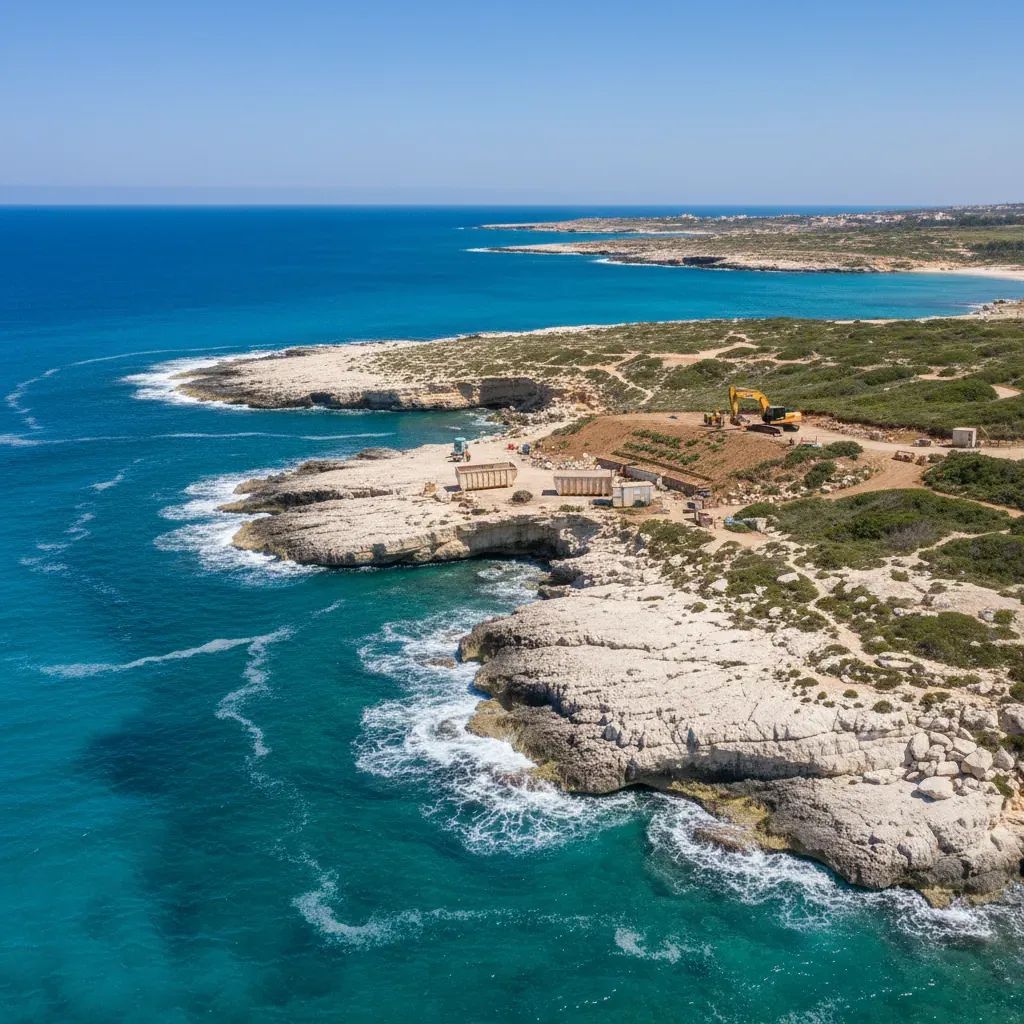
The Malta government has embarked on one of its most visibly consequential clean-up operations in recent memory, hauling away over 7 million kilograms of accumulated waste from the White Rocks coastal complex. What began in earnest during March 2026 represents the tactical opening move of a broader ambition: converting a site variously reported as between 369,000 and 450,000 square meters (approximately 37-45 hectares) of neglected shoreline into Malta's latest major national park—a genuinely family-accessible outdoor amenity that will offer residents something long in short supply on this densely built island.
Why This Matters
• Tangible progress on stalled plans: After years of development proposals and false starts, the visible removal of construction debris signals the project has transitioned from announcement to active execution.
• 225 truck trips worth of capacity: The sheer logistical effort—what it took to move 7 million kg—illustrates the depth of degradation the site had suffered before intervention.
• No construction clause locked in: The Malta government formally abandoned existing development tenders in November 2025, codifying a permanent freeze on residential or commercial building.
The Reality on the Ground
When Environment Minister Miriam Dalli and Parliamentary Secretary Glenn Bedingfield toured the White Rocks site in mid-March this year, they witnessed teams methodically clearing decades of accumulated dumping. The debris was predominantly construction waste—the detritus of partial demolitions, abandoned development projects, and years of informal disposal that had transformed the area into an eyesore punctuated by hazardous structures.
The operation itself serves as a proxy for the site's history. The fact that 225 truck movements were required to evacuate the waste gives tangible shape to what "decades of neglect" actually means in quantifiable terms. Each trip represented roughly 31,000 kilograms moved off the property. Ramon Deguara, the Director General of the Cleansing and Maintenance Division, joined the inspection tour to assess what remained to be accomplished.
The clean-up effort sits as a joint responsibility between two entities: the newly mobilized Project Green, a government initiative launched to oversee Malta's national park developments, and the established Cleansing and Maintenance Division. This partnership underscores the government's intent to treat the project as a genuine infrastructure undertaking rather than a symbolic gesture. According to Bedingfield, the initial debris removal phase represents only the threshold of the work ahead—additional pruning, vegetation management, and structural assessments will continue through the coming months as teams prepare the site for eventual public access.
From Wasteland to Family Destination
The White Rocks complex has languished in public consciousness as emblematic of Malta's failure to steward its own underutilized assets. The decision announced in the Budget 2026 speech to permanently dedicate the entire site to public park use represented a sharp reversal from an earlier era of development speculation. Where resort hotels, residential towers, and commercial complexes were previously mooted, the government now commits to open green space exclusively.
The pivot matters because it signals a policy recalibration toward preservation over development—an increasingly rare stance in a country where plannable land diminishes annually and construction sector interests wield considerable political weight. Endorsements from bodies like the Malta Development Association and environmental organizations including Nature Trust Malta reflect genuine relief that a significant coastal tract will remain undeveloped.
This transformation forms part of a three-point national park initiative. Manoel Island, long caught in contentious development debates, and Fort Campbell, a historic military installation, are also slated for conversion to public parks. Together, the three projects sketch a more ambitious green-space agenda than Malta has articulated in recent years.
What People Are Actually Asking For
The government did not make the park design in isolation. Through Project Green, officials conducted genuine public consultation with local councils, residents, and environmental advocates. The proposals that emerged from consultation reflect pragmatic desires—though which will ultimately be implemented remains to be determined.
Sports infrastructure features prominently in resident requests. Cycling tracks and jogging paths suitable for distance training have been proposed—facilities that exist piecemeal across Malta but rarely as a continuous, accessible facility. High-altitude rope courses and multi-use sports zones address expressed demand for active recreation. The existing jetty has attracted particular interest; proposals suggest rehabilitating it for water transport, potentially creating commuter ferry links to Valletta or other coastal nodes that might reduce vehicular traffic during peak hours.
Amenity requests skew practical: public toilet facilities, drinking fountains, designated parking with rapid-transit connections to discourage car-dependent visitation. A Park & Ride facility featured explicitly in submissions, targeting residents in congested areas like Sliema and St. Julian's who could use designated parking to access the site without adding to local road saturation.
Natural landscaping proposals emphasize preservation of native flora and strategic planting of shade-giving species to render the space usable during Malta's intense summer months. The scale of the area offers room for the kind of long-distance recreational corridors that are scarce in populated Mediterranean zones.
What This Actually Means for You
For residents in populated localities, White Rocks represents potential material improvement to quality of life. The site's coastal position and geographic footprint create opportunities for outdoor activities currently impossible or severely limited: genuinely long cycling routes that don't loop back after 2 kilometers, jogging paths suitable for serious training, waterfront leisure space accessible to families without private transportation.
The Park & Ride proposal carries practical significance for people living in central areas. If implemented, a properly functioning facility at White Rocks could siphon weekend recreational traffic away from already-congested arterial roads, effectively purchasing breathing room for residential neighborhoods.
Should the jetty restoration proposal advance, water-based commuting could become a tangible possibility. A potential ferry link from White Rocks to Valletta would function as both recreational amenity and practical transport alternative during peak-demand periods—a dual utility that makes infrastructure investment easier to justify.
Against these proposed benefits sits a fundamental uncertainty: timeline. The government has committed to opening portions of the site once clean-up concludes, described vaguely as the "not-too-distant future." No firm completion date has been published. No dedicated budget line has been itemized. The scale of the clean-up phase—225 truck trips—hints that subsequent phases involving path installation, lighting infrastructure, planting, and amenity construction will consume equivalent resources and time.
The Months Ahead
The immediate focus remains site characterization and hazard mitigation. Project Green is conducting topographical mapping to identify zones suitable for trails versus sports facilities versus natural landscaping. Structural assessments of existing buildings and infrastructure determine what can be repurposed versus demolished. Flora and fauna surveys will identify protected species and ecosystem sensitivities that must guide design decisions.
Once the debris removal concludes and safety work validates the site for public access, the government plans a phased opening strategy—initial sections becoming available while longer-term amenity installation continues. Whether this translates to late summer 2026 or extends into the coming months remains opaque.
The consultation window remains open. The government's demonstrated willingness to integrate genuine resident proposals—as opposed to generic park components—will substantially determine whether White Rocks evolves into a genuinely usable public asset or remains an underutilized monument to planning intention. The visible progress to date—7 million kilograms removed, teams actively on-site, structured stakeholder engagement—suggests the project has crossed from rhetorical commitment into operational territory. For residents eager to reclaim this stretch of coastline, the trajectory thus far offers cautious grounds for credibility, though sustained delivery remains the authentic test.