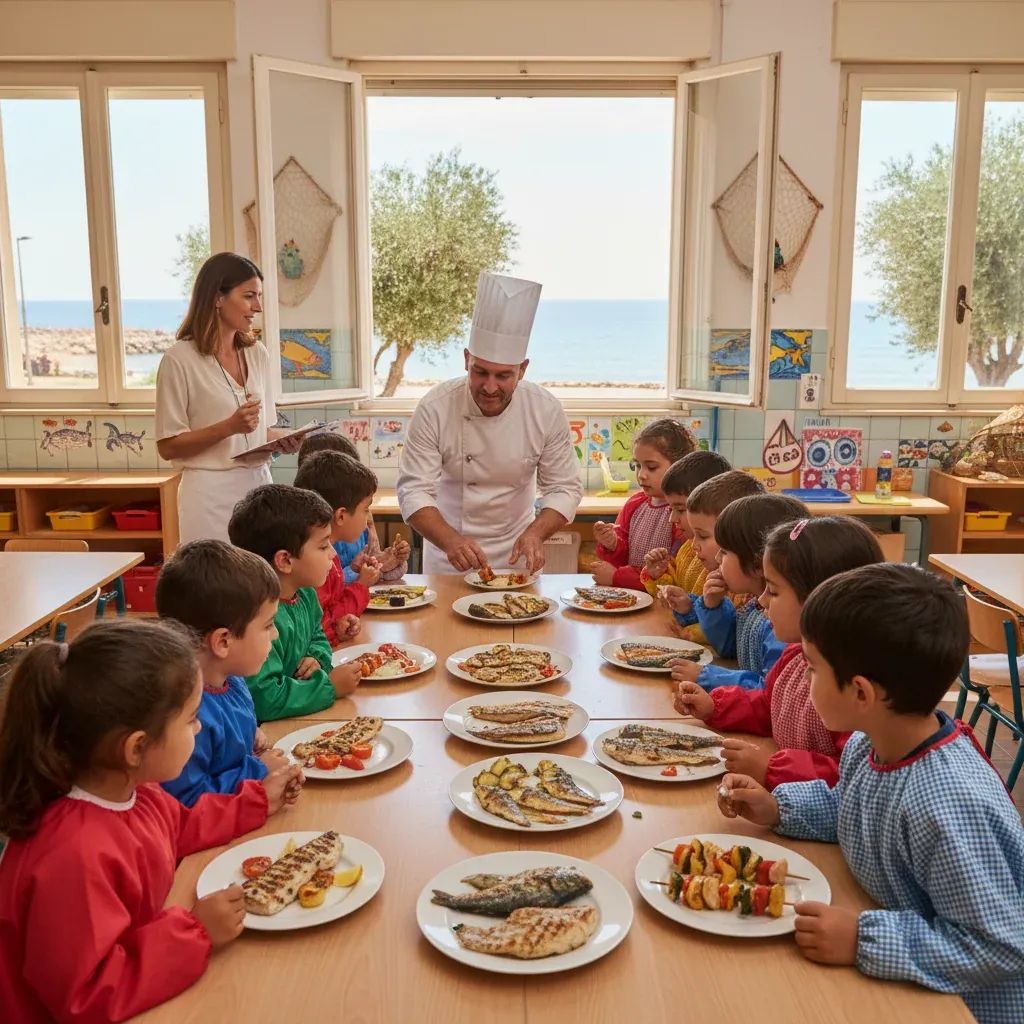
Schools are about to become test kitchens for one of Malta's most pressing dietary crises. Starting April 24, the Parliamentary Secretary for Fisheries is launching a four-week roaming initiative that will bring fresh fish, professional chefs, and nutritionists directly into primary school classrooms—not as a one-off tasting, but as a deliberate intervention aimed at reversing a generation's abandonment of a food that once defined Maltese eating culture.
Why This Matters
• Obesity urgency: Over 40% of Maltese primary students are overweight or obese, a rate that places the islands among Europe's worst. Children in their early years are already showing alarming weight gains—34% of five-year-old boys carry excess weight—and without dietary shifts, projections suggest girls under 14 could see obesity rates climb by 17% by 2035.
• Fish has become invisible: Only 6% of Maltese children currently eat fish regularly. Among young adults aged 15 to 24, just 39% consume it even once monthly. This represents a generational break with Mediterranean tradition that younger Maltese have largely abandoned.
• Local fishing sector at risk: National consumption forecasts show fish demand declining to approximately 5,300 metric tons by 2028, down from 5,800 metric tons in 2023. Without new demand signals from institutions like schools, the already-aging fishing fleet lacks incentive to invest in modernization or attract younger workers.
The Current Reality for Malta's Children and Fisheries
The numbers paint a stark picture. In 2022, 28.7% of 11-year-olds in Malta were classified as overweight or obese—nearly double the EU average of 18.3%. The situation worsens among younger children. Data from 2024 shows 34% of five-year-old boys and 32.2% of girls in the same age group already carrying excess weight. These aren't isolated cases; they reflect systemic dietary patterns established early in childhood that persist into adulthood.
Meanwhile, fish consumption has essentially vanished from Maltese youth experience. Government household surveys reveal that only 32% of adults eat fish weekly at home, a figure that drops sharply among teenagers and young adults. More than one in four Maltese adults claim never to eat fish. For children, the disconnect is even sharper: living on an island surrounded by fishing culture, most have never tasted locally caught fish or learned to prepare it.
The fishing industry feels this collapse acutely. Local fishermen now operate with aging equipment, unpredictable sales, and limited domestic market incentives. Aquaculture has returned to modest profitability, but only through cost-cutting measures, not growth. The National Fisheries Strategy 2026-2036, developed through consultations with 282 fishers, explicitly names education and demand creation as critical survival tools for the sector. Without intervention, consumption patterns suggest the local fleet will continue contracting.
How the Initiative Is Structured
The National Food Agency, operating with support from the Parliamentary Secretary's office, has designed a tightly controlled pilot rather than a sprawling publicity exercise. Starting April 24, a mobile team will visit four state primary schools—Marsaxlokk, Għaxaq, Msida, and San Ġwann—over four consecutive Fridays. Each school hosts the program for one week.
The format emphasizes hands-on education. Upon arrival, a registered nutritionist delivers an age-appropriate classroom session covering the specifics: omega-3 fatty acids and their role in brain development, vitamin D and calcium for bone growth, B vitamins, iron, and zinc. This isn't abstract health preaching; it's designed as interactive learning suitable for primary-aged children. Following the classroom component, professionally trained chefs prepare multiple fish dishes on-site, using local species selected to test diverse taste preferences. Students sample the prepared food in portions designed to minimize rejection from selective eaters.
Significantly, the program distributes recipe booklets featuring traditional Maltese fish preparations like aljotta (traditional fish soup) and galena, deliberately bridging school education to household cooking. Parents receive separate invitations to attend selected sessions and watch cooking demonstrations—a calculated effort to shift behavior beyond the school gate. If a parent learns to prepare fresh local fish affordably—realistically under €5 per person at bulk school prices—household adoption becomes plausible rather than aspirational.
Learning From Previous Attempts
Malta has run school nutrition programs before, and the results offer sobering lessons. The EU School Scheme for Fruits & Vegetables, implemented over years, successfully raised awareness among Maltese children but failed to sustain consumption increases without what researchers term "multi-component reinforcement." A 2012 evaluation found the scheme beneficial in Gozo but concluded it needed broader support to achieve lasting dietary change. More recent data is even more discouraging: a 2020 study of kindergarten-age children found fruit and vegetable intake remained poor despite years of school exposure.
The School Milk Scheme operated with a €441,000 budget during 2020-2021 and created institutional infrastructure—refrigerated storage, regular deliveries, billing systems. Yet even with established supply chains and consistent funding, getting children to shift consumption patterns proved difficult. The lesson embedded in both programs: exposure creates awareness, but awareness alone doesn't rewire eating habits, especially against peer pressure, limited home reinforcement, and competing convenience foods.
The Fish Fridays design appears to incorporate this knowledge. The inclusion of parental engagement, recipe materials, and planned integration into the National Fisheries Curriculum, alongside the multi-sensory classroom experience, signals a more comprehensive approach than previous one-off tastings. However, success remains uncertain—school nutrition interventions rarely deliver overnight transformations.
Why This Matters for Local Fishermen
For Malta's struggling fishing community, the real significance extends beyond four weeks of tastings. If the pilot demonstrates both logistical feasibility and student receptivity, schools represent a predictable, high-volume institutional buyer—something the sector currently lacks. Fishermen today struggle not primarily with production but with unpredictable sales, fierce competition from cheaper imported frozen fish, and limited clarity on future demand.
Expansion nationwide would create recurring orders that provide the demand certainty required for business planning. Young fishermen would have visibility into future sales, justifying investment in fleet modernization and attracting generational renewal. The Fisheries Hub project in Marsa, currently under development, is designed to streamline cold-chain logistics and distribution. Once operational, regular school deliveries become logistically viable in ways they're not today.
The tender process running parallel to the pilot will reveal critical unknowns: Can local suppliers meet required volumes? Do they maintain quality consistency? Can they compete on pricing without government subsidy? If local fishermen cannot satisfy these criteria, the programme defaults to imported fish, and the domestic industry gains nothing. If they can, schools become the proof of concept for other institutional buyers—hospitals, workplaces, restaurants—to follow.
The strategy also aligns with the National Fisheries Strategy's diversification pillar. Local fleets currently concentrate on high-value species like Atlantic bluefin tuna. Schools could absorb underutilized catch—smaller fish species, seasonal varieties—that fishermen currently struggle to sell domestically, reducing waste and creating value from otherwise marginal production.
What Households and Parents Should Know
For families, the immediate benefit is straightforward: children gain exposure to professionally prepared, locally sourced fish at no cost. More broadly, the program attempts to reverse a food literacy crisis. Many Maltese households abandoned traditional fish-based cooking due to perceived cost, time investment, and generational knowledge loss. An entire cohort has reached adulthood without learning basic fish preparation techniques, perpetuating the consumption decline.
The recipe booklets and chef demonstrations deliberately target this gap. If a parent learns to prepare local fish dishes for under €5 per person—realistic bulk school purchasing costs—household adoption becomes plausible. Food habits established in childhood persist into adulthood. If 500 children across four schools develop a taste for local fish, and even half their families adopt it, the consumption shift compounds across generations.
The program also signals an educational shift: fisheries knowledge, sustainable consumption practices, and connection to local agriculture are increasingly integrated into formal schooling. This represents a deliberate effort to counter decades of dietary homogenization toward processed convenience foods.
Timeline and Feasibility Uncertainties
If the pilot meets internal benchmarks—participation rates, parental engagement, logistical feasibility—the National Food Agency has indicated plans for nationwide expansion, potentially including schools in Gozo. The timing is deliberate: the four-week pilot concludes in early May, allowing feedback loops and adjustments before year-end decisions on scaling.
The tender process will operate in parallel, determining supplier readiness. Success is not guaranteed. Delays in logistics, supply inconsistencies, or cost constraints could force partial reliance on imports, diluting the local industry support benefit. Moreover, school nutrition interventions typically require sustained reinforcement to achieve lasting consumption changes, particularly among older children who actively resist behavior modification.
The "Fish Fridays" initiative sits within a broader ecosystem of campaigns: the existing "Let's Fish" programme through summer schools, "Discover the Variety, Eat Sustainable Fish" awareness efforts, and curriculum integration across primary and secondary education. Together, they represent Malta's most coordinated attempt to reverse fish consumption decline through formal education.
The Realistic Assessment
This is a pilot, not a solution. Four weeks in four schools will not resolve Malta's obesity crisis or single-handedly rescue the fishing industry. What changes if it succeeds is the direction of institutional investment and political priority. Currently, school meal programs emphasize processed convenience. A successful fish intervention signals government commitment to local sourcing, agricultural education embedded in schooling, and diet-based public health strategy as legitimate policy tools.
The real test arrives later: whether the consumption shift sticks beyond the initial exposure, whether local suppliers prove capable of meeting institutional demand, and whether the pathways created encourage younger Maltese to see fishing as a viable career. These questions have no answers yet. For now, schools become laboratories, and the fishing community watches closely to see whether childhood taste preferences can be reoriented toward the food their island has always produced.