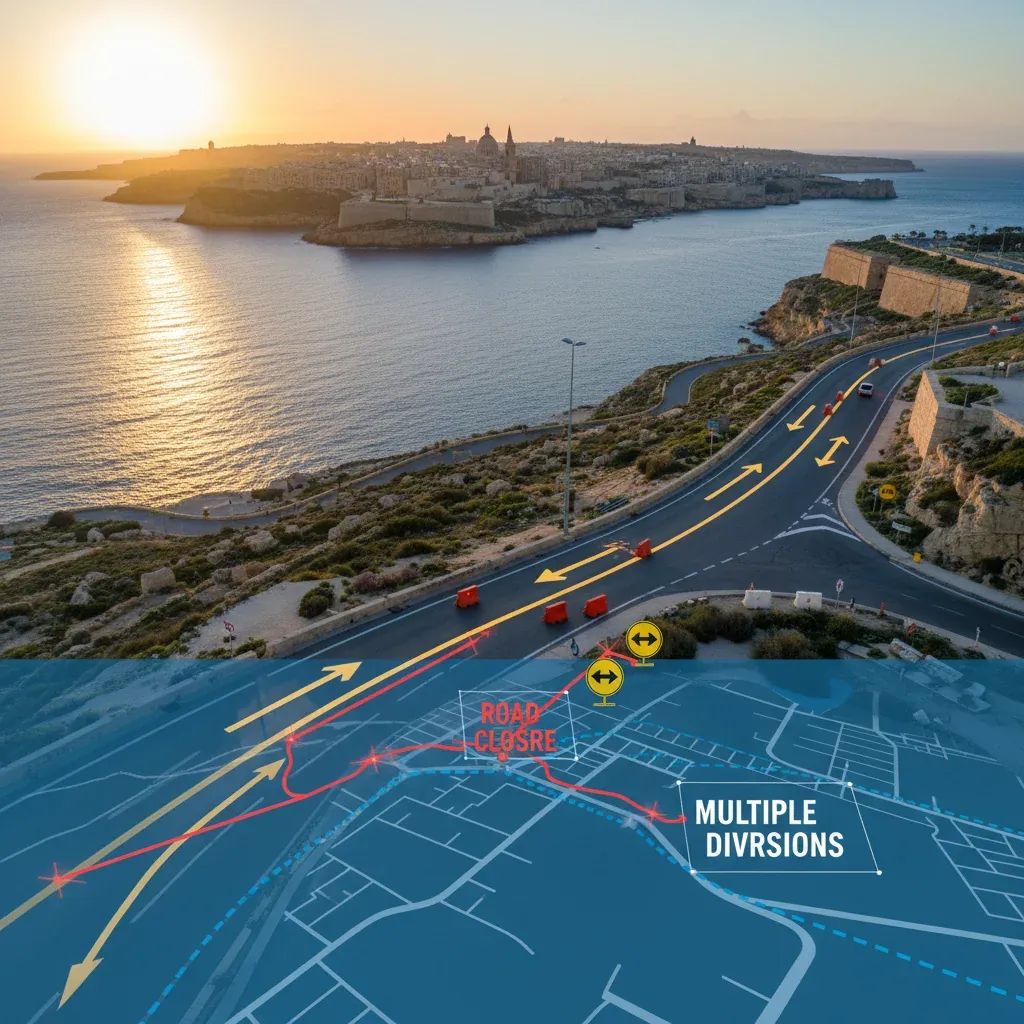
On Sunday, March 22, a coastal footrace involving 5,000 international athletes will systematically paralyze Malta's primary transport corridors for up to 13 hours, beginning when most residents are still asleep. The La Valette Marathon is widely recognized across Europe for its AIMS certification and prestigious Abbott World Marathon Majors qualifier status—credentials that attract elite runners from more than 60 countries. Yet for anyone planning to move vehicles, cross the island, or rely on buses that morning, the event represents something far more immediate: an operational shutdown of the roads most residents depend on.
Why This Matters
• Total vehicle paralysis between 6 AM and 2 PM across Tower Road, Barrier Wharf, and the Birgu waterfront—the three arteries that knit Malta's populated zones together. Exiting these areas becomes impossible without advance planning or ferry access.
• Public transport collapses entirely—dozens of bus routes will be cancelled or diverted, making traditional commuting across the island unreliable. Ferry services become the only dependable option for time-sensitive journeys.
• The Birgu waterfront remains sealed until 5 PM, trapping residents of the Three Cities in an effective vehicular isolation for 10+ hours unless they departed by 7 AM.
• Business disruption is severe but temporary—shops and services in Sliema, Valletta, and Birgu experience near-zero foot traffic and vehicle access all morning, though the trade-off brings approximately €1.6 M–1.7 M in international visitor spending to the local economy over the weekend.
The Race Structure and Timing Reality
The marathon unfolds as five separate starting waves across a three-hour window. At 6:30 AM sharp, the full marathon cohort—approximately 1,200 competitors—departs from Xemxija Hill in St Paul's Bay, committing to a grueling 42.2 km coastal push that winds along Malta's northern and eastern shorelines before terminating at Fort St Angelo in Birgu. At 7 AM, the half-marathon field launches from Exiles in Sliema, running the southern half of the full course. At 7 AM, the 10 km event begins at Triq il-Mediterran in Valletta, threading through Marsa before joining the finish line in Birgu. A 5 km run starts at 7 AM from Triq Ghajn Dwieli in Paola, a walkathon departs from Sliema at 7:10 AM, and relay teams follow at 7:30 AM.
The critical variable is this: every single category, regardless of distance or start time, funnels into the Birgu waterfront finish corridor. This geographic chokepoint means the entire harbor precinct—Vittoriosa, Senglea, and Cospicua—becomes inaccessible to vehicles from approximately 8 AM until 5 PM, rendering the Three Cities effectively isolated from the rest of Malta by road. A resident wanting to leave for a Sunday appointment across the harbor loses six hours of mobility.
Closure Timeline: What Closes When and Why
The earliest closures begin at 4 AM, well before runners appear, to allow marshals and course setup. Triq San Pawl il-Baħar in Manikata shuts in both directions from 4 AM to 7 AM, a three-hour window that forces anyone heading from the north toward Valletta to detour inland through Attard and Mdina—adding 25 to 40 minutes to an otherwise 30-minute journey. The message is implicit: depart before dawn or wait until mid-morning.
Tower Road in Sliema—the spine that connects the tourist seafront to the rest of the island—closes entirely from 5 AM to 10 AM. Drivers attempting to reach Tigne or traverse toward Valletta must either use secondary streets clogged with other diverted traffic or retreat inland, adding 45 minutes to any commute. Triq il-Creche, the parallel street, also closes from 5 AM to 8:30 AM, with buses rerouted toward Spinola, creating cascading delays across Sliema's already-congested infrastructure.
The Valletta waterfront becomes essentially sealed from 4:30 AM, when Barrier Wharf closes, until 10:30 AM. Additionally, the left lane of Great Siege Road (Triq l-Assedju l-Kbir) remains reserved for runners between 7:45 AM and 10:45 AM, compressing all southbound traffic into a single corridor and creating a bottleneck that radiates backward through Msida, Ta' Xbiex, and Gżira.
Finally, the Birgu waterfront—Triq Is-Sur in Senglea and Xatt Juan B. Azzoppardi—closes from 7:30 AM to 1 PM, but the broader harbor precinct remains cordoned until 5 PM, the longest disruption window on the island.
Strategic Navigation: Routes, Times, and Realistic Options
For those who must travel, the operational reality is stark: depart before 5:30 AM or postpone all journeys until 3 PM. Travel between 6 AM and 2 PM across the primary corridors is inadvisable.
If your destination is Valletta, exit the north by 5:30 AM or use the ferry. If you live in Sliema, driving is a lost cause; walk the 15 minutes to Exiles ferry terminal and board at 7 AM. If you reside in the Three Cities, accept vehicular isolation until late afternoon or depart before 7:15 AM. The ferries—Sliema-Valletta and Cospicua-Valletta services—operate every 30 minutes from 6:45 AM and take 10-15 minutes, making them faster than sitting in gridlocked Tower Road.
Transport Malta's suggested workaround for Valletta access is routing through the Valletta Waterfront, but this diverts traffic away from traditional entry points, creating a single compressive chokepoint rather than distributing demand. Residents familiar with pre-race navigation know this tactic merely trades one bottleneck for another.
Public Transport and Ferry Systems: Your Escape Routes
Buses across Rabat, Ta' Qali, Mosta, and Attard—the primary feeder routes into Valletta—will experience wholesale cancellations and diversions, with some services delayed by 60 minutes or more. The Tallinja App will broadcast real-time updates, but the honest assessment from regular commuters is that Sunday bus service is unreliable during marathons.
The Sliema-Valletta ferry is the proven workaround. Operating every 30 minutes from approximately 6:45 AM to 7:15 PM, the service covers 10-15 minutes of open water, completely bypassing the terrestrial gridlock. The Cospicua-Valletta ferry offers equivalent relief for residents of Vittoriosa, Senglea, and Cospicua attempting to reach the capital or access western zones. Cost is negligible: approximately €2 per journey for contactless payment, or free with a personalised Tallinja Card if you are a resident.
Download both the Tallinja and TM Alerts apps before Sunday. The former provides bus routing and real-time arrival data; the latter pushes notifications as roads reopen incrementally. However, do not expect precision—delays cascade as police clear each section, and the last runner typically finishes closer to 2 PM than 1 PM, meaning the Birgu waterfront remains operationally congested well into the afternoon despite official reopening times.
What This Means for Residents
The marathon's route—hugging the coast and threading through the island's most densely populated zones—leaves few viable detours. Tower Road, Barrier Wharf, and the Birgu waterfront are structural constraints, not optional closures. Residents and workers crossing these arteries should assume 90+ minutes of additional transit time or pivot entirely to alternative transport.
Remote work is the path of least resistance. If your employer permits, request Sunday off the grid. If you have a medical appointment, family obligation, or time-sensitive commitment on the opposite side of the island, reschedule if possible or depart by 5:30 AM. If you must move a vehicle between zones, accept that delays are not negotiable—plan accordingly or postpone.
Emergency access remains theoretically available through roaming ambulances, bike-mounted first aiders, and police motorcycle escorts. However, the Malta Red Cross and Mater Dei's Emergency Department have historically flagged concern about mixed-traffic sections on marathon routes. The underlying concern is legitimate: a motorcycle accident, pedestrian collision, or cardiac event on a live-traffic section becomes a cascading nightmare for both the casualty and hundreds of queued vehicles. A marathon is a public health intervention for participants but an operational liability for the island's emergency infrastructure.
Safety Evolution and 2026 Improvements
The 2023 edition generated damning participant reviews. Runners reported sections as "downright dangerous"—forced to navigate two active lanes of fast-moving traffic and roundabouts still in full operation. Course markings were unclear, cones had been stolen, and athletes reported breathing car fumes for extended sections. The chaos underscored a fundamental tension in Malta's approach to road events: the island's densest population corridors are simultaneously its most scenic routes, creating an irreconcilable conflict between spectacle and safety.
In April 2025, a Transport Malta official coordinating a separate marathon suffered serious injuries in a crash, providing a stark institutional reminder of operational risks. That incident accelerated policy reform.
For the 2026 edition, Transport Malta has committed to material changes: minimizing full closures, deploying motor officials and lead vehicles alongside runner groups, stationing marshals at every critical junction, and broadcasting real-time updates as runners clear each section through the TM Alerts app. These are incremental measures, not transformative solutions—the risk of live-traffic mixing remains—but they reflect institutional learning and a shift toward proactive safety architecture.
The Economics: Why Disruption Persists
The La Valette Marathon justifies its infrastructure cost through hard economic metrics. Its AIMS certification and Abbott World Marathon Majors qualifier status position it among Europe's elite marathons, attracting competitive runners and spectators from more than 60 countries. Held in March—outside Malta's peak tourism season—the event stretches the visitor calendar and injects estimated €1.6 M to €1.7 M in direct spending on accommodation, dining, retail, and transport. This is comparable to the 2019 Gozo Half Marathon, which generated €1.66 M, and represents meaningful economic stimulus during historically quieter months.
The multiplier effect ripples through hospitality, event management, and transport sectors. The Malta Tourism Authority treats sports marathons as anchors for extending the tourist season and diversifying the visitor base beyond beach-resort demographics. Yet the cost is equally real and borne unevenly: businesses in Sliema, Valletta, and Birgu experience near-total loss of foot traffic and vehicle access all morning. Residents in the Three Cities lose vehicular freedom for an entire day. Emergency response times in affected zones deteriorate.
The bargain struck by policymakers is straightforward: international visitor spending and sustained tourism activity in exchange for operational paralysis in core zones. Whether that trade-off is rational remains contested among residents, but it is the operational reality of hosting an AIMS-certified marathon through the island's most populated corridors.
Pre-Sunday Action Items
• Download Tallinja and TM Alerts apps immediately—both will be critical for real-time guidance on Sunday.
• Book ferry tickets or understand contactless payment if you anticipate using the Sliema-Valletta or Cospicua-Valletta services.
• Check the official La Valette Marathon website for location-specific closure times and any last-minute route adjustments.
• If you work across the island, arrange remote work or reschedule appointments to avoid the 6 AM–2 PM window entirely.
• Notify dependents, elderly relatives, or anyone relying on you for transport that Sunday mobility will be severely constrained.
• Residents of Tower Road, Barrier Wharf, or the Birgu waterfront should assume no vehicle access from 7 AM until 5 PM and adjust personal plans accordingly.
• Allow 90+ additional minutes for any car journey crossing affected zones, or postpone entirely.