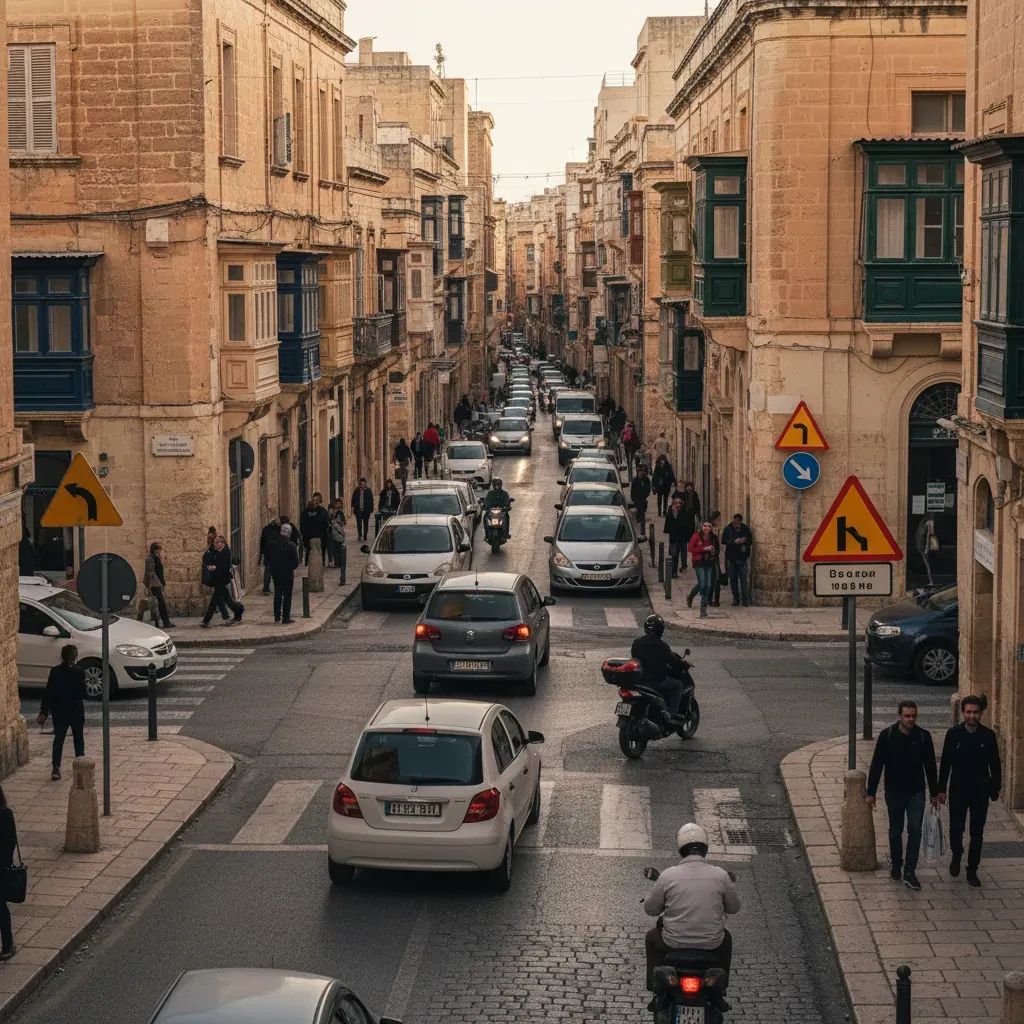
A 23-year-old motorist from Mosta remains hospitalized following a single-vehicle rollover on one of Malta's most dangerous stretches of road. The incident, which occurred at 11:30pm on Sunday, May 17, 2026, on Triq Louis Wettinger in Mellieħa, has reignited debate over whether enforcement and infrastructure improvements are keeping pace with a troubling shift in how accidents occur on the island—fewer collisions overall, but substantially more severe outcomes.
Why This Matters
• The Mellieħa Bypass is a persistent problem: Nearly 60% of motorists exceed speed limits there, with some recorded traveling at 137 km/h in 40-60 km/h zones.
• Malta's road fatalities reached 18 in 2025, up from 12 in 2024, marking a concerning reversal even as total crashes declined by 7%—suggesting accidents are becoming deadlier, not safer.
• The Northern Harbour district remains the collision hotspot, accounting for roughly one-third of all traffic incidents, straining emergency response resources across Mellieħa and neighboring towns.
The Pattern: More Deaths, Fewer Crashes
Malta's road safety picture from 2025 defies intuition. The year saw more than 13,000 traffic collisions reported nationwide, yet the final quarter showed improvement—fewer crashes, fewer injuries. Despite this apparent progress, 2025 ended with a stark reversal: 18 fatalities, six more than the previous year.
The pattern matters because it signals a shift in accident severity. Drivers are crashing less frequently but with greater force. Speeding correlates directly with this trajectory. On Triq Louis Wettinger, the Mellieħa Bypass, enforcement operations by local media and police have consistently documented rampant violations. Vehicles clocked at 132-137 km/h on roads marked 40-60 km/h represent not just minor infractions but fundamentally different collision physics—the difference between injury and fatality.
The Northern Harbour district, encompassing Mellieħa, St. Paul's Bay, and surrounding areas, reported approximately 1,200 collisions during 2025. That density of incidents strains the Malta Civil Protection Department and diverts ambulance resources during peak times. When emergencies cluster geographically, response times inevitably stretch.
Infrastructure Confusion and Driver Behavior
The Mellieħa Bypass underwent significant reconstruction in recent years, including a controversial narrowing to accommodate a service road. That project reduced the speed limit from 80 km/h to as low as 40 km/h within short stretches and introduced what residents describe as a "blind corner" that complicates sightlines, particularly after dark.
The result: variable speed zones that require constant attention and sometimes trip drivers unfamiliar with the route. Add excessive speed to road design that doesn't guide driver behavior intuitively, and the conditions for loss of control multiply. Sunday's rollover aligns with a troubling local pattern—three serious incidents on Mellieħa roads within the past 12 months. In August 2025, a 23-year-old motorcyclist sustained grievous injuries on Marfa Road. In May 2025, two people were hospitalized following a two-car collision on Triq Dawret il-Mellieħa.
The Mellieħa Local Council has formally requested the installation of fixed speed cameras on the bypass, but no timeline for deployment has been announced by Malta's transport authorities. Without routine enforcement, driver compliance remains sporadic. Police operations have issued dozens of speeding tickets, yet violations persist, suggesting that occasional enforcement is insufficient to change behavior.
What This Means for Residents and Commuters
For families in Mellieħa and regular commuters, the 2025 data is unambiguous: infrastructure and enforcement have not evolved with the risk. If you drive or cycle through these areas, heightened caution is essential, particularly in sections where speed limits drop abruptly or road geometry shifts without warning.
The accident density also has practical consequences. Ambulance response times during periods of multiple incidents stretch longer. Pedestrians and cyclists—groups with minimal protection in high-speed environments—face elevated risk. The Northern Harbour's collision density means emergency resources are thin across Mellieħa, St. Paul's Bay, and Naxxar.
For insurance purposes, residents in this district may face higher premiums or coverage limitations given the statistical elevation of risk. Drivers involved in accidents here frequently encounter aggressive claims investigations, particularly if speed is suspected. Anyone traveling through Mellieħa should document routes carefully and maintain dashcam footage.
Emergency Response: Capacity Building, Not Yet Results
The Malta Civil Protection Department has invested significantly in capability over the past 18 months. In February 2026, the CPD unveiled four new fire engines valued at nearly €3.5M, designed for rapid deployment in urban and semi-urban environments. The department now operates from 10 fire stations and one marine station strategically positioned across the islands.
During 2025, the CPD handled 6,638 incidents, with 12.5% of genuine 112 emergency calls routed to the department. While fleet modernization and broader government investment in the 112 emergency service suggest enhanced capacity, specific measurable improvements in response times for traffic accidents remain unpublished. The CPD has also launched a household distribution program for emergency manuals and fire blankets, aimed at empowering citizens to act before first responders arrive.
These initiatives reflect governmental recognition that emergency infrastructure has fallen behind demand. However, capacity building addresses response to accidents, not prevention. The real challenge lies upstream: enforcing speed limits consistently and redesigning roads that don't invite excessive velocity.
The Investigation and Broader Context
The Malta Police Force has not yet disclosed whether speed, mechanical failure, or road conditions contributed to Sunday's rollover. Investigations typically examine tire marks, vehicle telemetry where available, and roadway conditions at the time of impact. Given the historical pattern of speeding on Triq Louis Wettinger, authorities are likely examining whether the driver exceeded legal limits and whether abrupt road design changes played a role.
The 23-year-old driver's current condition has not been updated publicly. His case adds to a growing tally of serious injuries on Malta's roads—a toll that defies easy explanation. Fewer crashes in 2025 but more fatalities suggests that Malta's aging fleet of vehicles, combined with aggressive driving behavior and infrastructure that doesn't adequately control speed, has created conditions where accidents, when they occur, are disproportionately lethal.
Historically, Malta's road fatalities have fluctuated widely—9 in 2012, a peak of 23 in 2016, then back to stabilization around 12-16 annually. The 2025 spike to 18 represents movement in the wrong direction, a trend that short-term investment in emergency response alone cannot reverse. Until the Mellieħa Local Council's request for fixed speed cameras is approved and deployed, until road design incentivizes rather than confuses drivers, and until enforcement becomes routine rather than occasional, the Northern Harbour district will remain Malta's most dangerous zone.