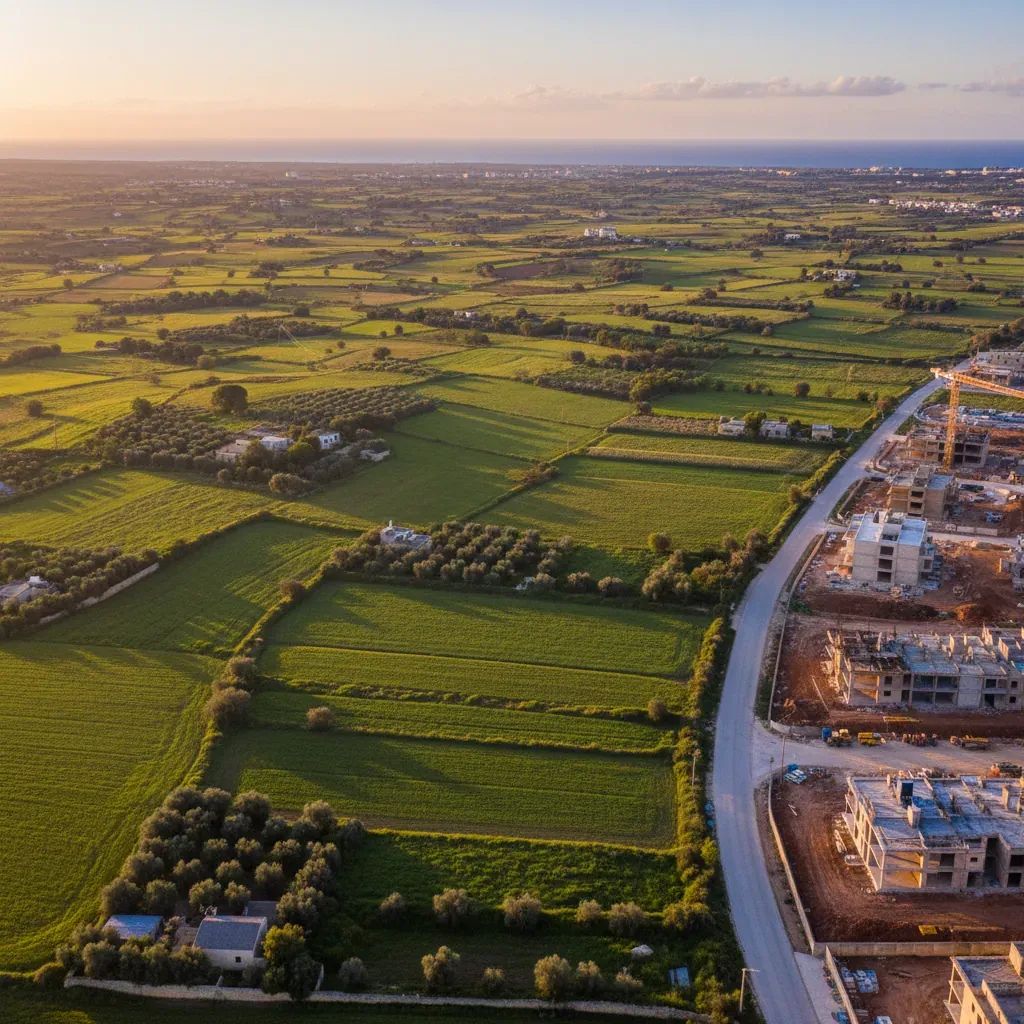
The Malta Planning Authority has approved the first of three contested residential blocks in Nigret, Żurrieq, overriding nearly 400 public objections and advancing the conversion of the locality's last significant agricultural buffer into urban housing. In a country with one of Europe's highest population densities and critically limited agricultural land, the loss of over 11,500 m² of farmland has intensified concerns about uncontrolled urban sprawl and the erosion of what remains of Malta's rural character. The decision, finalized on July 28, 2026, greenlit application PA/01822/26—a scheme that will erect 20 residential units across five stories, including basement garages, four ground-floor maisonettes, 12 apartments, and four penthouses.
Why This Matters:
• Agricultural land loss: Over 11,500 m² of permeable farmland will be concreted, reducing natural water absorption and accelerating runoff—a critical concern in a nation already vulnerable to winter flooding.
• ODZ conversion precedent: The development zone designation converts land from Outside Development Zone (ODZ) status, a protective classification for areas beyond urban boundaries. Once converted, such land becomes permanently available for building, setting a template for similar conversions across the island.
• Precedent for future sprawl: Two additional blocks (PA/1042/26 and PA/01847/26) are pending, collectively adding more than 30 units to a previously quiet, semi-rural fringe.
• Institutional override: The PA's approval directly contradicts earlier statements by Prime Minister Robert Abela suggesting state-owned land would not be deployed for such projects.
• Traffic and infrastructure strain: Residents warn existing road networks and services cannot handle the influx.
How a 2006 Plan Became a 2026 Flashpoint
The Nigret parcels were first flagged for development under the 2006 "rationalisation" exercise, a controversial scheme led by then-Planning Minister George Pullicino that converted pockets of Outside Development Zone (ODZ) land—areas designated to remain undeveloped and protect rural character—into buildable plots. Parliament endorsed the exercise, which was subsequently embedded into the 2006 South Malta Local Plan, designating Nigret for residential use with a three-floor-plus-semi-basement cap.
Yet for nearly two decades, those zoning provisions remained dormant. In June 2023, the PA's Executive Council unanimously approved a planning control application submitted by Grand Property Holdings Ltd—with Pullicino as the project architect—to activate the 2006 parameters. A second application by Tum Invest followed in September 2023, transforming an additional 18,302 m² of arable land into a residential complex despite incomplete archaeological surveys. The Superintendent of Cultural Heritage granted developers the option to conduct heritage studies after the zoning permit was issued, a procedural shortcut that drew sharp criticism.
By July 2023, the Nigret area was formally rezoned, and individual development applications began streaming in. The first to cross the finish line—PA/01822/26, filed by developer Josef Dimech—gained approval on July 28, 2026, despite an objection tally that ranks among the highest recorded for a single residential project in Żurrieq.
What Residents and NGOs Are Fighting
Opposition to the Nigret scheme has coalesced around five core arguments:
1. Overdevelopment and Density MismatchObjectors, led by Għaqda Residenti taż-Żurrieq and the activist collective Il-Kollettiv, argue that four- and five-story blocks are incompatible with the locality's character. They contend the projects should serve as transitional architecture between urban Żurrieq and the open countryside, not as a "wall of apartment blocks."
2. Loss of Permeable LandBirdLife Malta and Din l-Art Ħelwa highlight the environmental cost: permeable agricultural soil that aids groundwater recharge will be replaced by impermeable concrete. Malta already faces significant runoff and flooding challenges during winter storms, and removing this natural absorption layer exacerbates the risk. This issue resonates particularly with EU environmental directives on water management and habitat protection that Malta is obligated to uphold as an EU member state.
3. Salami-Slicing to Evade ScrutinyUnder Maltese planning regulations, urban developments exceeding 10 hectares or 500 units trigger mandatory Environmental Impact Assessments (EIAs) via the Environment and Resources Authority (ERA). Critics allege that by subdividing Nigret into three separate applications—each just below the threshold—developers and the PA are circumventing comprehensive environmental review. Environmental NGOs are preparing a formal complaint to the European Commission alleging systematic circumvention of these EU environmental directives.
4. Cumulative Impact IgnoredThe PA's case officer reports acknowledged the objections but provided minimal reasoning for why the collective impact of three simultaneous projects was deemed acceptable. Residents have urged the authority to assess the cumulative footprint on traffic, water infrastructure, and rural character, but no such regional analysis was conducted.
5. Public Land AmbiguityQuestions persist over whether the Lands Authority formally cleared the use of state-owned parcels within the development footprint. Wayne Flask, secretary of Il-Kollettiv, has demanded transparency on how public assets were transferred or leased to private developers.
Two More Applications in the Pipeline
Beyond the July 28 approval, two additional Nigret schemes remain under review:
• PA/1042/26 (Francis Agius): A four-story block containing one maisonette, 10 apartments, a penthouse with pool, and eight semi-basement garages.
• PA/01847/26 (Josef Dimech): Five apartments distributed vertically across five stories.
If all three projects proceed, Nigret will host at least 35 new residential units within a 300-meter radius, fundamentally altering the settlement pattern along Żurrieq's southern fringe.
Political Promises and Bureaucratic Reality
In 2023, Prime Minister Robert Abela publicly suggested that a solution could be found and that state-owned land would not be utilized for the Nigret developments. Yet the Planning Commission proceeded with the case officer's recommendation for approval, leaving residents to question whether executive statements carry binding weight over planning decisions.
The Momentum Party has joined forces with local groups, calling for an immediate moratorium on further approvals pending a comprehensive review of the 2006 local plans. Ruben Abela of Wirt iż-Żejtun noted that similar pressures to extend development boundaries are surfacing across multiple localities, signaling a broader policy tension between growth and conservation.
What This Means for Żurrieq Residents
For those living in Żurrieq, the approval translates into tangible, near-term changes:
• Construction disruption: Expect excavation, heavy vehicle traffic, and noise over an estimated 18–24-month build period, with peak activity during dry seasons.
• Increased residential density: The 20 new units will likely add 50–80 residents to a neighbourhood previously characterized by low-rise homes and agricultural plots, potentially straining local schools and health services.
• Property value impacts: Proximity to new construction typically depresses surrounding property values during the build phase; however, long-term effects remain uncertain depending on the final character of the development.
• Infrastructure concerns: New water, electricity, and sewage connections will be required. Residents should verify with the Water Services Corporation and Enemalta whether existing infrastructure can accommodate the additional load, or if upgrades are planned.
• Traffic congestion: The basement garages will generate additional vehicle movements on roads already considered inadequate by local councils. The existing access roads via Triq il-Qlejgħa and surrounding residential streets are narrow and poorly suited to construction traffic.
• Service access: Verify whether new roads will be built within the development or whether residents will rely on existing tight thoroughfares. Check with the Local Council about waste collection and emergency vehicle access during and after construction.
• Precedent risk: If the remaining two applications are approved, objectors warn that the entire Nigret belt could be opened to similar schemes, eroding what residents describe as their "last green lung."
Il-Kollettiv and Residenti taż-Żurrieq have filed judicial proceedings against the Minister for Planning and the Attorney General, challenging the legal validity of the 2006 rationalisation scheme and arguing that current environmental priorities render it obsolete. A court hearing is expected in the coming months, though construction timelines are unlikely to be delayed pending a verdict.
Comparative Context: A Nationwide Pattern
Nigret is not an isolated case. Residenti tal-Mellieħa representative Olivia Gauci expressed solidarity, noting that her locality faces similar encroachment on public and ODZ land. Across Malta, local councils in Marsascala, Siġġiewi, and Dingli have lodged formal objections to rezoning applications that mirror the Nigret playbook: invoke a decades-old local plan, submit piecemeal applications, and approve before cumulative assessments can be mandated.
The broader question facing Malta's planning regime is whether the 2006 rationalisation exercise—designed during a very different economic and demographic climate—remains fit for purpose in 2026, when water scarcity, flood risk, and urban heat islands have moved to the forefront of policy debates.
What Happens Next and How Residents Can Engage
Barring a successful judicial intervention, construction on PA/01822/26 is expected to commence within three months. The PA's board will review the two remaining applications in the coming weeks, with decisions anticipated before the end of the summer recess.
For residents who wish to engage further:
• View planning applications: Visit the Malta Planning Authority's public portal at https://www.planning.org.mt and search for PA/1042/26 and PA/01847/26 to review development briefs and submitted documents.
• File objections on pending applications: The submission period for objections on the two remaining Nigret applications closes on [specific date—check planning authority notice]. Objections can be filed online via the PA portal or submitted in writing to the Planning Authority, 1A, Blat l-Inja, Valletta.
• Contact resident groups: Għaqda Residenti taż-Żurrieq meets monthly; contact details are available via the Żurrieq Local Council website. Il-Kollettiv maintains an active social media presence and welcomes participation in public consultations.
• Local Council support: The Żurrieq Local Council can provide information on infrastructure capacity and planned services. Requests for council interventions or technical advice can be directed to [council contact details].
• Legal assistance: Din l-Art Ħelwa and BirdLife Malta offer guidance on environmental concerns and potential grounds for legal challenge. Contact their respective offices for advice.
Residents have vowed to maintain pressure through public demonstrations and legal channels, while environmental NGOs are preparing a formal complaint to the European Commission alleging systematic circumvention of EIA requirements under EU environmental directives.
For now, the Nigret saga underscores the friction between statutory planning frameworks locked in the past and a public increasingly concerned about the sustainability of Malta's built environment. Whether the courts, the legislature, or the PA itself will recalibrate the balance remains an open question—but the concrete, once poured, will be permanent.