
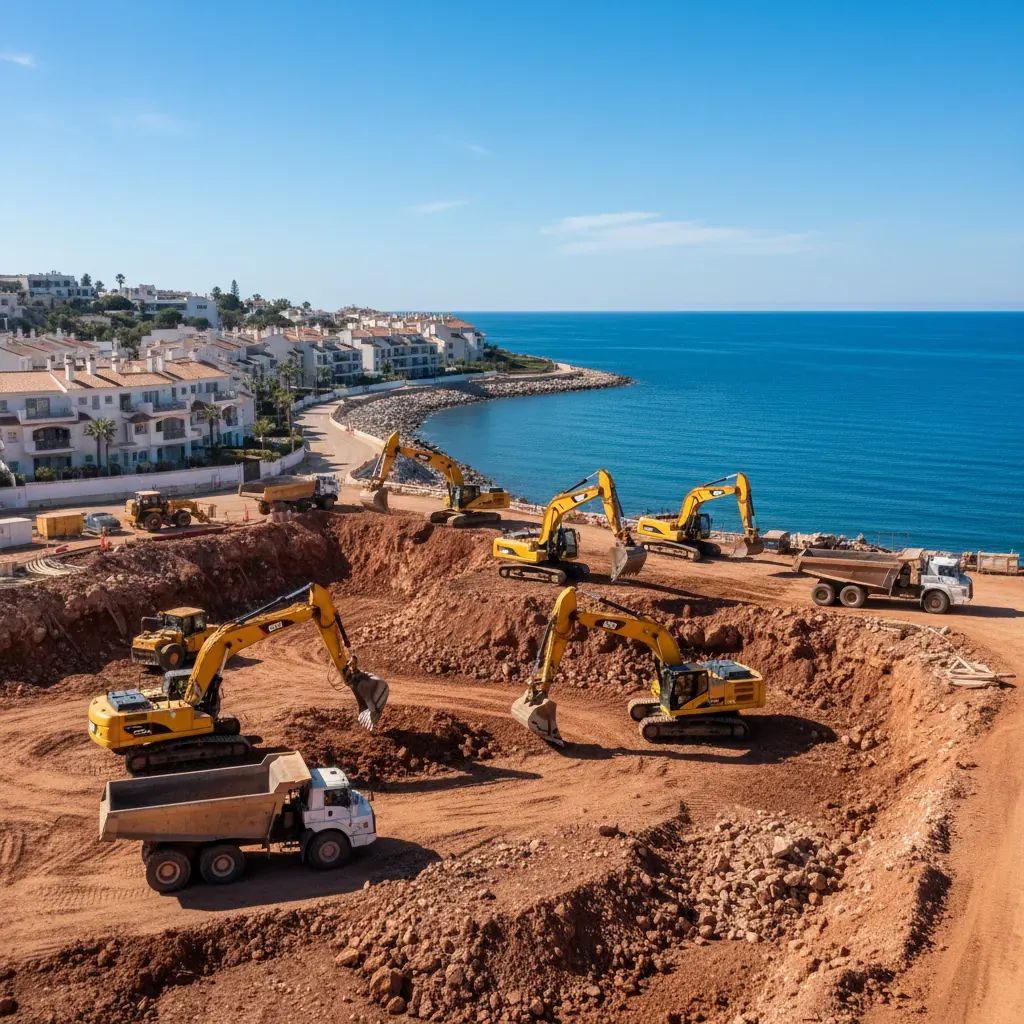
Heavy excavators continued tearing into the earth at a contested Sliema hotel site on Tuesday morning, even as a formal cease-and-desist order from the Building and Construction Authority (BCA) instructed all activity to halt immediately. The defiance marks the latest chapter in a protracted battle over tower hotels reshaping Malta's most densely populated coastal town—and raises fresh questions about enforcement authority in the island's property development sector. The BCA's intervention came shortly after media scrutiny, with Times of Malta having sent questions to the authority the day before the stop-work notice was issued, suggesting that investigative reporting may have prompted regulatory action.
Why This Matters
• Stop-work violations: Machinery operated for hours after the BCA issued its March 11 notice, captured in aerial footage.
• Permit limbo: The excavation underway has no approved permit; a February application (PA 771/26) remains pending.
• Façade demolition scandal: Developer Michael Stivala seeks to retroactively sanction the destruction of a building front he had pledged to preserve.
• Regulatory credibility: The incident follows a separate tribunal decision in February that revoked permits for two 14-storey hotels in a residential Sliema street, citing Planning Authority overreach.
Excavation Proceeds Despite BCA Order
Aerial surveillance on the morning of March 11 documented heavy machinery actively excavating the corner site at Triq San Vincenz, one of two tower block hotel projects controlled by property magnate Michael Stivala, president of the Malta Developers Association, within meters of each other on the Sliema seafront. The BCA had issued its stop-work notice earlier that same day, responding to resident complaints that excavation for two basement levels—intended for amenities and underground parking—was advancing without regulatory approval.
One resident had flagged the works to authorities a week prior, describing them as "illegal" and noting the absence of a valid permit, a geological survey, and persistent flooding of the excavation pit with seawater. That complaint appears to have triggered the BCA intervention, yet the machinery kept running for hours after the notice was served, according to visual documentation reviewed by multiple outlets.
The February 2026 application (PA 771/26) filed by Stivala seeks not only to authorize the basement excavation but also to sanction the demolition of the building's façade—a retention commitment made under a previous permit (PA 2965/23) approved in 2023. That earlier permit, which authorized a 14-storey hotel on the site of a former Labour Party club, was quashed by the Environment and Planning Review Tribunal in January 2026 after the tribunal found roof structures and upper-floor setbacks non-compliant. The tribunal requested revised plans; as of mid-March, none had been submitted, rendering the 2023 permit invalid.
The new application also proposes adding two additional floors to bring the structure to 17 storeys, while purportedly maintaining the previously approved height envelope—a geometric feat that has drawn skepticism from planning observers. The application would increase the hotel's room count and amenity offerings, embedding the site deeper into Malta's high-density tourism infrastructure.
What This Means for Residents
For residents in the immediate vicinity, the continued excavation represents both a practical nuisance and a symbolic failure of regulatory enforcement. Seawater infiltration into the dig site raises concerns about soil stability and potential subsidence risk to adjacent properties. The absence of a geological survey—mandated for excavations of this scale near the coast—compounds those fears.
More broadly, the episode underscores a persistent challenge for Sliema's residential population: the inability of enforcement bodies to halt unauthorized works in real time. Even when stop-work notices are issued, developers may calculate that the cost of proceeding outweighs the risk of penalties, particularly when applications are eventually approved retroactively. The Sliema Residents Association has condemned what it describes as a pattern of "ongoing irregularities" at Stivala's projects, including a 2025 incident in which a crane was installed without a permit.
Residents living near construction zones also face the daily friction of noise, dust, and early-morning disruption. While regulations prohibit construction before 7:00 AM and demolition before 7:30 AM, enforcement is sporadic, and complaints often go unaddressed for weeks.
A Broader Pattern of Defiance and Reversal
The Stivala case is not isolated. In February 2026, the Planning Tribunal upheld an appeal against a permit for two 14-storey hotels by developer Dale Spiteri on a residential street bordered by Triq Markizi Zimmermann Barbaro and Triq Bisazza. The tribunal found the project incompatible with the area's planning framework, exceeded height limits, and conflicted with national strategic planning objectives. The permit had been granted by the Planning Authority in June 2024, despite a case officer's recommendation for refusal and objections from residents, Flimkien għal Ambjent Aħjar, Din l-Art Ħelwa, and the Sliema Local Council. The reversal prompted calls for the resignation of Planning Authority Commission members who approved the project.
Elsewhere in Sliema, a separate Stivala project—the redevelopment of the ST Sliema Hotel on Manwel Dimech Street into a 15-storey Accord Mövenpick-branded property—was suspended by the BCA in March 2025 after workers attempted to demolish part of an adjacent building without consent, punching a hole into a residential apartment. A formal meeting with all responsible parties was required before work could resume.
The pattern suggests a development model in which projects proceed through cycles of approval, violation, stop-work order, revised application, and eventual sanction—a sequence that effectively normalizes non-compliance as a cost of doing business.
Enforcement Vacuum and Planning Authority Under Scrutiny
The Building and Construction Authority is tasked with site-level enforcement, but its capacity to monitor hundreds of active developments across Malta is limited. Stop-work notices are reactive, typically issued only after residents file complaints. Even then, as the March 11 incident demonstrates, compliance is not guaranteed.
The Planning Authority, meanwhile, faces accusations of rubber-stamping projects that contravene local plans and height policies. The February tribunal decision in the Spiteri case explicitly criticized the Planning Authority for granting a permit against expert advice. The authority's willingness to apply "flexibility policies" in areas near the promenade—allowing towers well above the four-storey residential norm—has been challenged repeatedly in court, with mixed results.
The Environment and Planning Review Tribunal serves as a corrective mechanism, but appeals take months or years to resolve, during which time developers may complete substantial work. Retroactive sanctioning applications, like Stivala's PA 771/26, allow projects to advance even when foundational permits are invalidated.
Tourism Growth vs. Residential Character
Malta's tourism sector continues to expand, with the island welcoming 3.2 million visitors annually—more than seven times its resident population of approximately 520,000. Hotel capacity is concentrated in coastal towns like Sliema, St. Julian's, and Buġibba, where tower blocks now dominate skylines that were largely low-rise as recently as the early 2000s.
Sliema's transformation has been particularly acute. Once a quiet residential and commercial district, the town now hosts multiple high-rise hotel projects within a few hundred meters of each other. The North Harbours Local Plan prioritizes residential use, but successive administrations have interpreted flexibility clauses to permit hospitality developments far exceeding original height limits.
For long-term residents, the shift has eroded quality of life. Parking scarcity, increased traffic, construction noise, and the conversion of residential streets into hotel corridors have prompted waves of emigration to quieter towns. Property prices in Sliema remain among Malta's highest, driven in part by investor demand for short-term rental units and commercial conversion opportunities.
The tension between tourism-driven economic growth and the preservation of residential neighborhoods has become a defining political issue in Malta, with no clear policy resolution in sight. The NH Collection Sliema, a 268-room hotel scheduled to open by the end of 2026, represents the scale of investment flowing into the sector, even as public opposition intensifies.


