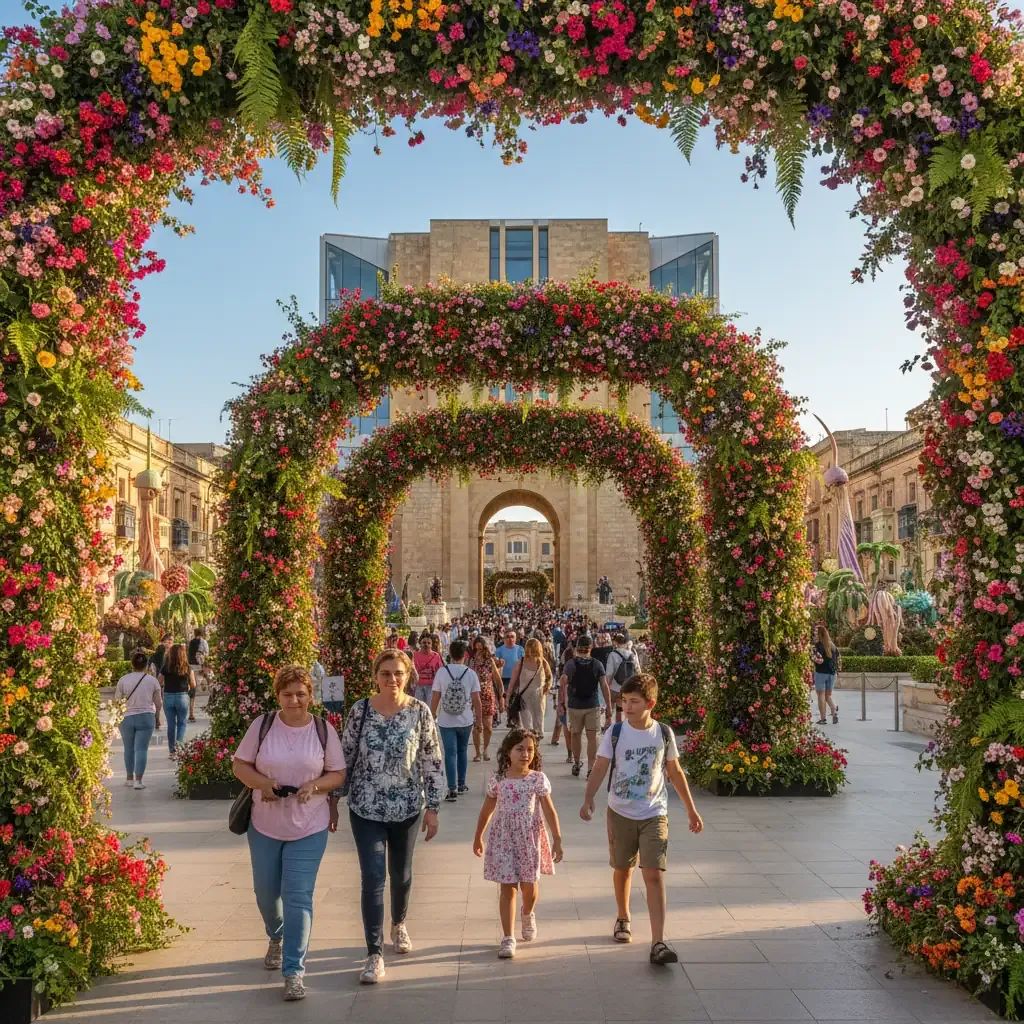
Valletta's streets are about to transform into an open-air botanical exhibition. For the next 11 days—from 30 April to 10 May—the Valletta Cultural Agency has staged one of the Mediterranean's most ambitious temporary greening projects, anchored by a striking floral corridor that begins at City Gate and stretches toward Parliament.
Why This Matters
• Eleven days of free public access to a completely reimagined urban landscape; no tickets, no entry fees, no barriers.
• Family-focused programming: Structured workshops for children run on 5 specific days, plus weekday recycling education and marketplace shopping alongside the gardens.
• Strategic timing: The festival concludes on Mother's Day (10 May), positioning it as a weekend destination during one of the year's highest-traffic holiday periods.
The City Gate Corridor: A Visual Gateway
The installation stretching from the ditch bridge to Parliament serves a deliberate purpose beyond decoration. Rather than clustering all botanical elements in one square, the Valletta Cultural Agency engineered a pathway experience: visitors entering the capital via City Gate now encounter an immediate immersion into the festival's environmental messaging. The arrangement uses approximately 10,000 zip ties to secure the floral elements—a logistical detail that underscores the engineering precision behind what appears as organic growth.
At its terminus stands a monumental vessel containing a carefully curated bouquet, a visual punctuation mark that signals arrival at the fantasy garden occupying St George's Square. This choreography of movement—from bridge to bouquet to square—mirrors how urban planners in cities like Copenhagen and Milan now think about green infrastructure: not isolated patches but continuous, experiential corridors that make ecology inescapable and tangible.
The Heart: St George's Square Transformed
The square itself becomes the festival's centerpiece. 45,000 shrubs combine with 12,000 individual flowers and 100 newly planted trees to create what organisers term a "fantasy garden." The sheer density of planting temporarily converts one of Valletta's most historically significant public spaces into a functional ecosystem, accessible daily from 10:00 AM to 6:00 PM.
For residents accustomed to the square's baseline hardscape and tourist density, the botanical transformation offers relief: shade from the newly planted trees, air circulation from vegetation, and reduced heat absorption compared to unadorned stone. These aren't aesthetic luxuries—they're measurable environmental benefits. Urban greening reduces ground-level temperatures by 2–8 degrees Celsius, traps particulate pollution, and creates microhabitats for pollinators.
The Economic Layer: The Eco Market
While the gardens supply visual texture, the Eco Market along Old Theatre Street adds a transactional dimension. Operating daily during festival hours, the market curates vendors selling locally manufactured sustainable goods: skincare products from circular-economy producers, jewelry from ethical suppliers, fashion items designed for durability, original paintings, and home furnishings prioritizing natural materials and minimal waste.
Unlike generic craft markets that welcome any seller with a booth fee, this marketplace enforces sustainability credentials. For residents pursuing conscientious consumption but frustrated by the friction of finding vetted suppliers, the festival consolidates options into a manageable, walkable shopping district. Vendors themselves benefit from concentrated foot traffic and festival visibility.
Learning Spaces for Younger Residents
The children's programming follows a structured educational model rather than ad hoc entertainment. Five targeted days—1, 2, 3, 9, and 10 May—feature workshops from 11:00 AM to 2:00 PM covering pebble art, upcycled craft techniques, and face painting. The curriculum subtly embeds environmental habits: upcycled crafts teach material reuse; pebble art uses reclaimed stone; face painting uses non-toxic pigments.
Simultaneously, the Wasteserv Roadshow stationed in Triton Square addresses a persistent Maltese frustration: confusion around recycling protocols. Using mascots and interactive exhibits, the initiative demystifies what materials belong in which bins—practical intelligence that residents repeatedly cite as a barrier to participation. By coupling this education with a festival atmosphere rather than positioning it as mandatory compliance training, adoption likelihood increases.
Choreographed Performance: Flash Mob Disruption
Between 10:30 AM and noon, Dancel Dance Studio stages flash mob performances at various Valletta locations. These brief, choreographed interventions—dancers materializing unexpectedly, performing routines communicating environmental messaging, then dispersing—function as urban theatre and awareness tools simultaneously. Commuters and office workers experience them as delightful interruptions to routine; organisers deploy them as communication vectors reaching audiences unlikely to attend traditional environmental seminars.
The Money and Logistics Behind the Display
The Valletta Cultural Agency's 2026 Cultural Programme carries a €4.5M annual budget, within which the Green Festival occupies a significant allocation. The specific cost of the City Gate installation remains undisclosed, though the resource deployment hints at substantial expenditure: sourcing 80,000 flower pots and plants, securing 10,000 zip ties, providing daily maintenance across multiple sites, and managing post-festival disposal generates considerable operational overhead.
Funding flows from the Ministry for National Heritage, the Arts, and Local Government, with collaborative support from the Environment and Resources Authority (ERA), Ambjent Malta, Circular Economy Malta, Wasteserv, the Energy and Water Agency (EWA), the Ministry for the Environment, Energy and Enterprise, and the Ministry for Public Works and Planning. Private sector involvement includes Derek Garden Centre and Project Green, both supplying plants and technical expertise.
This multi-agency coordination reflects a shift in how Malta's government frames environmental action: no longer marginal concern but integrated infrastructure priority spanning heritage, waste management, energy policy, and urban development portfolios.
Global Precedent: Why Temporary Greening Matters
Malta's 11-day installation follows logic demonstrated worldwide. Cities like Singapore, Milan, and London have embraced greening as climate adaptation infrastructure—merging architecture with vegetation to reduce urban heat, support biodiversity, and trap pollution. Temporary installations occupy a distinct strategic niche: they test public appetite for greening without permanent structural commitments. In a UNESCO World Heritage city like Valletta, where architectural modification faces regulatory resistance, 11-day exhibitions become pragmatic testing grounds. Successful festivals—measured by attendance, social media engagement, and subsequent policy inquiries—build political capital for permanent interventions.
Practical Navigation
The festival requires no advance registration or tickets. St George's Square remains open throughout, though expect crowding during midday weekend hours. The Eco Market operates independently, allowing shopping without navigating square density.
The route from City Gate to the square is paved and accessible, though floral installations may narrow certain pathways slightly. All programming concludes by 6:00 PM; evening hours return Valletta's streets to their baseline nocturnal state.
Parking remains Valletta's perennial constraint. Public buses terminating at the capital's entrance offer more reliable access than hunting on-street spaces. Park-and-ride facilities outside city walls provide an alternative for drivers arriving from the north or south.
After the Flowers Fade
Once the festival concludes on 10 May, the 80,000 plants enter a disposal phase. Historical editions have redistributed flora to schools, community gardens, and municipal projects, though the Valletta Cultural Agency has not yet confirmed this year's redistribution plan. The City Gate structures and giant vase will be dismantled, returning the area to its normal state.
The May 10 conclusion coinciding with Mother's Day reflects deliberate marketing strategy: positioning the festival as family-friendly during a high-footfall holiday weekend. Whether the investment catalyzes lasting behavioural shifts toward sustainability remains an open question. The immediate outcome is concrete: for 11 days, Malta's capital functions as a living laboratory for urban ecology, a botanical proof of concept that precedent exists—globally and now locally—for integrating nature into dense historic cities.