The Malta National Archives has confirmed new research identifying six photographers from the island who contributed their work to London exhibitions during the 1880s, including a previously undocumented academic whose photographic activities had been completely overlooked. The findings offer fresh perspective on Malta's participation in European photography during the height of the British Empire's colonial exhibitions.
Why This Matters for Malta Residents
• One "thoroughly unknown" photographer—Professor Vincenzo Micallef, a chemistry academic at the University of Malta—exhibited three collections in London despite leaving no documented photographic publications or studio records.
• The discovery highlights Horatio Agius's early war reportage from the 1882 Anglo-Egyptian conflict, an overlooked contribution to photojournalism.
• Nearly 3,000 items were shipped from Malta for the 1886 Indian and Colonial Exhibition, demonstrating the island's active participation in Victorian visual culture.
• Malta adopted photography in 1839, the same year France announced the medium, placing the island among Europe's earliest practitioners—a heritage that remains largely undocumented for the Maltese public.
• The findings underscore the continuing need for a national photography museum to preserve Malta's scattered collections and make them accessible to residents and researchers.
The Six Photographers Who Traveled to London
Research published in March 2026 identifies five of the six Maltese photographers whose work appeared at the 1886 Indian and Colonial Exhibition in South Kensington. The sixth name remains absent from surviving records, likely due to incomplete cataloguing or archival loss.
Horatio Agius (1844–1910) dominated the show with multiple albums, including rarely seen images of the Anglo-Egyptian war of 1882—one of the earliest instances of conflict photography from the Mediterranean region. Agius, who operated extensively in the Three Cities (the historic fortified cities of Vittoriosa, Senglea, and Cospicua across the harbour from Valletta), had learned technical skills early in his career and built enough commercial success to acquire property and a Neapolitan knighthood. His sharp, detailed prints of Valletta's Grand Harbour and Cottonera fortifications remain critical historical records.
Richard Ellis (1842–1924), a British-born photographer who arrived in Malta at age 19 to settle on the island and became instrumental in developing its photographic tradition, exhibited just two items—an unusually modest showing for someone who amassed an archive of tens of thousands of photographs. Ellis had studied at the Daguerre Institute in Paris before establishing his Valletta studio in 1871. His clientele eventually included King George V, King Albert I of Belgium, and the Queen of Portugal. The Richard Ellis Archive, comprising between 36,000 and 45,000 glass plate negatives, was digitized in the 1990s and now serves as a primary research resource for understanding Malta's visual history.
Giuseppe Lorenzo Formosa (d. 1898) submitted the largest assortment, featuring factory interiors, hand-colored enlargements, and images of Islamic mosques in Malta. He priced unmounted prints at one shilling each, targeting middle-class British buyers fascinated by colonial exotica.
Alessandro Caruana (active circa 1862–1905), who began as a miniature painter before transitioning to photography, won prize medals at both the 1885 Malta Industrial Exhibition and the 1886 London event. Like Ellis, he contributed only two display items, suggesting a focus on quality over quantity. Caruana worked in Floriana and later Valletta, often next door to Ellis's first studio.
The Mystery of the Chemistry Professor
The most surprising inclusion is Vincenzo Micallef (1837–1915), who held the chair of chemistry at the University of Malta for over 40 years after his appointment at age 22 in 1859. Micallef exhibited three collections of photographs yet left behind no photographic publications, studio records, or known commercial practice. Researchers describe him as "thoroughly unknown" in photography circles.
Micallef's participation suggests that photographic practice in Victorian Malta extended well beyond professional studios into the realm of amateur scientific inquiry. His residence at 99 Strada Reale (now known as Republic Street) in Valletta in 1886 would have placed him within easy reach of other photographers and the colonial administration that organized the London shipment.
The absence of any surviving images or technical writings raises questions about whether his work was experimental, documentary, or purely personal. The fact that the Malta colonial government deemed his collections worthy of international exhibition indicates they met a high standard, even if his name never appeared in commercial directories.
Malta's Early Adoption of Photography
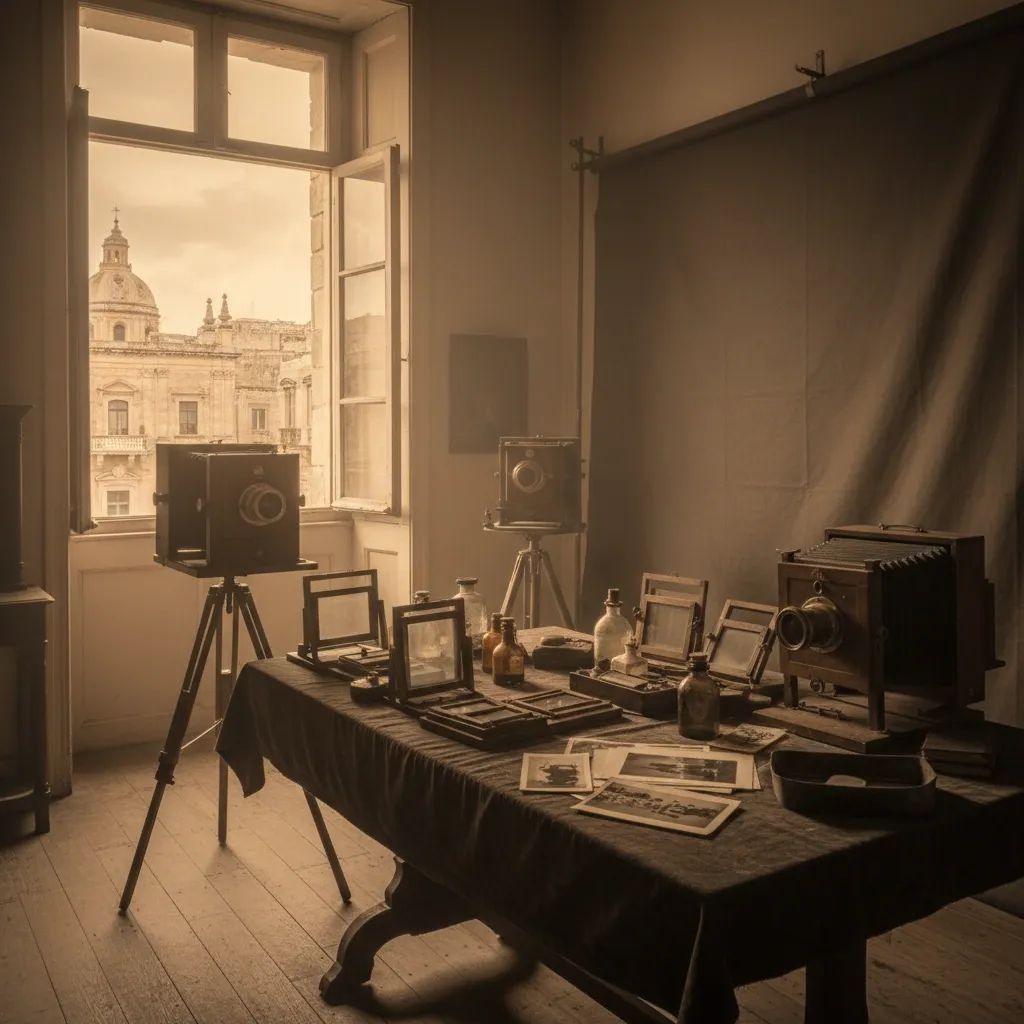
Malta's photographic community emerged remarkably early. Francesco Galea operated a Valletta studio in 1839, the same year Louis Daguerre announced his process in Paris. French pioneers Émile Jean-Horace Vernet and Frédéric Goupil-Fesquet demonstrated daguerreotype technology in Malta in March 1840, producing some of the Mediterranean's first photographs.
By the 1880s, Malta had developed a sophisticated photographic ecosystem. The colonial government's decision to ship nearly 3,000 items—including photographs, crafts, and industrial samples—to the 1886 exhibition reflected both imperial ambition and genuine local talent. The detailed catalogue from that event remains a primary source for historians.
The strategic location of Malta in the Mediterranean made it a natural subject for documentary photography. British fortifications, naval operations, urban transformation under colonial rule, and the daily life of a multilingual, multicultural population all provided rich material. Photographers like Salvatore Cassar (1855–1928) specialized in panoramic images and postcards that captured what one scholar called "the atmosphere of an age."
Women also played a role earlier than in many European markets. Sarah Ann Harrison opened Malta's first female-run studio in Senglea (a fortified city in the Three Cities, across from Valletta) in 1864, while Adelaide Anceschi transitioned from apprentice to professional photographer in the late 19th century, unusual achievements in the male-dominated field.
What This Discovery Means for Malta's Cultural Heritage Today
The identification of Micallef's involvement and the fuller documentation of the 1886 exhibition participants fills important gaps in Malta's cultural record. However, this discovery also exposes a significant problem: the scattered and fragmented state of Malta's photographic heritage.
The National Archives of Malta continues to expand its audiovisual preservation capacity, while the Malta Image Preservation Archive (MIPA), founded by photographer Charles Azzopardi, works to rescue negatives and equipment from disposal. Several comprehensive volumes have been published recently, including "100 Years of Photography in Malta" by Charles Paul Azzopardi, featuring over 800 photographs, and "Photography in Malta – The History & The Protagonists" by Kevin Casha, recognized by the Royal Photographic Society of London. These works challenge older narratives and bring forward evidence of Malta's early adoption of the medium.
Despite this wealth of material, Malta still lacks a dedicated national photography museum. Curators and historians have repeatedly called for a permanent institution to house the thousands of images currently scattered across private collections, archives, and family estates. For Malta residents interested in the island's cultural heritage, this represents both an opportunity and a challenge: the collections exist but remain largely inaccessible to the general public.
Malta residents can currently view portions of these collections through the National Archives of Malta (Valletta), the Malta Image Preservation Archive, and specific exhibitions at cultural institutions. However, without a centralized museum, much of this visual heritage remains hidden from public view—mirroring the very problem this 1886 exhibition discovery has revealed about Vincenzo Micallef and other contributors whose work vanished from memory.
A Persistent Pattern: Malta's Cultural Reach into the Victorian World
The 1880s discoveries underscore how much remains to be learned about Malta's photographic pioneers. With one of the six exhibitors still unidentified and Micallef's images entirely absent from public view, archival research continues to reveal new facets of the island's visual history. These findings represent a recovery of forgotten contributors and a reminder that the island's cultural footprint in Victorian Europe was larger and more sophisticated than previously understood.
For those interested in Maltese heritage, this discovery signals the importance of ongoing archival work and the urgent need for better preservation and public access to Malta's photographic legacy. The next chapter in this story will depend on whether the island's institutions can build the infrastructure—particularly a national photography museum—to ensure these stories are not forgotten again.