
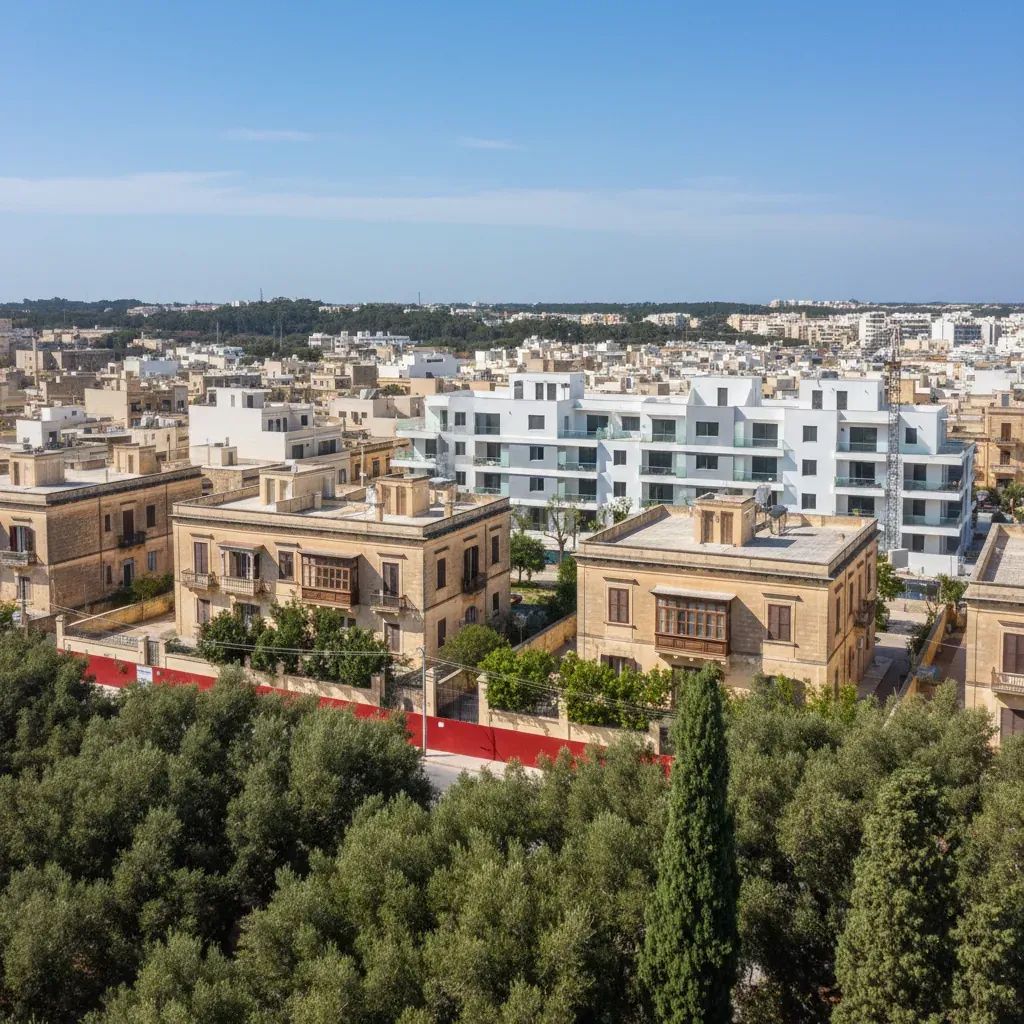
The Malta Planning Authority has green-lit a divisive residential and commercial complex on the site of the old Dolphin Centre in Balzan, triggering renewed debate over development density in residential neighborhoods just outside heritage zones. The approval, which came through a 9-2 vote, paves the way for 102 apartments, 15 shops, two offices, and 132 underground parking spaces—a project that drew more than 240 formal objections from residents, environmental groups, and the local council.
Why This Matters:
• Height and density: The approved building reaches 16.3 meters—roughly five storeys—in an area dominated by two-storey villas and adjacent to the Urban Conservation Area (UCA).
• Traffic and infrastructure: Balzan residents fear the influx will overwhelm already strained sewerage, electricity, and parking systems.
• Environmental precedent: Critics accuse the developer of "salami-slicing" applications to dodge mandatory environmental impact assessments.
• Mature trees at risk: Two prominent ficus trees near the site face potential damage from excavation, with replacement terms that do not guarantee like-for-like replanting.
A Contested Site with a Legal Past
The Dolphin Centre site, spanning almost 4,000 square meters at the junction of Triq il-Kbira, Triq Guzeppi Frendo, and Triq Wied Hal Balzan, has been the subject of repeated redevelopment bids. CF Homes Ltd, a subsidiary of CF Estates Ltd in which construction magnate Joseph Portelli holds the largest single shareholding, first secured approval for a smaller project comprising 88 residential units back in September 2022. That permit was revoked by the Environment and Planning Review Tribunal in March 2023, citing breaches related to height limits and the omission of heritage features, including a historic boundary wall and nymphaeum from the original Villa Birbal, which was illegally demolished in 1987. An appeal by CF Developers Ltd against that revocation was rejected by the Court of Appeal in July 2023.
The latest application, presented by architect Maria Schembri Grima on behalf of Clifton Cassar for CF Homes Ltd, adds 14 more apartments to the earlier plan and includes two terraced houses. It also proposes a new eight-meter-wide pedestrian footpath cutting through the complex, connecting Triq il-Kbira with Triq Wied Ħal Balzan, with restricted access for emergency and service vehicles. Despite these revisions, the fundamental objections remained: scale, proximity to the UCA, and the risk of irreversible environmental damage.
What This Means for Balzan Residents
For those living in and around Balzan, the approval represents a tangible shift in the local built environment. The development sits at the edge of a Residential Priority Area and will transition from two-storey blocks nearest the villa zone to the maximum allowable height over a horizontal span of approximately 15 meters, with each successive floor set back by at least 3 meters in line with DC2015 P6 design guidelines. But residents argue that even a graduated approach cannot mitigate the visual intrusion on a village known for its low-rise, heritage character.
Infrastructure concerns are acute. Balzan Mayor Angelo Micallef, one of the two dissenting votes in the Planning Authority session, has repeatedly flagged the town's aging sewerage and electricity networks. The addition of over 100 apartments and 15 commercial outlets is expected to generate substantial demand for on-street parking, despite the provision of 132 basement garages spread over two underground levels. A dedicated service lift, internal corridors, and four underground loading bays were incorporated into the design after Planning Commission requests, yet skeptics question whether these measures will prevent deliveries and commercial traffic from spilling onto already congested streets.
Flooding is another flashpoint. Residents and the local council have documented recurring stormwater issues in the area, and objectors argue that the engineers' report submitted with the application failed to address these comprehensively. While the applicant has committed to flooding mitigation measures, responsibility for implementation and monitoring rests solely with the developer, raising questions about enforcement and long-term accountability.
Trees, Heritage, and the "Salami-Slicing" Debate
Few issues proved as emotive as the fate of two mature ficus trees standing just outside the site on Triq il-Kbira. The Environment and Resources Authority (ERA) imposed a conditional requirement that the trees be protected during construction. If either is damaged, it must be replaced as indicated by ERA—but the condition does not stipulate that replacements match the originals in size, age, or exact location. Architect Joanna Spiteri Staines, a prominent local objector, has warned that deep excavation for the two-level basement and the overhead extension of upper floors will almost certainly compromise the root systems and canopy. The project architect countered that the basement level already exists and that the trees would not be affected.
The Superintendence of Cultural Heritage (SCH) initially raised strong concerns about the project's scale and visual impact on the Balzan UCA. Following revisions, the SCH granted clearance for the relocation of a prominent niche of St Roque from the Dolphin complex façade, which is listed in the National Inventory of the Cultural Property of the Maltese Islands. The SCH also noted improvements such as the retention of a historic boundary wall and the relocation and restoration of a nymphaeum, recommending approval subject to a €12,000 bank guarantee and site monitoring.
Environmental groups Din l-Art Ħelwa and Flimkien Għall-Ambjent Aħjar (FAA), along with NGO representative Romano Cassar on the Planning Authority board, have lamented the absence of a comprehensive Environmental Impact Assessment (EIA). They contend that the developer fragmented the project into multiple smaller applications—including a separate bid for an additional 11 apartments nearby—to stay below the threshold that would trigger mandatory environmental scrutiny. This practice, known as "salami-slicing," is not illegal but is widely criticized for circumventing holistic assessments of cumulative impact.
Portelli's Development Footprint
Joseph Portelli has been a dominant figure in Maltese real estate since founding J. Portelli Projects in 1996. His portfolio spans high-end residential complexes such as Mercury Towers, Sienja Villas in Mellieħa, and Forum Residences, as well as hospitality ventures including Quaint Boutique Hotels and the Levante, Scirocco, and Mistral hotels in St Julian's through CF Estates. Portelli is set to exit his 30% stake in CF Estates by the end of 2025, but his influence on the island's built environment remains substantial.
Not all of his projects have proceeded smoothly. A controversial proposal to develop a rural site in Wardija, involving the demolition of an old farmhouse and construction of garages, apartments, and pools on Outside Development Zone (ODZ) land, has drawn hundreds of objections and condemnation from the Environment and Resources Authority. That application remains under review. The Dolphin Centre saga is the latest in a string of high-profile battles over scale, heritage, and environmental stewardship.
Privacy and Design Mitigation
In response to objections, the applicant introduced several design adjustments. To limit overlooking into adjacent properties, the rear garden wall was raised to 4.5 meters, balconies at the back of apartments were set further back than required by Sanitary Law, and fixed planters were added to rear roof terraces. The building's transition from the Residential Priority Area to the maximum allowable height is designed to soften the visual shift, but critics argue that the sheer mass of the complex—102 apartments plus commercial space—cannot be disguised by setbacks and planting.
The Planning Authority's approval, secured by a comfortable majority, reflects a policy environment that continues to prioritize development over conservation in cases where statutory height limits are technically met. Nationalist Party MP and architect Toni Bezzina has represented residents in outlining concerns related to height, parking, flooding, and infrastructure, but the political will to halt the project proved insufficient.
The Broader Pattern
The Dolphin Centre approval is part of a wider pattern in Malta where developers leverage permissible building envelopes to maximize density, often in neighborhoods ill-equipped to absorb the resulting pressures. The absence of a Traffic Impact Assessment, despite regulations that typically require one for developments of this size, underscores the procedural gaps that objectors have highlighted. The waiver granted in this case suggests a willingness to accommodate large-scale projects even when baseline data on traffic and parking impacts are lacking.
For Balzan, the approval marks a turning point. The village, long characterized by its heritage streetscapes and low-rise residential fabric, will now host one of the largest mixed-use complexes in its core. Whether the promised mitigation measures—basement parking, pedestrian footpaths, heritage relocations—will offset the impacts on daily life, infrastructure, and the UCA remains to be seen. What is certain is that the Dolphin Centre redevelopment sets a precedent for how similar sites on the fringes of heritage zones are likely to be treated in the years ahead.


