
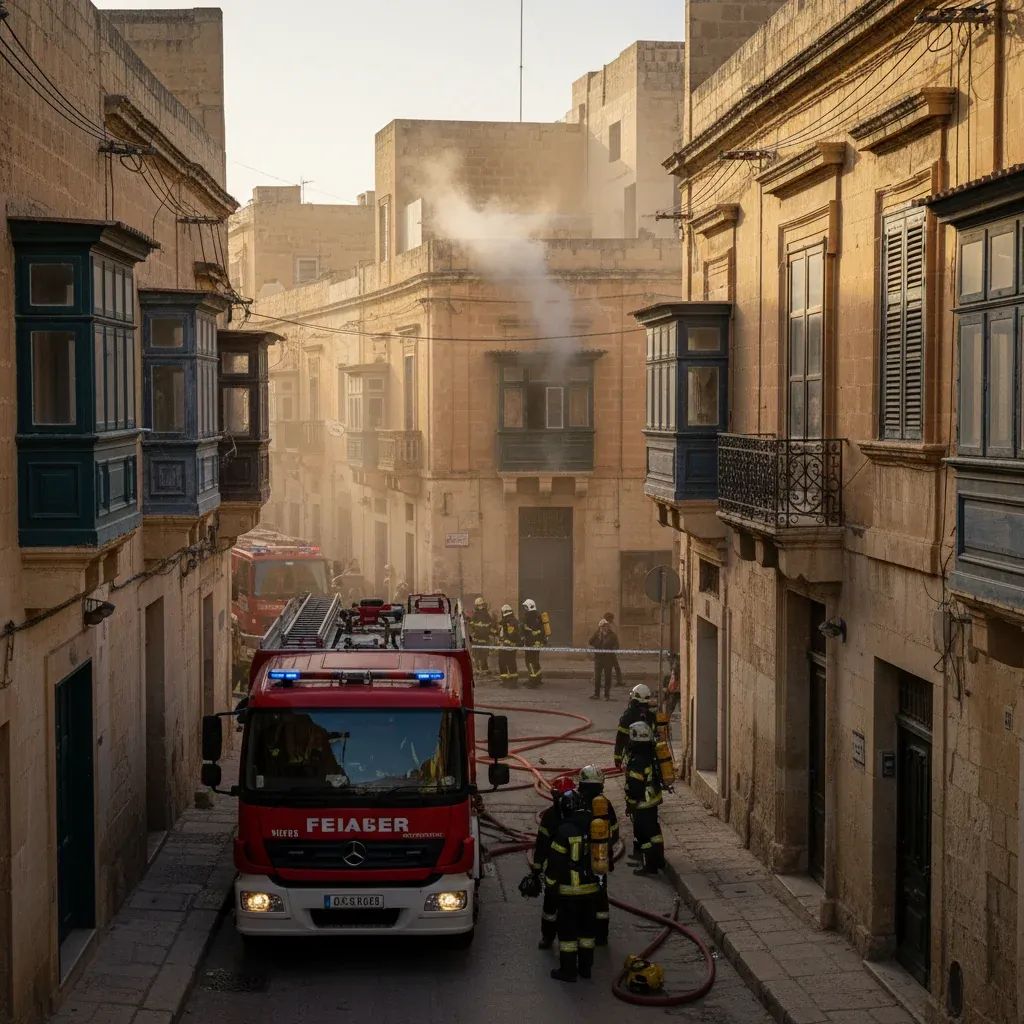
Firefighters in Birkirkara responded to a violent explosion on Monday, May 11, 2026, that ripped through a residential property on Triq San Konstantinu around 4:10 PM. The Malta Civil Protection Department deployed three fire engines after the blast ejected a first-floor balcony into the street and triggered a blaze that took hours to suppress. While no injuries have been reported, the incident has exposed a troubling pattern: Malta's aging fire safety framework remains vulnerable to preventable disasters, and residents across the island face similar risks.
Why This Matters
• A repeating problem: Neighbors confirm multiple fires at the same property over the years, suggesting structural vulnerabilities and regulatory gaps go unchecked indefinitely.
• Gas cylinder dangers persist: Firefighters conducting a room-by-room search found no occupants but located potential explosive materials—a routine concern that underscores how common these risks are across residential areas.
• Mandatory upgrades delayed: A new Fire Safety Act has been drafted by Parliament but remains unpassed, leaving residential buildings to operate under 2004 advisory guidelines with no legal force, leaving occupants to fend for themselves.
• Response strain: The Civil Protection Department fields thousands of incidents annually across all categories, stretching resources that grow thinner each year.
The Scene and Initial Investigation
Neighbors heard the explosion first, a sharp crack that rattled windows across the street. Seconds later came the unmistakable sound of shattering glass as the wooden and glass balcony exploded outward, showering the pavement with debris. The property sits in one of Malta's densest neighborhoods, a warren of interconnected buildings where fire spreads quickly if not contained fast.
Witnesses reported varying accounts of whether the property was occupied at the time. The elderly occupant had moved out recently, and neighbors believed the house was empty. However, one bystander claimed to have seen someone rush out of the building moments before the fire erupted. The Malta Police Force is investigating these accounts as part of their effort to determine the incident's cause.
Firefighters entered wearing breathing apparatus, searching methodically for occupants and potential accelerants. Gas cylinders remained a primary concern. LPG is heavier than air—a fact that transforms basements and cellars into death traps when cylinders leak. Gas pools in these low spaces like invisible vapor, waiting for a stray spark or a pilot light to ignite. Under Maltese law, storage in such spaces is explicitly forbidden, yet enforcement remains inconsistent.
Why the Regulations Lag Behind Reality
Malta's fire safety framework was established in 2004 and has barely been revised since. These guidelines exist as advisory documents, not legally binding statutes. They predate the lithium battery revolution, modern construction materials, and the density of human habitation that characterizes contemporary Malta. Parliament has drafted a new Fire Safety Act and a revised Building Code, both of which would mandate smoke detectors, emergency exit clarity, and non-flammable cladding. Neither has passed into law yet. Timelines for implementation remain uncertain.
The Civil Protection Department does what it can with the budget and personnel it has. The department plans to distribute free fire blankets and safety booklets from fire stations this year, a gesture toward awareness but not a solution. Retrofitting buildings with sprinkler systems, upgrading electrical wiring, and installing proper ventilation for gas storage remain unfunded luxuries available only to those with deep pockets.
Gas Storage: The Persistent Danger
LPG cylinders are ubiquitous in Maltese homes. They heat water, cook meals, and power outdoor grills. They are also a frequent source of disaster, particularly when stored improperly. The danger lies not in the cylinder itself but in how gas behaves when it escapes. Because it is denser than air, a leak in a basement or semi-submerged storage area creates an invisible reservoir of explosive vapor. A spark—from a light switch, a pilot flame, even static electricity—can ignite it catastrophically.
Maltese law explicitly prohibits storage of cylinders in basements, cellars, or semi-subterranean spaces. Indoor storage, if necessary, demands dedicated ventilation at floor level and ceiling level, non-flammable construction materials separating the cylinder area from living quarters, and physical isolation from any ignition source. The reality, however, often diverges from regulation. Older buildings predate these rules or were grandfathered in without upgrades. Landlords cut corners. Tenants inherit dangerous setups and either accept them or move.
Safe storage requires outdoor placement whenever possible, or a well-ventilated, open-sided shed. Cylinders must remain upright and secured, with valve caps protecting the connection when not in use. Rain and moisture are enemies—they corrode steel and weaken structural integrity. A 5-meter buffer from any ignition source is the minimum. Every 10 years, cylinders must be retested under the EU's Pressure Equipment Directive (2014/68/EU) to verify structural soundness.
In recent months, gas cylinder explosions have caused serious incidents across the island. In April 2025, cylinders exploded on balconies in Fontana and Gżira, damaging vehicles and neighboring apartments. In April 2026, a cylinder explosion in a Msida basement garage critically injured a 35-year-old man and damaged the building envelope. These incidents demonstrate that gas storage failures are not isolated anomalies but a persistent, systemic risk requiring immediate attention from both residents and regulators.
What Comes Next
Investigators will sift through the Triq San Konstantinu property to determine the origin. Was it a gas leak ignited by a pilot light or spark? An electrical fault? The investigation will consume police resources over the coming weeks. They will need to interview witnesses and examine ownership records, maintenance history, and any insurance claims. The Malta Police Force will coordinate with the fire service to compile technical evidence.
For residents across the island, the incident is a stark reminder of what happens when safety infrastructure lags behind urban density. Until the Fire Safety Act becomes law and the Building Code reflects modern risks, homeowners and tenants must bear the burden of vigilance. Check your gas cylinder storage now. Ensure it sits outdoors, far from rain and ignition sources, firmly upright with a protective cap. Install battery-powered smoke alarms in every bedroom and common area. Know your escape route. Keep it clear.
For emergencies, call 112. For non-urgent concerns about fire safety, contact your local civil protection office or the fire prevention division of the Malta Civil Protection Department. Residents with information about this explosion or the property's history should contact the police immediately.


