
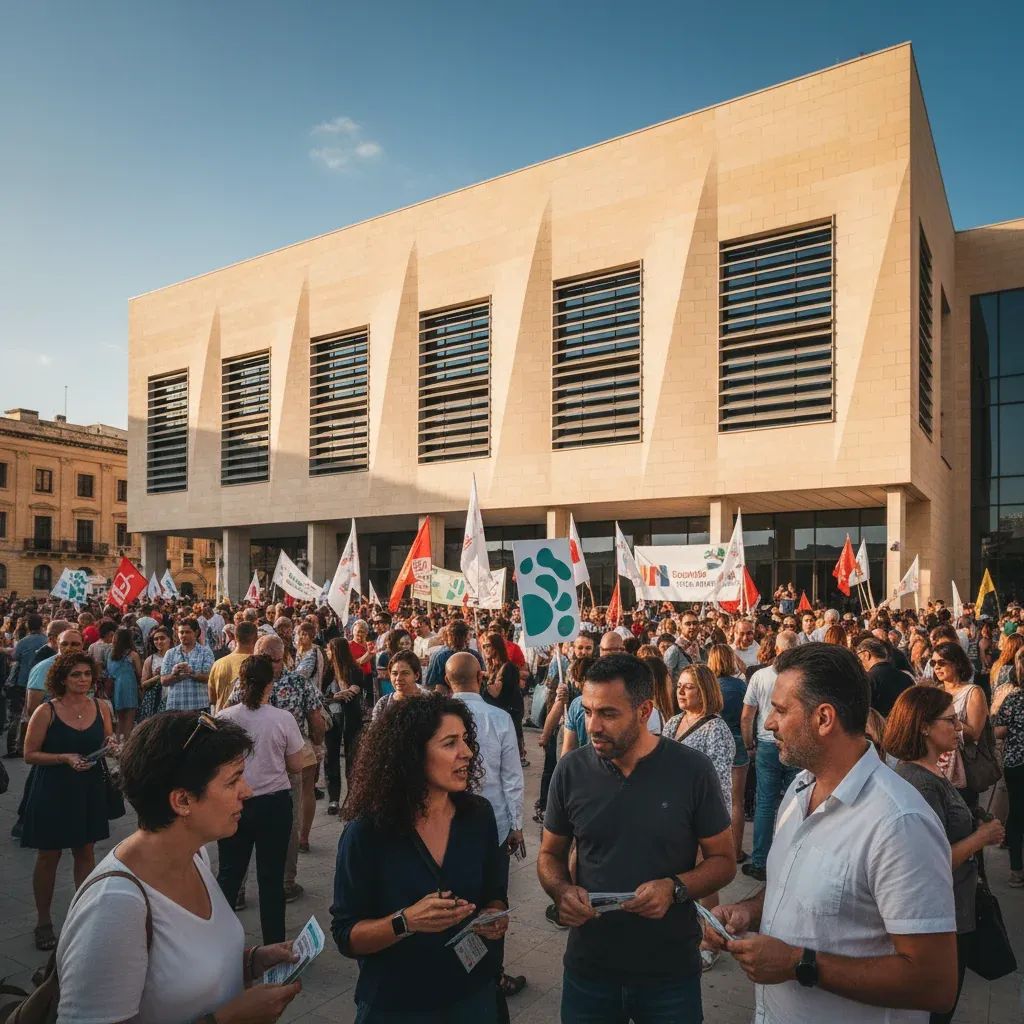
Campus Confrontation Sets Tone for Final Countdown
The Malta general election entered a new phase on May 18 when five party leaders convened at the University of Malta's Sir Temi Zammit hall for a significant pre-election campus debate. With voters heading to the polls on May 30—just 12 days away—the debate crystallized competing campaign visions centered on whether Prime Minister Robert Abela and the Labour Party could retain government or whether Opposition Leader Alex Borg and the Nationalist Party could engineer a late surge after 13 years in opposition.
The campus setting delivered exactly what Maltese political observers had come to expect: boisterous student participation, enthusiastic applause for favored speakers, and sharp heckling of opponents. The atmosphere underscored genuine youth engagement with political questions that dominate daily life for younger Maltese residents: housing affordability, traffic congestion, and whether economic growth has genuinely benefited ordinary families.
Why This Matters:
• Economic models clash directly: The two major parties present fundamentally different visions for growth and prosperity
• Housing crisis takes centre stage: Both Labour and the PN have pledged targeted schemes to support first-time buyers facing high property costs
• Smaller parties force uncomfortable questions: ADPD/Momentum challenges development-focused policies; Aħwa Maltin centers immigration concerns
• Polling remains competitive: Campaigns often tighten in final weeks, and youth voter preferences in marginal districts could prove decisive
• Transportation divides: Parties propose contrasting solutions to Malta's notorious traffic congestion
Labour and Nationalist Visions: Growth vs. Quality of Life
Prime Minister Abela has positioned his campaign on economic continuity and expansion. Labour's platform promises support for workers, expanded family benefits, and investment in emerging sectors including artificial intelligence and digital innovation. The party projects sustained economic growth and argues that higher-value industries can simultaneously address housing pressures and congestion by reducing dependence on construction-led development.
Labour's approach to the housing crisis includes a first-time buyers scheme designed to ease market entry for younger Maltese. The party emphasizes its track record on wages, pensions, and energy price management as justification for voter trust.
Opposition Leader Borg counters that economic growth divorced from lived experience rings hollow for families struggling with traffic paralysis, overburdened services, and soaring property costs. The Nationalist Party's campaign platform targets younger voters and argues that workers are "working harder to afford worse lives" despite low unemployment. The PN has pledged targeted interventions on tax policy and housing support, emphasizing direct relief from monthly financial pressures.
Both major parties have signaled commitments to easing the housing affordability crisis, though their proposed mechanisms differ. The PN has emphasized tax relief for younger workers alongside mortgage support; Labour has highlighted expanded state support for families alongside its lending scheme.
On transportation, the parties present contrasting philosophies. Labour has proposed infrastructure improvements including a rapid transit system; the PN has criticized current conditions without fully articulating a comprehensive alternative strategy.
Energy policy represents another point of divergence. The PN has pledged to reduce electricity costs; Labour emphasizes price stability under its government. Economists have noted that some claimed savings targets lack detailed implementation mechanisms.
When Smaller Voices Reshape the Debate
Arnold Cassola (Momentum), Sandra Gauci (ADPD), and Paul Salomone (Aħwa Maltin) used their platform to present alternatives to the two-party consensus that has dominated Maltese politics since independence.
ADPD and Momentum, running as an environmentalist coalition, have positioned themselves as advocates for stricter planning controls and environmental protection. The coalition has called for revised development policies and argues that construction-led growth models are inherently unsustainable. Their platform proposes corporate tax increases rather than cuts and advocates for workplace policy changes including reduced working hours.
Aħwa Maltin's platform represents a different political space. Under the banner "Malta Għall-Maltin" (Malta for the Maltese), the party has centered its campaign on immigration policy concerns and demographic change. The party argues that labour market policies should prioritize Maltese applicants and has proposed restrictions on non-EU work permits—positions that represent significant departures from current practice. While electoral success remains uncertain under Malta's proportional representation system, the party's presence signals growing voter concern about migration and demographic change.
Campaign dynamics have included broader political culture issues. The debate also surfaces ongoing tensions around identity politics and voter expectations for respectful campaign discourse.
Three Fault Lines That Will Determine the Winner
The May 18 debate exposed three structural divides shaping this election.
First: Housing and Generational Economics. Both Labour and the Nationalist Party have pitched schemes to ease first-time buyers into a market where entry prices feel unattainable to young professionals. Labour emphasizes expanded state support across family and housing needs. The PN emphasizes tax relief and direct mortgage assistance. Young voters must weigh competing approaches to immediate cash flow relief versus longer-term state support infrastructure. Neither major party has fundamentally questioned whether current development patterns will yield genuinely affordable housing—an issue ADPD has raised more directly.
Second: Transport and Quality of Life. Labour's infrastructure proposals compete with different visions for reducing congestion. ADPD has advocated for transit models emphasizing reduced car dependency rather than accommodating existing patterns. The PN has criticized current conditions without articulating a comprehensive alternative. For voters experiencing daily gridlock, this represents perhaps the clearest choice between competing philosophies: accelerate existing infrastructure or redirect fundamentally toward different mobility patterns.
Third: Economic Model and Sustainability. Labour's vision assumes Malta can address congestion and housing pressures through higher-value industries and digital innovation. The PN's rhetoric emphasizes productivity gains and relief from current burdens. ADPD argues both positions underestimate sustainability challenges and that Malta requires more fundamental policy reorientation. This represents not merely implementation differences but core philosophical divides about whether the current economic model can be reformed or requires deeper restructuring.
The Election Within the Election
With 163 candidates filed across 13 electoral districts, voters enjoy genuine choice. Yet polling consistently indicates this remains fundamentally a two-party race, though campaign dynamics can shift in final weeks.
The campus tradition of engaged student participation continued on May 18, serving as both political theater and genuine marker of youth political involvement. Student voters, disproportionately concerned about housing affordability and employment prospects, will likely prove decisive in marginal districts. Whether Labour's economic expansion promises or the PN's targeted relief resonates more powerfully will emerge only when ballot boxes close on May 30.
The smaller parties measure success differently. ADPD and Momentum hope to influence policy directions even without securing government. Aħwa Maltin seeks to establish itself as a permanent political fixture. All three aim to normalize discussion of issues—environmental policy, development strategy, immigration control—that neither major party campaigns on prominently but voters increasingly demand.
For Maltese residents, the core choice remains between Abela's growth-centered approach and Borg's alternative vision emphasizing immediate quality-of-life improvements. This wager—whether pursuing incremental adjustments to existing economic patterns beats admitting the model requires deeper reformation—may define Malta's trajectory for the next 13 years. Only the May 30 ballot will reveal which message resonated most powerfully with voters navigating high housing costs, traffic congestion, and questions about whether the island's prosperity genuinely benefits ordinary families.


