
Why This Matters
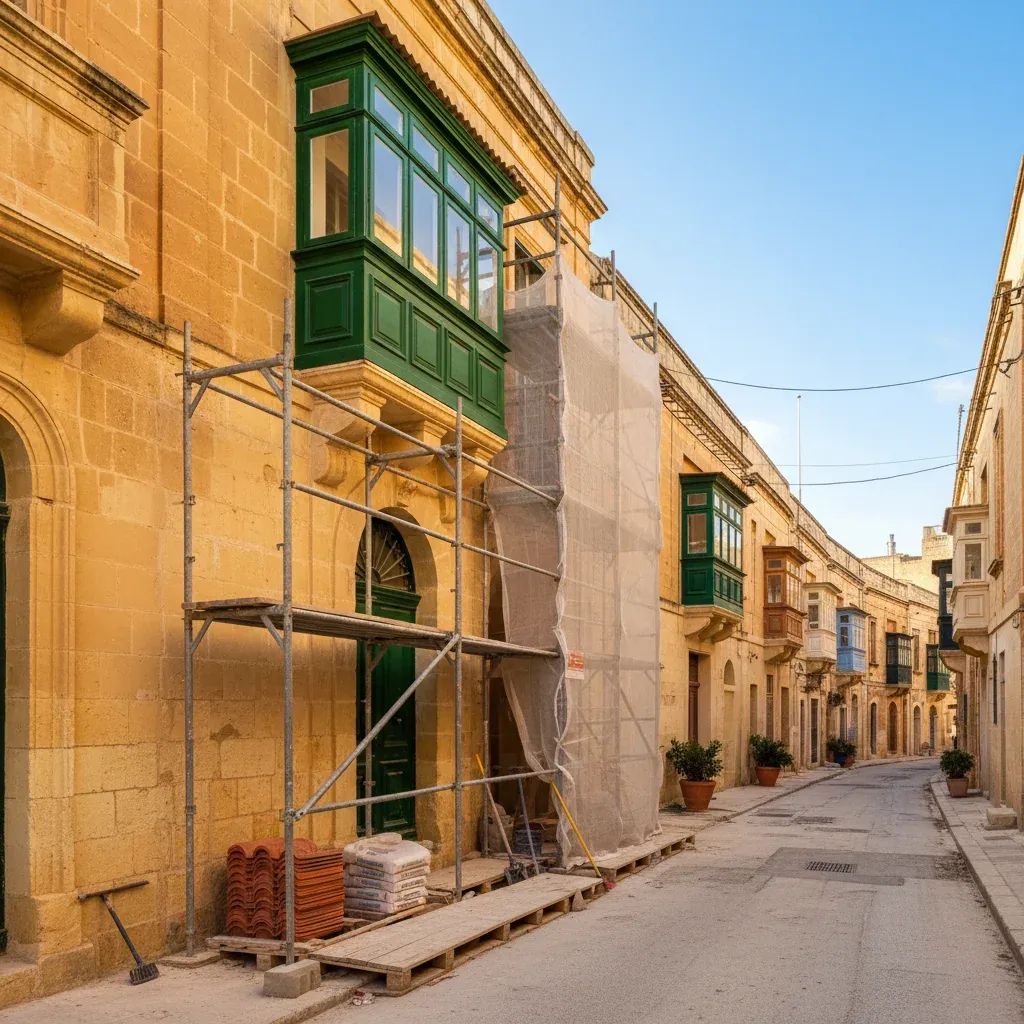
• Work resuming soon: Contractors are mobilizing to restart construction across Ħal Farruġ (Luqa), Bormla, and other sites following binding financial approval in late March 2026.
• Three-year setback for Luqa: The flagship 267-unit development is now targeted for December 2028 completion instead of January 2026—meaning families on waiting lists face extended delays.
• Governance under scrutiny: The National Audit Office is investigating Malita over cost inflation, unpaid contractor claims exceeding €624,000, and governance concerns.
• Financial lifeline secured: A sanction letter (a binding financing commitment from a bank)—potentially including Bank of Valletta with government backing—provides several million euros to resume works.
The Restart and What Triggered It
After months of financial paralysis, Malita Investments—the quasi-public developer managing Malta's affordable housing portfolio—has cleared a critical hurdle. In late March 2026, the company announced a binding financing commitment through a formal sanction letter, a significant step beyond indicative loan proposals that had been under negotiation.
The specifics remain opaque. Neither Malita nor the government has disclosed the exact loan size, the lending bank's identity, or all conditions attached to the facility. However, industry sources and public filings suggest the package likely involves several million euros and may feature Bank of Valletta participation, contingent on government guarantees that are still being finalized under European state aid rules.
This breakthrough arrives after a brutal 18 months. In November 2025, Malita ground construction to a halt across three major sites, citing acute liquidity pressures. The pause left dozens of contractors unpaid, including two firms with documented claims totaling over €624,000 for completed work—a significant sum that suggests deep cash-flow problems rather than routine payment delays. For the roughly 750–800 families on the company's waiting list—many facing precarious rental situations or income instability—the freeze felt like a broken promise.
The stoppage also exposed structural vulnerabilities within a government entity designed to solve a social crisis. Malita was originally conceived as a financing vehicle for large public infrastructure, but its mandate had gradually narrowed to social housing. When liquidity evaporated, the company lacked operational flexibility to navigate the gap between expenditure and available cash.
Malita's Track Record
To appreciate why this financing announcement matters, consider Malita's original ambitions versus current reality. The company was allocated 14 sites across 11 localities in 2017 with a target of approximately 750–768 apartments. By mid-2025, 392 units had been handed over to tenants across various locations. That leaves roughly 360–376 units still in the pipeline—a substantial remainder, but progress has been uneven.
Most of Malita's smaller projects outside Luqa were reported complete by 2022, yet some units in Bormla remained idle despite occupants receiving allocation notices as far back as 2022. The Luqa development alone—comprising three residential blocks with 267 dwellings and representing the company's flagship initiative—was supposed to finish in January 2026. The revised target of December 2028 represents not a minor scheduling slip but a decisive abandonment of the original timeline.
This matters because affordable housing in Malta is not a marginal policy concern. Rental costs consume an outsized share of disposable income for lower and middle-income households, particularly in urban areas around Valletta, Sliema, and the Three Cities. When a developer earmarked specifically to address this pressure falters, the human cost accumulates—families deferring life decisions, renters absorbing price increases, and a visible gap between policy intention and delivery.
How Malita's Housing Model Works—and Why It Requires Scrutiny
Unlike traditional public housing schemes, Malita's approach is distinct in its mechanics. Apartments are leased at commercial market rates, not subsidized rents. The mechanism that makes them "affordable" is the intervention of the Housing Authority, which conducts means-tested assessments (income checks to verify eligibility) and provides direct subsidies to eligible occupants.
This design offers flexibility: if a tenant's income rises sufficiently, the subsidy can be withdrawn and redirected to another applicant on the waiting list. In theory, this targets resources to those with the most acute need. In practice, it introduces administrative complexity and creates periodic tenant churn—households moving out when subsidies end, necessitating reassignment cycles.
By contrast, social housing in established democracies typically anchors affordability through rent-setting formulas rather than subsidy mechanisms. In Scotland, rents are set as a percentage of market rate and capped by law, while in England, social rent typically ranges from 50–60% of market. This creates tenant certainty and simplifies administration.
Malita's subsidy-driven model is not inherently inferior, but it demands transparent eligibility criteria, robust income verification, and consistent audit oversight—precisely the governance elements now under investigation by the National Audit Office.
The Governance Crisis Beneath the Surface
The financing announcement, while necessary, does not resolve the institutional turbulence that precipitated the crisis. In November 2025, the Public Accounts Committee formally requested a National Audit Office investigation into Malita, citing concerns over cost overruns, contractor payment failures, and governance lapses. By January 2026, the NAO had launched the formal probe.
Marlene Mizzi, Malita's former chairperson, publicly alleged that political interference influenced board decisions and that she was removed after raising governance concerns. Malita's board has denied these claims, attributing its woes to external economic factors. Regardless of the precise cause, the reputational damage is real. Leadership turnover in late 2025 and early 2026—including new appointments for CEO and CFO roles—signals organizational disruption.
The NAO investigation remains ongoing. Its eventual findings will carry weight beyond Malita itself; they could reshape how Malta structures and oversees quasi-public entities entrusted with essential infrastructure. If the audit identifies systematic mismanagement or political capture, it may trigger legislative reforms governing public company boards, tender processes, and contractor payment schedules.
What Happens Now: The Practical Timeline
Malita Investments is currently negotiating restart terms with contractors. Works are expected to resume "in the near term," contingent on final conditions being satisfied—language that, given the company's recent history, warrants skepticism.
The Ministry for Social and Affordable Accommodation and the Social Housing Ministry have publicly welcomed the financing announcement, reaffirming housing as a national priority. Both ministries have incentive to expedite delivery; unfilled social housing units represent political vulnerability, particularly as rental inflation persists in Malta's private market.
However, the path to completion remains fraught. Three years of slippage on the Luqa project, unfinished units languishing in Bormla, contractor litigation still winding through courts, and the shadow of an ongoing audit all indicate that delivery risk remains elevated. Families on waiting lists should not expect a smooth path to occupancy.
If You're on the Waiting List
If you're currently waiting for Malita housing, here's what you should know:
• Verify your position: Contact the Housing Authority directly to confirm your place on the waiting list and whether your circumstances have changed since your initial application.
• Monitor for updates: Malita and the Housing Authority typically communicate allocation decisions by post. Expect delays, but watch for formal notification of any movement toward occupancy.
• Explore alternatives: While waiting, enquire with the Housing Authority about alternative social accommodation schemes or rental support programs that may alleviate immediate housing pressures.
The government faces pressure to deliver on this revised timeline. European Investment Bank funds—€22 million for Luqa alone, plus the earlier €53.7 million facility from 2017—are already committed. If Malita fails to meet the 2028 deadline, questions about public management competence will intensify. For prospective tenants, the promise of affordable accommodation hinges on effective project governance, transparent administration, and timely execution—a combination Malita has struggled to consistently demonstrate.


