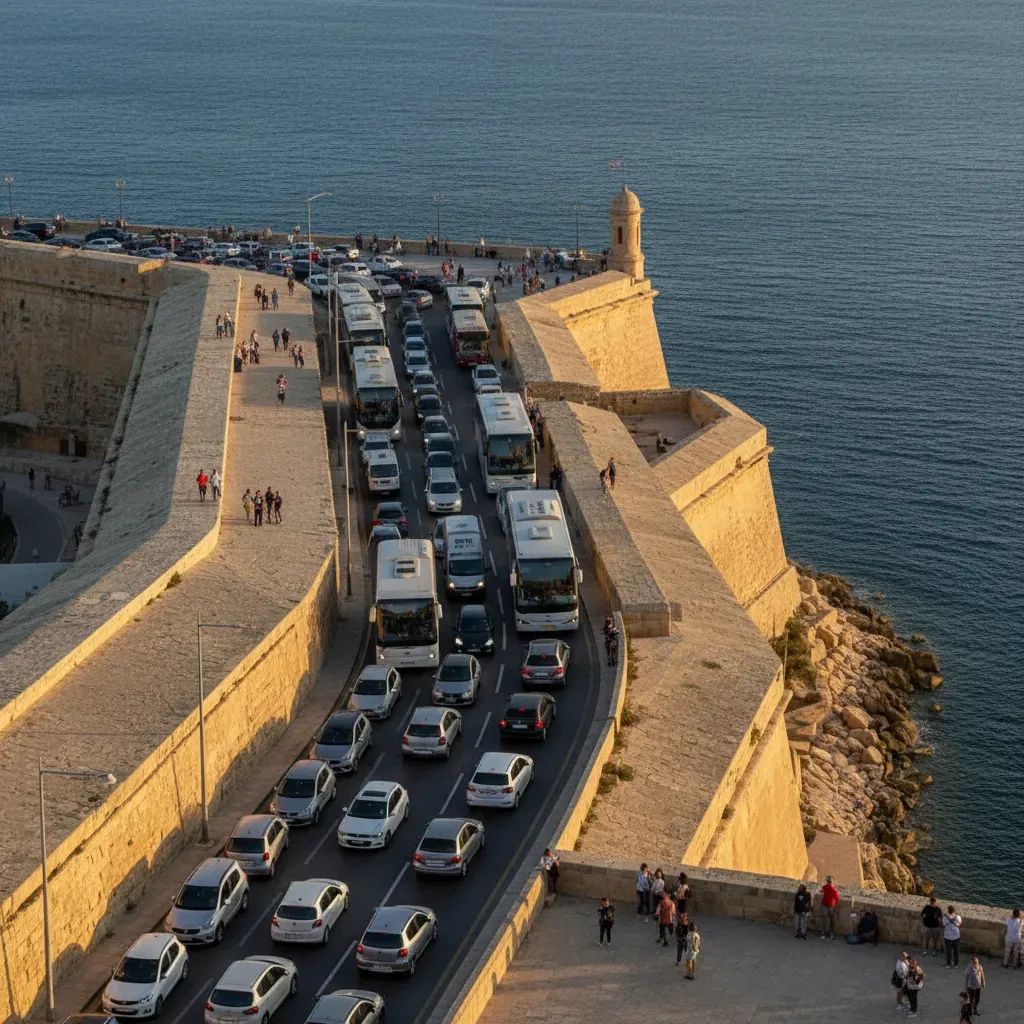
Europe's most overcrowded island asks what comes next
Mainland Malta has become Europe's most overcrowded island, registering 38,777 overnight stays per square kilometre — a density that surpasses Lanzarote and Ibiza combined. The figure comes from a study by BookRetreats.com based on European Commission data, and it underpins a growing consensus: the islands are straining under visitor numbers that resident infrastructure was never built to sustain.
The numbers behind the strain
Malta is on track to welcome over 4.7 million tourists by the end of 2026, a record that would shatter previous benchmarks. July alone saw 489,728 arrivals — a 50 per cent jump compared to July 2023. The early months of the year followed the same trajectory: February recorded an 18.5 per cent rise in arrivals over February 2025, with January and February combined showing a 19.9 per cent year-on-year increase.
The concentration is not abstract. Tourists add an average of 46,918 persons to Malta's resident population, pushing the effective headcount to 615,763. Tourism intensity reached 8.2 tourists per 100 residents in 2024, spiking to 14.2 in August. In San Ġiljan, that figure reached 126.4 tourists for every 100 residents at peak season.
A poll conducted in April 2026 found that 45 per cent of residents consider tourist volumes “excessive.” In hotspots like St. Paul's Bay, Mellieħa and Gozo, that sentiment rises above 57 per cent.
What breaks when capacity is exceeded
Infrastructure complaints have moved from anecdotal to systemic. Residents report buses running at full capacity year-round, ferry queues to Gozo stretching for hours, and frequent power cuts during peak demand. Sewage overflows near beaches have become a recurring headline, and the Blue Lagoon in Comino has seen daily crowds reach 12,000 during summer — triple the 4,000-person cap authorities introduced after sustained pressure.
ADPD Chairperson Sandra Gauci stated in July 2026 that "Malta cannot take on more 'unchecked' tourism growth," arguing that the negative impacts are "cancelling out the benefits." She cited deteriorating beach quality caused by drainage systems that cannot cope with the swell in population.
The policy shift underway
In April 2026, the Maltese government introduced the most significant regulatory overhaul in years. New rules cap hotels at 200 rooms, limit guesthouses to 20 rooms or 40 beds, and bar hostels from exceeding 40 beds. Height limitation allowances for hotels have been removed for future developments, and one- and two-star hotels are no longer favourably considered — particularly in Outside Development Zones.
Short-term rental operators must now affix a license number and 24/7 contact details to their property exteriors, inform residential block administrators of their status, and submit waste management plans. Harsher penalties now apply to unlicensed operations.
A new penalty system also targets antisocial visitor behaviour: walking in swimwear through city centres, damaging heritage sites, or creating excessive noise in residential areas can trigger on-the-spot fines.
Where the strategy falls short
Critics say the measures do not go far enough. The regulations apply only to new builds and conversions, doing little to address existing saturation. Emmanuel Galea, a tourism industry veteran, noted in September 2026 that Malta's strategy still lacks clear benchmarks for “quality,” making it difficult to gauge success. He proposed measuring performance through local spending retention, seasonal spread, geographic distribution and behavioural impact.
Data supports his scepticism: while aggregate tourist spending rose in early 2026, average expenditure per visitor declined, as budget airlines brought higher volumes but lower individual contributions.
What Mediterranean neighbours are doing differently
Croatia has capped cruise ship arrivals in Dubrovnik to two per day and introduced timed entry systems for its Old Town. Ibiza has placed seasonal restrictions on non-resident vehicles and raised a sustainable tourism tax to fund water and energy infrastructure. Portugal is promoting “slow tourism” and reinvesting tourism revenue into community projects.
All three destinations are moving away from growth-at-all-costs models toward strategies that protect residents' quality of life — a direction the Malta Hotels and Restaurants Association now endorses. The MHRA has called for an end to tourism funding for commercially established party events, arguing that such funding should instead support initiatives offering lasting value to local communities.
What residents actually face
Community groups describe a year without a true low season. Residents complain of constant noise, litter, and the feeling of being "strangers in their own country." Housing costs have risen as residential properties convert to short-term lets, and public spaces are increasingly encroached upon by commercial activity.
The Ministry for Foreign Affairs and Tourism is coordinating pilot projects in Valletta and Swieqi this summer to tackle tourism-related pressures, with plans to expand if successful. The Malta Tourism Authority has also realigned its marketing budget to prioritize cultural and heritage events during off-peak months.
What happens next
The government's Vision 2050 targets 4.5 million annual visitors by 2035, while insisting on a shift toward high-value tourism. New direct flights to New York began in June 2026, aimed at attracting higher-spending markets. The Malta Tourism Observatory continues to monitor trends across environmental, economic and social indicators, though no hard national carrying capacity limit has been set.
For now, the question Noel Muscat posed — who is delivering the "mortal blow" to tourism — has been answered by the data. The counterpart question, whether policy can outrun the consequences, remains open.