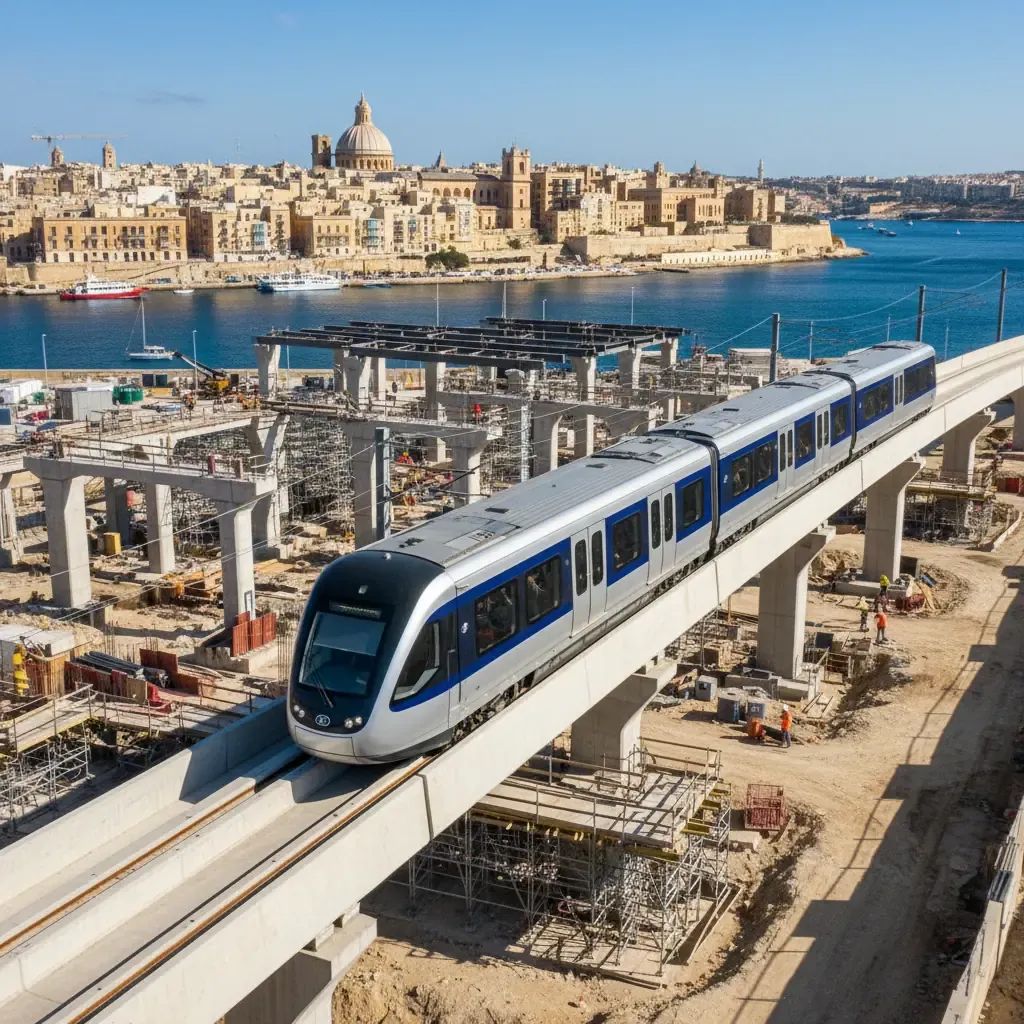
Malta's government has committed €2.8 billion to a light rail project designed to reshape the island's transport landscape over 15 years. The project will not deliver passenger services until 2036—a full decade away—and its success depends on encouraging a car-dependent population to shift travel habits without implementing congestion pricing or parking fees that have proven effective in other Mediterranean cities.
Why This Matters
• First services launch in 2036. Construction begins in May 2031, meaning residents will experience another 5+ years of current traffic conditions before any operational relief, followed by 3-4 years of roadwork disruption during construction.
• Geographic coverage creates accessibility challenges: The route connects St Paul's Bay to Malta International Airport via Valletta, Qormi, Mater Dei Hospital, and the University of Malta. However, Sliema, St Julian's, and Gżira—home to over 80,000 residents and a major employment center—will rely on feeder buses to Mater Dei Hospital to access the rail network. Southern towns including Tarxien, Marsa, Paola, and Żejtun face even longer connections via the airport terminal.
• Funding mechanism remains unclear: The €2.8 billion sits outside government budget forecasts through 2029. Officials have not publicly disclosed whether the state absorbs all costs, private partners co-invest, or passenger fares will be introduced—each scenario has different implications for household transport budgets.
• Geology testing begins this spring: Drilling starts May 4, 2026 in Floriana and May 11 in Qormi. Underground infrastructure costs approximately 10 times more than surface-level alternatives. Results will significantly influence final route configuration and project costs.
The Geological Testing Phase: Critical First Step
Transport infrastructure in Malta faces a fundamental constraint: geology determines feasibility before any other factor. Malta's limestone composition presents both opportunities and risks. The core sampling tests launching this May in Floriana and Qormi are essential technical work that will determine whether construction costs remain within projections or require substantial revision.
The cost difference is significant. Elevated monorail or at-grade rail typically costs €40–60 million per kilometer in comparable Mediterranean contexts. Underground tunnels and stations approach €600 million per kilometer. This explains why planners are working to minimize subsurface construction. Yet dense urban areas like Valletta—where surface disruption would significantly impact residents and businesses—may require tunneling regardless of cost.
A previous experience offers context. When the Malta Transport Authority previously examined burying vehicular traffic beneath Floriana's St Anne's Street, geotechnical surveys revealed limestone with fractures and water saturation unsuitable for excavation. If similar conditions emerge along the proposed La Valette corridor, the route configuration—affecting ridership potential, construction disruption, and costs—could require significant adjustment. The €800 million contingency buffer, roughly 40% of total project cost, reflects the acknowledgment that geological findings may necessitate design modifications.
ARUP, the international engineering consultancy leading design, will complete 18 months of drilling analysis by late 2027. Detailed design work follows through 2029. Environmental approvals and procurement run through 2032. This timeline represents a more detailed approach than previous proposals, with specific technical milestones and measurable outcomes.
Route Configuration and Station Access
The La Valette Line spans 24 kilometers from St Paul's Bay southward to Malta International Airport. Confirmed anchor points include Valletta, Qormi, Mater Dei Hospital, and the University of Malta. Officials have indicated that additional stops will be added as design develops, though specific locations remain under review. Station placement depends on geological viability combined with practical factors including property acquisition, neighborhood engagement, and construction logistics.
The proposed route configuration creates both coverage and accessibility considerations for residents. For those in Sliema, St Julian's, and Gżira, the nearest rail connection at Mater Dei Hospital requires a feeder bus ride. Residents in southern areas like Tarxien, Marsa, Paola, and Żejtun would travel via the airport terminal to access the system. These distances mean that private vehicles will likely remain faster for many daily trips, particularly during off-peak hours when bus frequency is lower.
To address this, Mizzi Studios and ARUP propose an integrated transport ecosystem: a redesigned bus network launching in 2030 will deploy smaller, more frequent feeder buses connecting urban centers to rail stations and ferry terminals. Expanded maritime services from Buġibba and Marsascala will provide north-south alternatives. Enhanced pedestrian and cycling corridors will support car-free access to stations.
This multimodal approach requires coordinated execution across multiple systems. Comparable projects elsewhere show mixed results. Jerusalem's Light Rail moves 130,000 daily passengers, partly because it genuinely reduces travel times compared to driving. Lisbon and Barcelona paired metro expansion with parking restrictions and central zone pedestrianization. Zurich uses demand-based parking pricing. These cities typically combined infrastructure investment with measures that made private car use less convenient or more expensive.
Malta's government has not indicated plans for on-street parking fees, congestion charges, or significant road-space reallocation. This means the rail system, buses, ferries, and cycling must compete against cars based on convenience and speed alone—without the cost penalties that typically accompany modal shift in successful transport systems.
What This Means for Malta Residents
Timeline expectations: Residents will experience current traffic conditions until 2031, then 3-4 years of construction disruption. Any meaningful travel-time improvements depend on passenger service beginning in 2036 and the integrated bus network redesign launching in 2030.
Access from your neighborhood: For residents in Sliema, St Julian's, Gżira, and southern towns, the feeder bus connection adds journey time. The effectiveness of this connection depends on the 2030 bus network redesign delivering reliable, frequent service. Current gaps in bus timetabling and frequency make this a variable outcome.
Property and development: Areas near proposed stations—Valletta, Qormi, Mater Dei, and the University—may experience changes in property values and local development patterns. Property acquisition for the rail corridor may affect some homeowners; authorities will conduct public consultations as design progresses.
Travel costs: The government has not yet decided whether passenger fares will be charged. Currently, buses and ferries are free. If fares are introduced, household transport budgets will be affected; if services remain free, the state will absorb operational costs through taxation.
Finance Minister Clyde Caruana has previously raised questions about the project's fiscal sustainability. The absence of appropriations from government revenue forecasts through 2029 indicates that the funding mechanism remains under discussion within government.
Car Dependency and Transport Culture
Malta's vehicle ownership rate—approximately 600 cars per 1,000 residents—ranks among Europe's highest. This reflects decades of car-oriented urban planning, historically affordable fuel, and minimal parking enforcement. Transport culture is deeply embedded in daily routines and infrastructure design.
Transport Minister Chris Bonett has characterized the project as offering "viable alternatives" to car travel rather than imposing penalties on drivers. This approach reflects political considerations: infrastructure referendums and transport initiatives gain public support when tangible disruption remains distant. The current timeline places construction disruption from 2031 onward, allowing several years of public discussion and adaptation before residents experience roadwork impacts.
Successful transport modal shifts in other European cities typically combined new infrastructure with disincentives for car use: London reduced road capacity for vehicles while expanding transit; Barcelona restricted parking and expanded pedestrian zones; Lisbon paired metro expansion with parking management. These measures created meaningful cost or convenience advantages for transit use.
Without similar measures in Malta, the light rail, enhanced buses, ferries, and cycling routes must compete against cars based on speed and convenience alone. Research from comparable cities suggests this is challenging. Metropolitan areas with metro systems typically achieve a 37% car-trip share, compared to 54% in car-dependent regions. That shift usually occurs when paired with parking or congestion cost policies.
Implementation Timeline and Government Commitment
The project schedule includes specific phases: geological studies through 2027, detailed design and planning through 2029, environmental approvals and procurement through 2032, construction beginning in 2031, and phased passenger service opening through 2041.
This structured timeline represents a more granular commitment than earlier transport proposals for Malta. Previous initiatives, including a 2021 metro concept, did not reach implementation. Electoral cycles every five years mean that successive governments will inherit and potentially reshape earlier commitments. The light rail's success depends on consistent political support across multiple administrations.
Public concern about traffic congestion ranks consistently high in polling. Residents have expressed strong support for transport improvements that reduce gridlock. However, public tolerance for disruption has limits, particularly if construction timelines slip, costs increase significantly, or if the completed service does not deliver meaningful travel-time improvements.
What Residents Should Know Going Forward
As geological testing begins this spring, residents near Floriana and Qormi may notice drilling activity and temporary traffic adjustments. Public consultations on route refinements will follow in coming months, offering opportunities for neighborhood input on station placement and local impacts.
Property owners near the proposed corridor should monitor government announcements regarding land acquisition and compulsory purchase processes. The government typically provides consultation and compensation frameworks for such acquisitions.
The 2030 bus network redesign will affect current routes and schedules. Residents currently using bus services should expect notification of changes as that project develops.
For households planning long-term decisions—relocation, property purchase, or transport investments—understanding the light rail timeline and feeder bus redesign helps inform choices. Properties near stations may see development pressure; neighborhoods farther from rail access will depend on bus connectivity.
The Broader Challenge
The project represents Malta's most substantial infrastructure commitment to public transport in decades. Its success requires several elements to align: geology must cooperate, costs must remain manageable, bus network redesign must deliver reliable frequent service, residents must shift travel patterns, and political commitment must persist across electoral cycles.
International experience suggests that infrastructure alone rarely transforms transport culture without accompanying measures that increase car-use costs or reduce car convenience. Whether this project can achieve meaningful modal shift through infrastructure and service quality alone remains an open question. The drilling beginning this month will provide the first technical answer. The political and behavioral answers will emerge over the next 15 years.