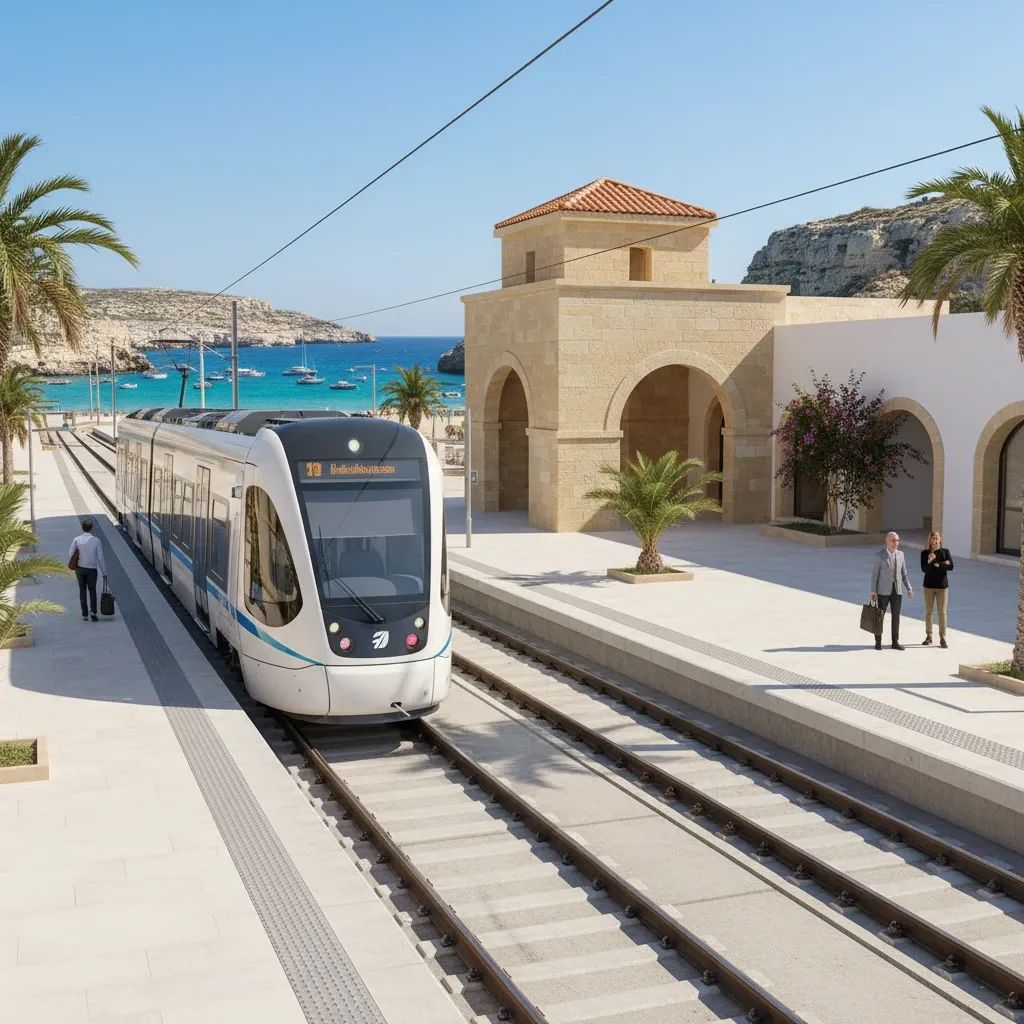
The Malta Ministry of Transport has formally unveiled the La Valette Line, a €2.8 billion hybrid light rail project slated to link St Paul's Bay to Malta International Airport over the next 15 years. The initiative resurrects a transport mode that vanished from the archipelago nearly a century ago—a calculated gamble on reducing private car dependency in a nation where road congestion has outpaced infrastructure capacity.
Why This Matters:
• Geological testing starts May 4 in Floriana, signaling the project's shift from concept to physical assessment.
• €1.8 billion allocated for construction, with the airport-to-Valletta segment expected to break ground in the early 2030s.
• Travel time reduction: The rail system promises under 10-minute waiting intervals and seamless integration with bus hubs and park-and-ride facilities.
• Historical echo: Malta's original railway operated from 1883 to 1931 before succumbing to bus competition—a cautionary tale for planners today.
The Ghost Railway That Still Haunts Policy
Malta's first railway, affectionately called "il-vapur tal-art" (the land ship), ran a modest approximately 11 km (7 miles) single track from Valletta through Floriana, Hamrun, Birkirkara, and Balzan before terminating in Mdina and later Mtarfa. When it debuted on February 28, 1883, the line slashed the three-hour carriage journey from Mdina to Valletta down to 25 minutes—a revolution for residents of the old capital and surrounding villages.
Yet the Malta Railway's triumph was short-lived. Trams launched in 1905, buses gained traction in the 1920s, and the railway's finances hemorrhaged. The original operator, Malta Railway Company Ltd., collapsed in 1890, forcing the Malta Government to nationalize and reopen the line in 1892. An extension to the Mtarfa barracks debuted in 1900, serving wounded soldiers during World War I, but by 1931 the railway ceased operations entirely. The tram network followed in 1929. Both fell victim to the flexibility and lower capital costs of motor buses.
Today, the Birkirkara station building houses the Malta Railway Museum, opened in November 2023, displaying the sole surviving original carriage. Station remnants dot the countryside, and the Valletta tunnel once served as an air-raid shelter during World War II—a stark reminder that infrastructure outlasts the vehicles that use it.
What This Means for Residents
Malta Transport Minister Chris Bonett unveiled the "Malta in Motion" plan on April 23–24, 2026, branding it as the largest infrastructure undertaking in the nation's history. For residents, the practical implications unfold in phases:
• 2026–2027: Geotechnical coring in Floriana (May 4) and Qormi to assess bedrock stability. No service disruptions expected, but localized roadworks likely.
• 2027–2029: Detailed design and planning. Public consultations on station locations and route alignment—expect community meetings in affected parishes.
• 2029–2032: Environmental approvals and procurement. Property acquisition along the 24 km corridor may trigger compensation negotiations.
• Early 2030s onwards: Construction of the airport-to-Valletta segment, estimated to take three to four years. Expect lane closures, noise, and phased station openings.
• By 2041: The full line to St Paul's Bay operational, with stops at Qormi, Mater Dei Hospital, Valletta, and the university.
The system will blend underground, street-level, and elevated sections, designed by Arup alongside Maltese firm Mizzi Studios. Stations will integrate with Tallinja bus routes, creating mobility hubs where passengers can switch modes without duplicating fares. Park-and-ride facilities at peripheral stations aim to intercept car commuters before they clog Valletta's narrow streets.
Buses, Ferries, and Bikes: The Integrated Bet
The railway is only one pillar of the "Malta in Motion" framework. Transport Malta CEO Kurt Farrugia emphasized that buses will remain the backbone, particularly as the current bus concession expires in 2029—a natural reset point for network redesign.
Malta Public Transport operates 121 routes and 1,974 stops, with the Tallinja app offering real-time tracking. In April 2025, the network added 400 daily trips and introduced new routes in underserved residential zones. Four additional night routes launched on April 5, 2026, addressing shift workers' complaints about stranded late-night journeys.
Ferry services between Malta and Gozo carried 7.3 million passengers in 2025, up from 6.8 million the prior year. A consistent fast ferry service introduced in late 2024 halved commute times compared to traditional crossings. The Valletta fast ferry terminal, damaged by Storm Harry, reopened in April 2026. To meet demand, two additional ferries (a 250-car vessel and a 75-car vessel) will join the fleet in early 2029, alongside port infrastructure upgrades at Mġarr.
Cycling infrastructure is also expanding. The Grand Harbour cycling network—connecting Msida, Pietà, Blata l-Bajda, Valletta, and the Waterfront—enters its final stretch, with Phase 1 due by July 2026. The government has committed to 50–60 km of dedicated, segregated routes islandwide, linking green spaces and employment hubs.
Financial incentives for electric cars and e-bikes debuted in 2026, though free public transport has yet to trigger a mass shift away from private vehicles—a reality that underscores the challenge facing the La Valette Line.
The €2.8 Billion Question
The rail system's €2.8 billion price tag (€1.8 billion for construction alone) dwarfs Malta's annual transport budget. Critics point to the 1883 railway's demise as a cautionary tale: even a beloved service can't survive if it fails to adapt to competition. Buses killed the original railway because they offered door-to-door flexibility without the capital intensity of fixed track.
This time, planners are betting on integration rather than competition. The La Valette Line won't replace buses—it will anchor them. High-capacity, high-frequency rail (sub-10-minute waits) handles the densest corridors, while buses feed passengers into stations and serve lower-density neighborhoods. Ferries relieve pressure on the Marsamxett and Grand Harbour crossings, and cycle lanes offer last-mile solutions.
But the 15-year timeline exposes residents to prolonged uncertainty. Property values along the route may fluctuate, businesses near construction zones face disruption, and the risk of cost overruns looms. The original railway took twice as long to complete as planned (construction began in 1881, service started in 1883), and its stations never turned a consistent profit.
Historical Parallels and Colonial Echoes
The original railway's route connected the harbours to the old capital and military barracks, serving a colonial logistics imperative. The line climbed 150 meters and crossed 18 level crossings, powered by three Manning Wardle locomotives from Leeds, England, with the fleet eventually growing to 10 locomotives to meet operational demands.
The new La Valette Line shares a similar logic—linking the airport (Malta's economic gateway) to Valletta (the administrative and tourist heart) and extending to St Paul's Bay (a residential and hospitality hub). The difference is scale: today's system must accommodate 7.3 million inter-island ferry passengers in 2025, 121 bus routes, and a car ownership rate that the 1883 planners never imagined.
What Comes Next
Residents in Floriana and Qormi will notice drilling rigs by early May, marking the start of geotechnical assessments. Over the next two years, public consultations will determine station placements, fare structures, and integration protocols with Tallinja. By 2029, the bus concession renewal will lock in the network's architecture, making the rail-bus-ferry nexus a binding reality rather than a policy aspiration.
Success hinges on whether Maltese commuters—already accustomed to free bus travel—will trust a rail system enough to abandon the convenience of private cars. The original railway operated for 48 years before buses replaced it. The La Valette Line must prove it can coexist with, rather than succumb to, the competition.