
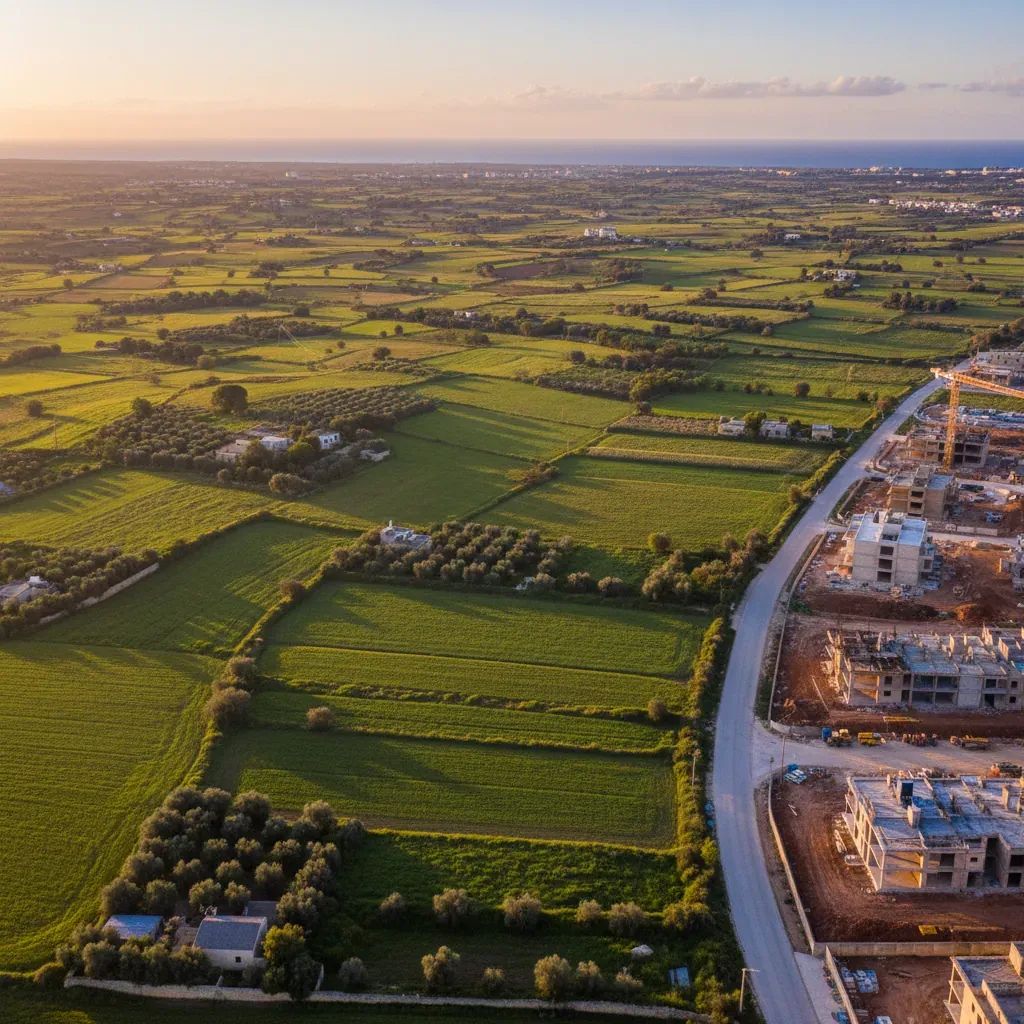
The Malta Planning Authority faces renewed scrutiny over a deepening pattern that environmental advocates claim is effectively monetizing countryside destruction: accepting substantial fines instead of demanding actual removal of illegal construction. The ADPD-Green Party has accused the Maltese government of engineering a "non-stop onslaught" on protected rural areas—what Malta designates as Outside Development Zone (ODZ) land—through policy reforms that critics contend reward speculation dressed as sports development.
Why This Matters
• New policy loopholes: A February 2026 draft permits commercial facilities (supermarkets, malls) to occupy up to 40% of sports project floor space on ODZ quarries, raising questions about enforcement priorities.
• Fine cap ineffective: At least 161 illegal ODZ developments have hit the €50,000 penalty ceiling with no further action taken—some cases unresolved for decades.
• Proposed amnesty scheme: Reforms allow owners to pay €150,000–€600,000 to "regularize" illegal ODZ buildings, potentially generating €200 M in revenue but setting a precedent that countryside violations are purchasable.
The Sports Facility Trojan Horse
At the center of ADPD's latest objections sits a draft policy framework issued in February that theoretically opens ODZ quarries for organized sports use. Organizations registered with SportMalta for at least a decade and lacking international-standard facilities can apply to convert abandoned quarries—but the devil, environmentalists say, resides in the definition of "ancillary."
While the policy reserves 60% of floor area for sporting activity, the remaining 40% is explicitly earmarked for commercial operations: retail outlets, offices, even shopping centers. Within that nominal sports allocation, the framework permits spas, hostels, bars, and restaurants. ADPD argues this construct transforms legitimate athletic need into a vehicle for property speculation, enabling large-scale commercial complexes in zones historically reserved for agriculture and natural landscapes.
The public consultation window closed on March 27, 2026, but the underlying tension—whether Malta prioritizes genuine grassroots athletic infrastructure or developer profit—remains unresolved. Critics note the policy conspicuously omits agricultural land from the list of protected "interests," signaling to farmers and conservationists that even productive cultivation zones may become fair game.
When Fines Replace Enforcement
Malta's existing penalty regime, introduced in 2012, imposes daily fines between €2 and €50—capped at a total of €50,000 per violation. Once that threshold is reached, no additional financial pressure accumulates. The Planning Authority itself has conceded these amounts are "no longer an effective financial deterrent," particularly for so-called "mega developers" for whom half a hundred thousand euros amounts to rounding error on multi-million-euro projects.
By June 2025, official records documented 161 illegal developments sitting at maximum fine exposure with no enforcement escalation, some dating back multiple decades. Under rules codified after May 2008, illegal ODZ construction was theoretically non-sanctionable and subject to mandatory removal; in practice, enforcement actions frequently stall or prove, in the words of critics, "functionally useless" in achieving actual demolition.
The €200 M Regularization Gambit
Reform proposals tabled mid-2025 and expected to reshape enforcement throughout 2026 offer a stark pivot: pay to stay. An illegal 250 m² ODZ structure can secure a "concession"—meaning the Planning Authority ceases enforcement—for roughly €150,000. Full regularization, granting legal status retroactively, doubles that to €300,000. If the property encroaches on a Grade 2 scheduled heritage area, the penalty doubles again to €600,000.
The scheme opens a four-year application window with escalating penalties in the final year. Developments photographed in the Planning Authority's 2024 aerial surveys are excluded, while illegalities predating 1994 become eligible for full legalization at double the concession rate. Revenue from this amnesty—projected to exceed €200 M—will ostensibly feed the Development Planning Fund for restoration and urban embellishment projects.
Environmental coalitions, including Ġustizzja Għal Artna (an alliance of seven NGOs: BirdLife Malta, Din l-Art Ħelwa, Flimkien għal Ambjent Aħjar, Moviment Graffitti, Nature Trust–FEE Malta, Ramblers' Association Malta, and Wirt Għawdex), condemn the framework as a green light for further violations. Their argument: if countryside destruction carries a price tag but not a prison term or bulldozer, developers will simply budget illegality as an upfront development cost.
What This Means for Residents
For Malta's landowners, farmers, and conservation advocates, the revised enforcement landscape poses concrete risks and limited remedies:
• Agricultural viability: Productive farmland adjacent to approved sports-facility quarries may face increased development pressure, noise, traffic, and light pollution, eroding crop yields and property values.
• Precedent creep: A €300,000 regularization fee for a 250 m² building translates to roughly €1,200 per square meter—a figure that pales against high-end residential resale values, incentivizing speculative construction now for regularization later.
• Loss of green corridors: ODZ zones serve ecological functions beyond aesthetics—water percolation, habitat connectivity, temperature moderation. Each sanctioned illegality fragments these networks permanently.
• Transparency deficit: The proposed four-year window operates largely on individual application; there is no public registry yet mandated to disclose who applies, which structures secure amnesty, or how much revenue each municipality generates.
Daily fines are set to rise dramatically under the reform—from €50 to €2,000 per day—but if the cap remains or enforcement resources stay static, the increase may prove cosmetic.
Contested Projects
Beyond the quarry policy, ADPD has flagged multiple recent applications where sports rhetoric overlays commercial intent:
• Application PA/676/22 at Ta' Qali (June 2025) proposed a four-story hotel, shops, restaurants, rugby pitch, football fields, sprint track, and tennis courts on substantial ODZ acreage—a mega-development Moviment Graffitti called purely speculative.
• Application PA/04579/25 in Sant'Antnin, Marsaskala (August 2025) sought a retirement home on agricultural ODZ land under a "social purpose" exemption. Processing was later suspended following ADPD objections.
• Ta' Durumblat, Mosta (March 2026): ADPD warned that a recycled 2019 proposal threatens 40,000 m² of productive farmland—a scheme nearly identical to one rejected nine years prior.
In April 2026, the Planning Authority did reject PA/07170/23, a Marsaskala shopping mall and hotel on ODZ land, following ADPD objections citing traffic congestion and overtourism. That refusal remains an outlier in a regulatory climate many perceive as increasingly permissive.
Alternative Enforcement Models
Environmental coalitions propose harder-edged measures:
• Mandatory physical removal with enforceable deadlines, costs borne by violators rather than taxpayers.
• Suspension of construction during appeals, preventing fait-accompli buildings that courts later declare illegal but cannot economically dismantle.
• Reclassification of agricultural and natural parcels stripped from ODZ status in 2006 but not yet legally committed to development.
• Outright prohibition of sanctioning any post-2008 ODZ illegality beyond minor amendments.
• Third-party enforcement standing, allowing NGOs to intervene formally when the Planning Authority declines action.
These proposals rest on a philosophical alternative: that countryside protection requires deterrence credible enough that developers calculate illegality as prohibitively expensive—not merely a cost center to be financed upfront.
The Revenue vs. Deterrence Dilemma
The government frames the amnesty scheme as pragmatic: existing illegalities languish in enforcement limbo for decades; converting them into €200 M+ for restoration projects injects capital into public goods. Opponents counter that this logic incentivizes a cycle—build illegally, wait for the next amnesty window, pay regularization fees smaller than land acquisition costs would have been.
The National Audit Office previously documented that MEPA's enforcement capacity (now the Planning Authority's responsibility) was "diluted by high volume and prolonged outstanding cases" and insufficient surveillance resources. Absent structural reform—more inspectors, satellite monitoring, real-time violation alerts—higher fines may simply inflate future amnesty revenue without curbing new violations.
For residents who watch rural vistas contract annually, the question remains whether Malta's countryside operates as a protected commons or a conditional asset awaiting the right political moment and payment schedule to convert into something else.


