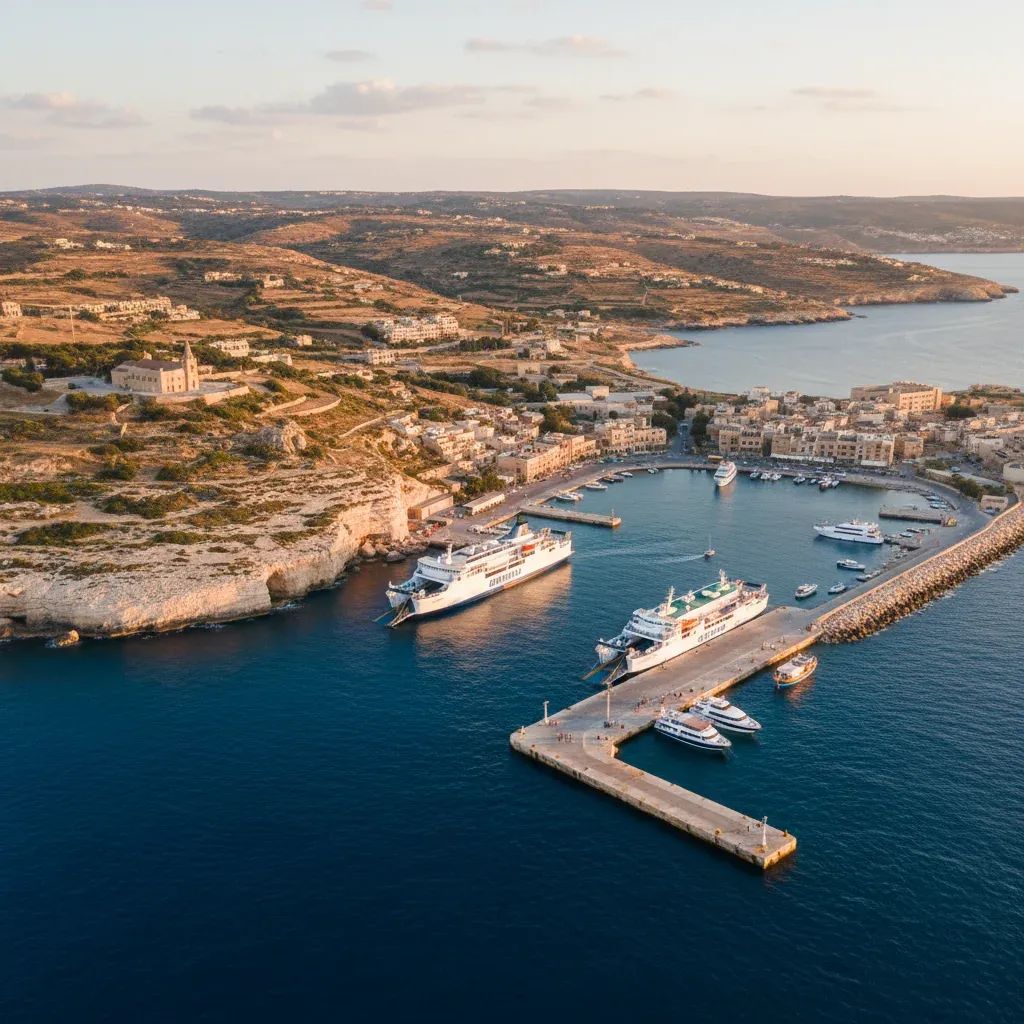
The Valletta fast ferry terminal is poised to restart operations within days, ending a three-month disruption that stranded thousands of commuters and complicated business logistics across Malta's maritime corridors. On April 7, Transport Minister Chris Bonett announced that reconstruction efforts initiated immediately after Storm Harry would reach completion imminently—a development that restores one of the archipelago's most critical transportation links and marks a turning point for inter-island connectivity.
Why This Matters
• Commute times halve: The 25-minute fast ferry crossing replaces the 90-120 minute journey via the northern route to Ċirkewwa and its conventional ferry alternative.
• Tourism logistics normalize: Visitors disembarking in Valletta can now access Gozo directly rather than enduring complicated ferry transfers during peak season.
• Business operations stabilize: Cross-island enterprises regain operational efficiency as travel predictability returns to normal schedules.
The Storm's Impact
Storm Harry arrived on January 20 as a Force 10 gale with sustained winds exceeding 100 kilometers per hour, transforming the Valletta fast ferry terminal into a liability within hours. The impact extended far beyond infrastructure—it disrupted the movement patterns of residents who depend on regular island-to-island transit. Unlike the conventional Gozo Channel ferry service from Ċirkewwa, which resumed operations within days, the specialized terminal sustained structural damage requiring comprehensive remediation.
The economic consequences rippled across sectors. Tourism operators faced immediate complications as cruise passengers disembarking in Valletta found same-day Gozo excursions logistically prohibitive. Hotels throughout the capital redirected guests northward, disrupting the seamless itinerary circuits that define spring tourism revenue. For three months, the absence of a southern crossing fundamentally altered how travelers, workers, and commerce moved through Malta's geographic reality.
The Cost of Detours
Residents commuting between Malta and Gozo for employment, healthcare, or commerce encountered significant travel time increases: a journey that ordinarily consumed 25 minutes by fast ferry now demanded 90 to 120 minutes via the northern terminal. For someone commuting three times weekly, this added roughly 3-5 hours monthly to transit alone. Multiply that across thousands of regular travelers, and the aggregate disruption becomes economically substantial before factoring direct business costs.
Tourism operators absorbed tangible losses. Cruise lines typically schedule tight Valletta-to-Gozo-to-Valletta day circuits; the terminal closure forced either expensive motorcoach transfers or cancellation of Gozo components entirely. Hotels competing for spring bookings suddenly faced logistics complications competing properties in other Mediterranean destinations did not. The service gap coincided precisely with Malta's tourism acceleration, amplifying competitive disadvantage.
Understanding Storm Harry's Impact
The Insurance Association of Malta recorded 751 claims directly linked to Storm Harry's devastation, with Catherine Calleja, the association's president, publicly noting that local insurers process only a portion of actual losses. Many Maltese businesses file claims through overseas insurers, obscuring the true economic impact. Early estimates suggest insured damage alone exceeded €12 million, with uninsured losses—particularly within aquaculture, agriculture, and small coastal enterprises—potentially adding several million euros to the final tally.
For context, Malta's weather history includes more severe storms. The 1979 October storm killed four people and over 1,000 farm animals while collapsing streets and bridges. The 1982 October tempest set national wind records at 133 kilometers per hour, resulting in four deaths and 19 injuries. The February 2019 "Fish Rain" storm featured comparable Force 12 winds and generated €25 million in total damages. Storm Harry's absence of fatalities reflects modern warning systems and public adherence to evacuation guidance issued by Malta's Civil Protection Department—an operational success that partially offset its material destruction.
Infrastructure Improvements Underway
Storm Harry exposed systematic vulnerability in Malta's coastal defenses, particularly around the Grand Harbour. Infrastructure Malta has responded with a comprehensive reinforcement strategy already cleared by the Environment and Resources Authority (ERA) and awaiting final Planning Authority approval.
The multi-layered defense system targets protection for Valletta's exposed waterfront over a two-and-a-half-year implementation horizon. Core elements include a 102-meter breakwater positioned at Fort St. Elmo designed to deflect waves approaching from easterly and northwesterly directions—the primary vectors that inflicted damage during Storm Harry. The proposal incorporates a fully submerged artificial berm (a rock and concrete structure) spanning the shoreline between St. Elmo Bridge, Mgerbeb Point, and Barriera Wharf. Twin concrete revetments at Mgerbeb Point will absorb wave energy and check erosion. An additional 100-meter extension to the existing western breakwater completes the defensive perimeter.
Storm Harry supplied the political momentum and practical justification for accelerating approvals. Officials argue—credibly—that proactive infrastructure investment produces better returns than reactive disaster repair.
What Residents Should Know
Once operations resume, the terminal will restore more than convenience. For practical information, residents should note that the service is operated by Virtu Ferries, which typically runs fast ferry services between Valletta and Gozo. Operating hours and any potential phased service resumption details are expected to be confirmed closer to the reopening date. Residents should monitor announcements from Virtu Ferries and Malta Public Transport for updated schedules and any temporary fare adjustments related to the terminal's recovery.
For passengers, the fast ferry represents seamless inter-island movement—a foundational service that anchors both economic activity and daily life across the archipelago. Commuters will reclaim those lost hours. Businesses will normalize cross-island staffing. Tourism operators will reconstruct the itinerary circuits that maximize visitor experience and revenue generation.
Transport Minister Bonett's April 7 statement positioned completion as imminent—a development worth monitoring closely for anyone whose routine depends on that southern crossing. For three months, disruption was the baseline. Within days, normalcy reasserts itself.