
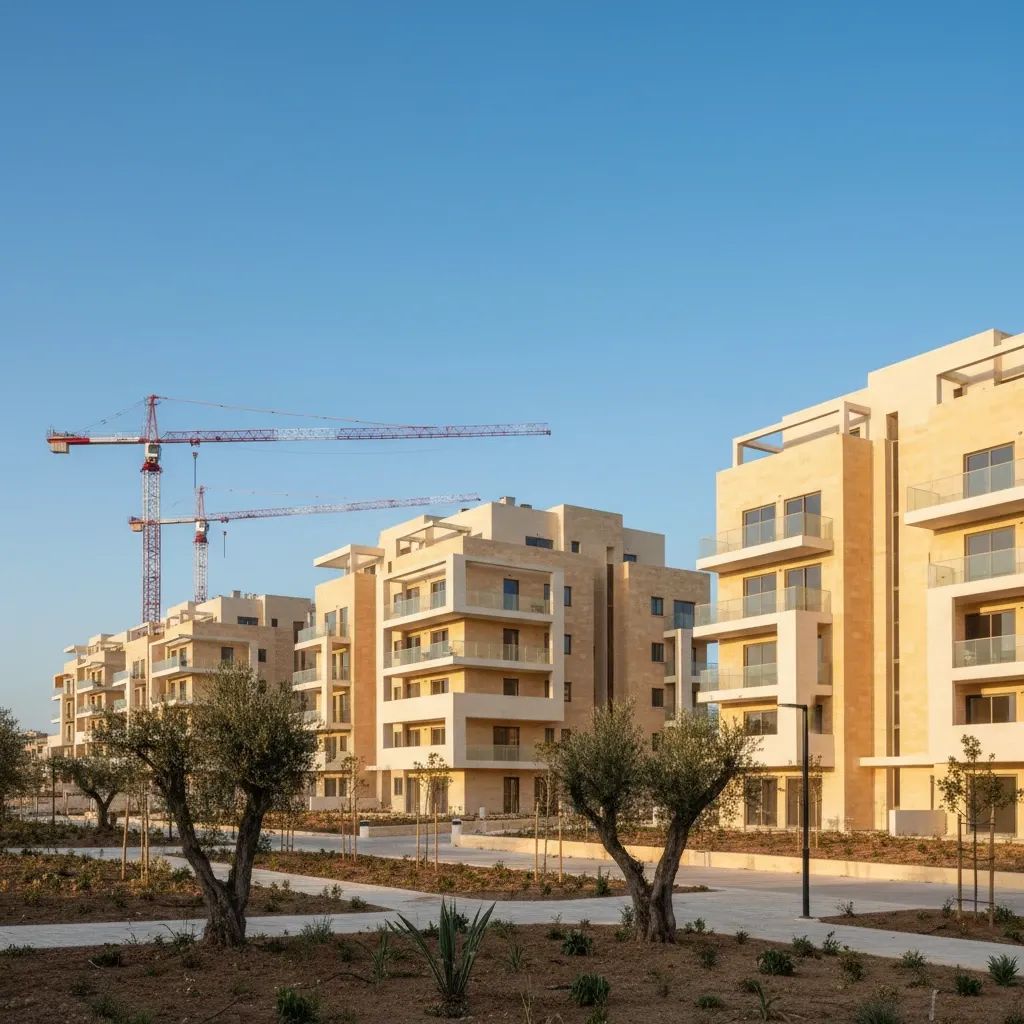
Malta's property market is on an unmistakable collision course with the incomes of its residents. If you're trying to buy your first home in Malta, the numbers released this week by the National Statistics Office confirm what you already suspected: it's getting harder, faster than almost anywhere in Europe. Prices climbed 6.1% year-on-year in the final quarter of 2025, translating into a market where younger citizens and first-time buyers face an increasingly impossible arithmetic: their wages cannot keep pace with what homes actually cost.
Why This Matters
• Apartments and maisonettes kept their upward trajectory, with asking prices averaging €414,621 for apartments after a 10% annual surge—nearly double the wage growth expected through 2026.
• A minimum-wage couple now affords only 2.2% of available properties, down from 5.7% a year prior; even average-earners find just 70% of apartments accessible.
• Median loan debt for buyers aged 25 to 35 reached €220,400 by 2024, a €36,000 jump since 2021, with one-third relying on parental bailouts to close the gap.
• The price-to-income ratio for apartments sits at 14.5—among the highest in Europe—suggesting homes require more than a decade of household income to purchase.
The Stalled Paycheck
The numbers expose a fundamental mismatch. The Malta Statistics Office data showing 6.1% property appreciation in Q4 2025 arrives alongside wage projections that tell a different story. Nominal salary growth is forecast at 5.9% for 2025, but will decelerate sharply to just 2.9% by 2027. Meanwhile, the government's Cost of Living Adjustment for 2026 rose only €4.66 weekly—barely a rounding error in household budgets—while minimum wage crept from €961 monthly to €994, an increase of about 3.4% over several months.
Across the broader Eurozone, house prices climbed 5.5% in the same quarter, revealing that Malta's housing market is outpacing even its economically stronger neighbors. This acceleration reflects a convergence of forces: record tourism driving demand, a migration wave of foreign workers, and a €2.89 billion transaction value in the first three quarters of 2025 alone. Transactions themselves jumped 4.6% year-on-year to 9,788 units, indicating feverish buyer activity at higher prices.
Yet the fundamental problem remains supply-starved demand. For every home on the market, there are multiple competing offers. Properties sell for 93% to 97% of their asking price—a stark seller's advantage that leaves buyers with virtually no negotiating room.
Who Stays Locked Out
Consider the lived reality. A couple earning Malta's minimum wage combines to roughly €23,000 annually. According to analysis of the affordability crisis, this household can now purchase from only 2.2% of listed properties. Twelve months earlier, that figure was 5.7%. The pool has shrunk by more than 60% in a single year. Even households at the national average income of €51,000 find themselves squeezed, with access to just 70% of apartments—a slippage from 79% previously.
This creates a cascading debt trap. Buyers aged 25 to 35, who account for half of all residential mortgages taken in Malta, face median loan obligations of €220,400. This figure has swollen by nearly €36,000 since 2021, effectively demanding that an entire generation take on six-figure debts to achieve what their parents' generation considered an attainable life milestone.
The result is a fundamental shift in how homeownership works. Over one-third of first-time buyers now depend on parental financial assistance—inheritance, gifts, or co-lending arrangements—to secure their deposit or bridge financing gaps. Homeownership has ceased being primarily a function of individual earning power and savings discipline; it has become an inheritance game. Those without affluent parents remain renters or are simply priced out of the market altogether.
The Rental Trap
For Maltese residents unable to purchase, the rental market offers little refuge. A one-bedroom apartment in central Valletta, Sliema, or St. Julian's averages €834 monthly. Two-bedroom units run approximately €1,000, while three-bedroom homes exceed €1,300. Rental yields hover modestly at 4.05% for landlords, which means tenants see little incentive for property owners to hold down prices; the market will bear these rents because the alternative—buying—is financially impossible for younger cohorts.
Rents themselves are climbing at 2% to 3% annually, a pace that compounds into meaningful annual cost increases. A tenant paying €834 this year pays €850 next year and €866 thereafter. Over a decade, that €1,000 monthly unit costs more than €11,000 extra—a sum that, had it been available, might have funded a property deposit.
A couple paying €1,000 monthly rent spends €12,000 annually with no equity gained. With a €250,000 mortgage at current rates, monthly payments would be approximately €1,100–€1,200, but government grants could reduce this to below rental costs while building ownership. That distinction matters enormously when you're weighing your options.
Government Measures: Real Help or Bandages?
Recognizing the crisis, the Malta Cabinet and Housing Authority have deployed a multi-layered policy arsenal, many provisions now permanent fixtures in law:
Direct Purchase Support: The €1,000 annual grant over 10 years for home loan repayments became permanent, applying to properties up to €500,000. Stamp duty exemption on the first €200,000 of a purchase price now applies to first-time buyers, including those who previously owned non-residential property. The deposit assistance scheme expanded its property cap from €225,000 to €250,000, with government covering interest costs.
Heritage and Energy Incentives: First-time buyers purchasing older-style homes or properties in Urban Conservation Areas receive €15,000 grants in Malta or €40,000 in Gozo, earmarked for restoration costs. The newer "Ixtri Proprjetà Sostenibbli" scheme offers €4,500 to €9,000 grants for properties meeting strict energy-efficiency standards or achieving "Net Zero" certification—a nod toward sustainability-minded buyers.
Equity Sharing: An expanded equity co-investment scheme now allows individuals aged 25 and over to purchase homes up to €350,000 with partial government participation, with the state's share repayable over 20 years. This de facto transforms the government into a co-owner on properties where conventional financing would otherwise be impossible.
Social Housing Expansion: The Affordable Housing Foundation, a government-Church partnership, plans to deliver 260 homes at approximately 30% below market rates. The 'Nikru Biesh Nassistu' rental scheme, which subsidizes private landlords to offer low-cost housing to eligible families, is assisting over 1,300 households and continues through 2026. Malita Investments, a quasi-public developer, is completing 752 apartments and 698 parking spaces via a European Investment Bank-financed social housing project.
Vacant Property Rehabilitation: A grant scheme, doubled from €25,000 to €50,000, incentivizes owners to renovate abandoned or vacant properties aged 20 years or older and lease them to the Housing Authority for social housing for a decade. This attempt to unlock dormant housing stock reflects policy recognition that new construction alone cannot meet demand.
These interventions collectively represent genuine effort and real financial commitment. Yet they address symptoms rather than root causes.
How to Navigate These Schemes
These schemes vary significantly in eligibility and benefit. First-time buyers under 40 should start by examining the €1,000 annual grant and stamp duty exemption, which offer the broadest qualifying criteria. Those considering older properties should evaluate the UCA (Urban Conservation Area) grants, while sustainability-focused buyers can layer the energy-efficiency grants on top of base support. For those unable to assemble a conventional deposit, the equity co-investment scheme and the expanded deposit assistance program deserve serious attention. The Housing Authority website provides eligibility checkers for most programs—using them upfront can save months of wasted exploration.
The Structural Reality
What these measures cannot easily alter is the underlying supply-demand imbalance. Malta's population is growing—net migration from foreign workers continues briskly, fueled by robust economic performance (the European Commission projects 4% GDP growth for Malta in 2025). Each arrival increases housing competition. Construction, while active, cannot match this pace of demand creation.
The market reflects this tension. Properties move quickly; asking prices hold firm or climb. Buyers accept minimal negotiating leverage. Landlords maintain rental rates because they know prospective tenants have nowhere else to go.
Demographic and migration trends, analysts broadly agree, will remain an upward force on housing prices through the decade. The Malta Central Bank reported that property prices, when adjusted for inflation, still appreciated 4.39% in Q3 2025—a real gain that excludes monetary effects. Looking ahead, consecutive forecasts project prices rising 4% to 5% annually, with maisonettes potentially outperforming at 6% to 7%. Over five years, cumulative appreciation is conservatively estimated at 20% to 35%.
Against this backdrop, wage growth of 2.9% by 2027 becomes almost meaningless as a purchasing power lever. The income-price gap widens, not narrows.
Transparency and Forward Motion
The government recently announced a new public Property Price Register, set to launch and providing access to actual transaction-level data. This transparency initiative aims to reduce market opacity, support more accurate valuations, and enable evidence-based policy design—acknowledging that hidden pricing mechanisms have historically distorted the market.
The Register also signals an implicit understanding that housing cannot be left to opaque market mechanics. If transaction visibility improves, policy interventions become more targeted and more effective.
Still, most housing economists studying Malta's market reach the same conclusion: schemes that ease short-term affordability gaps cannot substitute for structural supply expansion. Until construction—both private and public—matches the rate of demand creation driven by migration and economic growth, prices will continue their ascent. The government's interventions create a safety net for some; the majority of younger residents, however, will find that net increasingly insufficient.
For now, many Maltese households face an unpalatable trilogy of choices: assume historically high debt levels, activate family wealth and connections, or accept indefinite rental tenancy. The government's policies have made the first option marginally more tenable. They have not yet made homeownership a realistic expectation for ordinary earners without exceptional family circumstances.


