
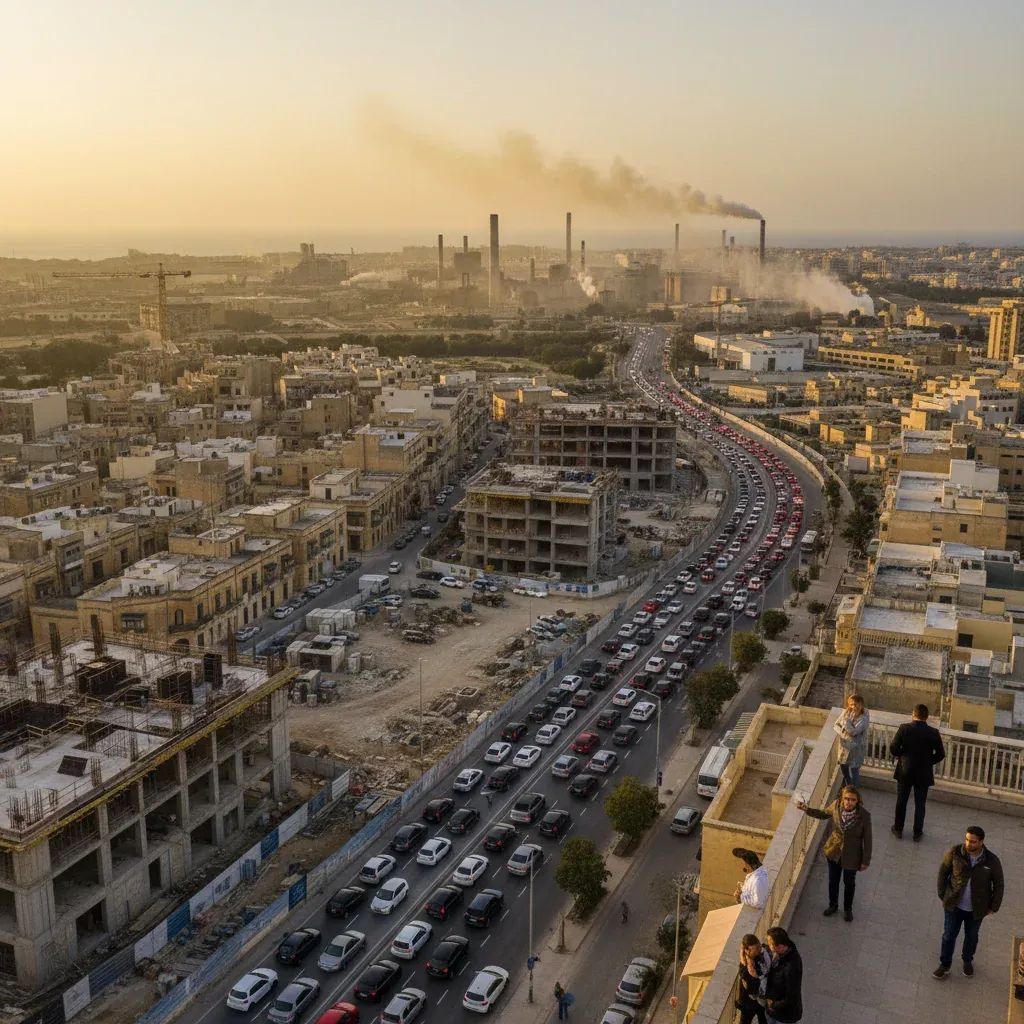
The Environment and Resources Authority and Malta's Planning Authority have left comprehensive light pollution guidelines unpublished for six years, despite completing public consultation in August 2020. This regulatory vacuum comes as Malta's light pollution worsens at 10% annually—faster than global averages—and the archipelago fails to meet EU night sky protection requirements.
Why This Matters: Immediate Health and Environmental Risks
• Health risk: Artificial light disrupts circadian rhythms, linked to insomnia, obesity, diabetes, and elevated cancer risks. Approximately 42% of Malta's areas have become brighter compared to 2017-2018, according to a 2023 study, affecting residents' sleep and wellbeing across the islands.
• Environmental damage: Malta's wildlife—including cliff-nesting Shearwaters, marine turtles, and nocturnal pollinators—face habitat disruption
• EU enforcement exposure: Malta has not honored the European Union's mandate for member states to address light pollution through Nature Restoration Action Plans
• Energy waste: Adaptive lighting could cut municipal electricity consumption by 30%
What This Means for Residents
Malta's current light pollution levels have real consequences for daily life. No site on the islands exhibits natural darkness, and the Milky Way is visible for only about 12.8% of the Maltese Islands. Most of Malta falls within Bortle Scale 7-8, where 9 represents the brightest artificial sky.
The central, eastern, and southern regions—including Sliema, Valletta, Marsa, Birzebbuga, Mosta, Birkirkara, Luqa, Qormi, and Paola—experience severe light pollution. The northern and western parts of Malta, and particularly Gozo's western coastline around Dwejra, Ta' Ċenċ Cliffs, Wied il-Għasri, and San Blas Bay, remain relatively darker but face increasing pressure.
Beyond the loss of stargazing opportunities, excessive artificial light disrupts the body's natural sleep-wake cycle, with blue light particularly problematic for melatonin suppression. This links directly to metabolic illnesses, heightened risks of breast cancer and strokes, and depression. For wildlife, the consequences are equally severe: dragonflies, bees, birds, and marine turtles experience disrupted migration patterns and reduced populations. Plant species that rely on night length to regulate flowering, dormancy, or leaf fall face confused seasonal timing, making them vulnerable to frost or pests.
Coalition Demands Immediate Action
A coalition of 12 environmental and heritage NGOs, spearheaded by the Light Pollution Awareness Group within the Astronomical Society of Malta, launched campaigns in May and August demanding comprehensive measures. Their proposals include equipping all state-owned buildings with warm, shielded, non-excessive lighting, rolling out dark-sky-friendly infrastructure to sports complexes and industrial zones, and introducing lighting management plans for major sites like Malta International Airport, the Malta Freeport, Gozo Channel terminals, and Transport Malta-managed car parks.
The advocacy groups are also pushing for the establishment of official Dark Sky Heritage areas across Malta, building on existing designations in Dwejra, Gozo, and Comino. Their platform includes financial incentives for businesses and residents to replace non-compliant lighting, bans on excessive façade illumination and improperly shielded security lights, and "meaningful fines" for excessively bright billboards, upward-facing floodlights, and particularly bright lighting left on throughout the night.
Perhaps most significantly, the coalition is calling for an independent light pollution authority with powers to conduct inspections, process complaints, issue fines, and maintain a public registry of violations—a model that would shift enforcement away from the Malta Police Force and toward specialized environmental oversight.
The Bureaucratic Maze
The Environment and Resources Authority stated it is working with the Planning Authority to publish "Operating Procedures for Light Pollution Reduction," indicating the draft document underwent review following public feedback. However, no publication date has been provided, and the Minister for the Environment has only confirmed the guidelines are being revised—a process critics argue should not require several years.
The delay stems from what environmental advocates describe as a "fragmented approach," with responsibility passed between authorities and no single entity taking decisive action. Malta's existing legislation makes only scattered references to light pollution, with little enforcement backing them up. This regulatory vacuum persists even as designated Dark Sky Heritage Areas in Gozo have faced growing intrusions of artificial light.
European Models Offer Clear Path Forward
Malta could draw from successful European frameworks. France's "Decree of 27 December 2018" sets national technical requirements for outdoor lighting, limiting most fixtures to less than 1% of total light emission directed upwards and capping Color Correlated Temperature (CCT) at or below 3000 Kelvin. The decree mandates switching off façade, signage, and interior lighting visible from outdoors between 1 a.m. and 6 a.m.—or one hour after closing—leading to a documented 19% reduction in high-level light pollution exposure across mainland France between 2014 and 2023.
Slovenia's strict light pollution law, in force since 2007, includes an upward light output ratio of 0.5% for lamps—among the lowest globally—resulting in estimated energy savings of 40% to 60% in cities like Ljubljana. The Czech Republic's national law, enacted in 2002, emphasizes shielded fixtures that block upward light beams, while Croatia's 2023 Act on Protection Against Light Pollution mandates comprehensive lighting plans and standardized methods for data collection and infrastructure planning.
The Energy and Economic Argument
Beyond environmental and health considerations, light pollution represents significant energy waste and contributes to climate change. Adaptive lighting systems that dim when areas are unoccupied could reduce municipal electricity consumption by up to 30%, according to environmental analysts. For Malta, where energy costs remain a concern for both households and businesses, this represents a tangible financial incentive to implement dark-sky-friendly infrastructure.
The Environment and Resources Authority has not announced a timeline for implementing the long-delayed guidelines, nor has the Malta Cabinet signaled prioritization of the issue in upcoming legislative sessions. With Malta potentially facing EU enforcement actions for failing to meet night sky protection requirements, the regulatory delay carries both environmental and legal consequences for the archipelago.


