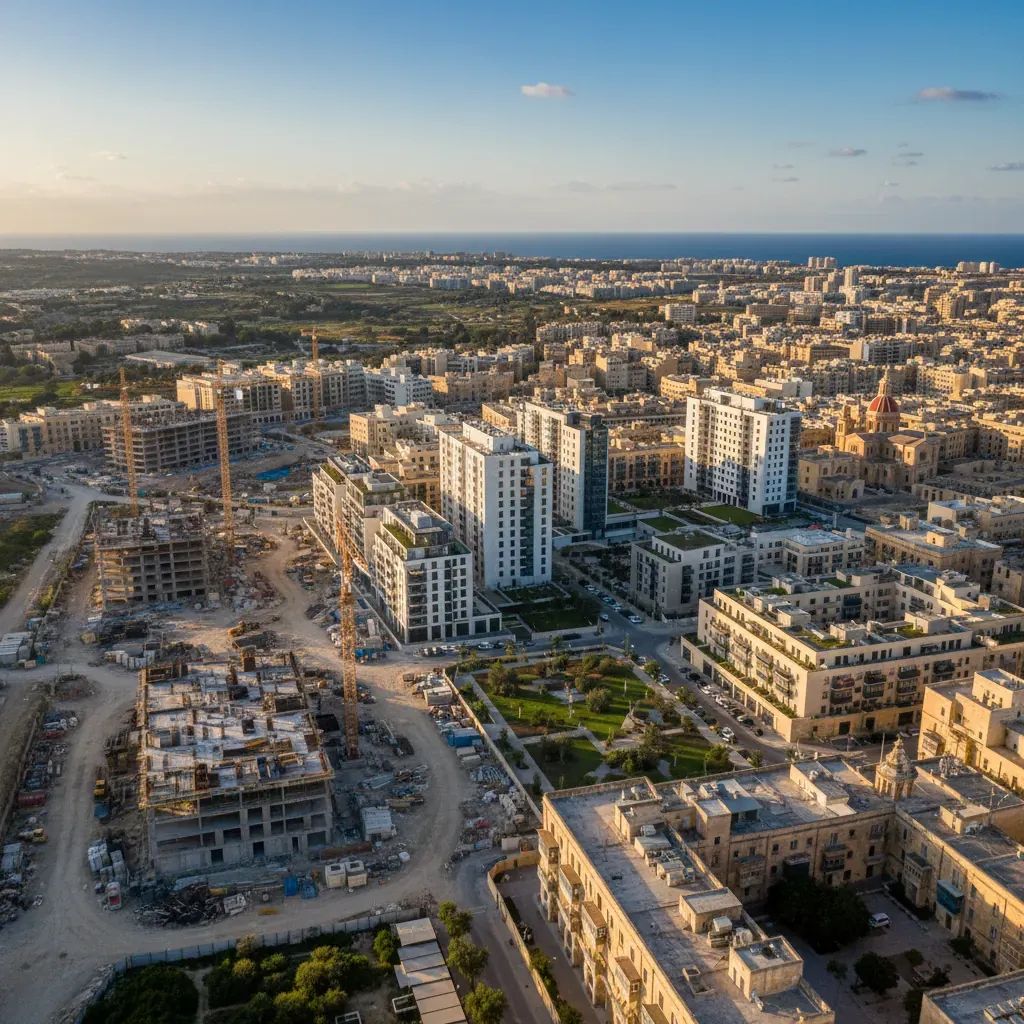
The Malta Prime Minister's Office has indicated it will pursue sweeping revisions to the country's local planning frameworks if broader reform efforts fail to produce a political consensus—a prospect that has rattled environmental advocates already skeptical of the administration's planning priorities.
Why This Matters:
• Local plans control which land can be built on; changes could rezone agricultural areas for housing or hotels, affecting your neighborhood's character and traffic patterns.
• Recent government-ordered plan amendments have benefited specific developers while maintaining minimal public transparency, establishing a concerning precedent.
• The Protection of Agricultural Land Regulations (enacted September 2025) now offer some ODZ safeguards, but critics say they're insufficient against politically-driven revisions.
The Planning Crossroads: Consensus or Unilateral Action?
During a media briefing on Saturday, Prime Minister Robert Abela outlined a conditional roadmap for planning reform. If stakeholders cannot align on a comprehensive overhaul—a process he described as necessary after two decades of delays—the government would advance independent amendments to local plans. He framed this fallback as addressing "injustices and anomalies" embedded in the controversial 2006 land reclassifications, when roughly 2M square meters of previously protected farmland was converted to development zones.
The phrasing has triggered alarm bells among environmental organizations. To them, references to correcting past wrongs carry an ominous subtext: the government may be signaling an intention to further expand development zones rather than reverse them—potentially opening new tracts of countryside to construction and rewarding political allies in the real estate sector.
The Tal-Franciz Tower Precedent
The Villa Rosa redevelopment in St. George's Bay, St. Julian's has become the poster child for what environmental groups fear will accelerate if local plans are comprehensively revised. Developer Anthony Camilleri originally held a 2018 permit to repurpose the site as a mixed-use complex, combining offices, restaurants, villas, and a language school. A court dissolved that permission in December 2024 on procedural grounds.
Rather than scale down the vision, Camilleri pivoted to a radically different concept: three towering hotel blocks. The largest would reach 34 storeys, with companions climbing 27 storeys. To enable this vertical leap, the Malta Government ordered a partial rewrite of the St. George's Bay local plan.
The draft revision, currently open for public feedback, proposes ceilings of 39 storeys for one hotel and 22 storeys each for two others—a nearly sixfold increase from the original local plan's 6-to-7-storey maximum. Environmental NGOs have denounced the revision as a "blueprint for overdevelopment" and what they describe as a direct gift to a favored developer. The Auditor General has separately opened an investigation into the sale of a public alley to Camilleri's team at what auditors characterize as a substantially discounted price—a corridor deemed essential for the project's internal connectivity.
What Local Plan Changes Mean for Residents
If the government proceeds with broad revisions, everyday life across Malta could shift measurably:
• Neighborhood transformation: Agricultural land bordering your community could become construction sites, with associated machinery noise, increased traffic, and altered skylines.
• Height precedents: Once the government raises height limits in one area to accommodate a developer's proposal, that new ceiling becomes a floor for future applications, creating cumulative pressure upward.
• Property values: Homeowners in zones targeted for reclassification may see valuations spike, increasing property taxes or forcing out long-term residents priced out of rising costs.
• Consultation opacity: Public consultation windows for plan amendments are often compressed—typically weeks rather than months—allowing limited opportunity to lodge formal objections.
Environmental coalitions argue that without transparent governance and credible scientific backing, plan revisions become mechanisms for political patronage rather than rational urban policy.
Rural Settlement Creep in Gozo
In Xewkija, Gozo, the Planning Authority initiated a 2025 consultation to formally designate an area as a Rural Settlement, clarifying permissible development boundaries and height restrictions. Officially framed as procedural clarification, critics contend such exercises function differently in practice: they formalize previously informal or technically illegal building activity, effectively legitimizing past non-compliance and signaling future tolerance for expansion.
The 2014 Rural Policy and Design Guidelines have long been accused of enabling piecemeal rural overdevelopment. Terms such as "national interest" or projects deemed "unfeasible in urban areas" have become regulatory loopholes, allowing developers to justify countryside construction projects that might face rejection in urban planning contexts.
A Failed Reform Bill and Its Lessons
Bills 143 and 144, introduced in 2025 to modernize the Development Planning Act, were immediately branded a "developers' charter" by activist networks. The proposals would have granted the Planning Authority expanded discretion to amend local plans unilaterally—specifically removing land from protected ODZ status or adjusting building heights without fresh parliamentary scrutiny.
The legislature dissolved before the bills passed, rendering them void. Prime Minister Abela has since acknowledged that certain provisions were "too ambitious" and that "public sentiment wasn't aligned" with their intent. He has pledged not to reintroduce elements lacking consensus, specifically excluding provisions that would rezone green areas or authorize new industrial zones.
However, Abela remains committed to resurrecting the planning appeals reform, a long-delayed measure first promised in May 2023. This amendment would suspend construction work during the appeals process—a safeguard environmental groups view as minimal given the scale of other proposed changes. Activists counter that a surgical legislative fix could achieve this outcome without bundling it with a comprehensive overhaul they view with deep suspicion.
The Malta 2050 Vision and Its Ambiguity
In February 2026, Prime Minister Abela unveiled the Malta 2050 Vision, a long-term strategic framework organized around four pillars. One addresses the "smarter use of land and sea," though environmental groups note the document lacks binding enforcement mechanisms or concrete interim milestones. Abela has publicly expressed a preference for vertical construction—encouraging density in urban areas—and has opposed new industrial zones while supporting the regularization of individual dwellings.
Separately, a proposed amendment to the Development Notification Order (March 2026) seeks to establish planning rules for restoring buildings damaged by unforeseen events, with restrictions designed to prevent creation of new development entitlements. Meanwhile, the Protection of Agricultural Land Regulations (Legal Notice 150/2025, effective September 28, 2025) created a formal legal framework protecting ODZ farmland from non-agricultural misuse—a regulatory addition that environmental advocates acknowledge as progress but consider insufficient without complementary safeguards elsewhere in the planning system.
The Coalition's Conditions for Trust
The Ġustizzja għal Artna coalition, representing multiple environmental NGOs, has announced a formal "campaign of resistance" targeting any local plan amendments pursued under the current administration. The group has set explicit preconditions for withdrawing opposition:
Leadership by credible figures, not political appointees with party connections or financial interests in the development sector.
Grounding in scientific evidence, including independent environmental carrying capacity studies and ecological impact assessments.
Genuine public participation, involving consultation windows of meaningful duration and transparent decision-making processes free from back-channel developer influence.
"Local plans remain among the few restraints on predatory overdevelopment," the coalition stated. "Without these conditions, we will continue our opposition to protect what remains of Malta's environmental character."
Election Pressure and the Planning Timeline
The debate unfolds against an impending general election, with civil society and opposition figures alleging the government has strategically postponed contentious planning measures to avoid voter backlash. Whether the Malta Government will prioritize building consensus or move unilaterally on plan revisions could define the island's physical geography for decades—determining which green spaces survive development pressure and which communities face transformation into high-rise districts.