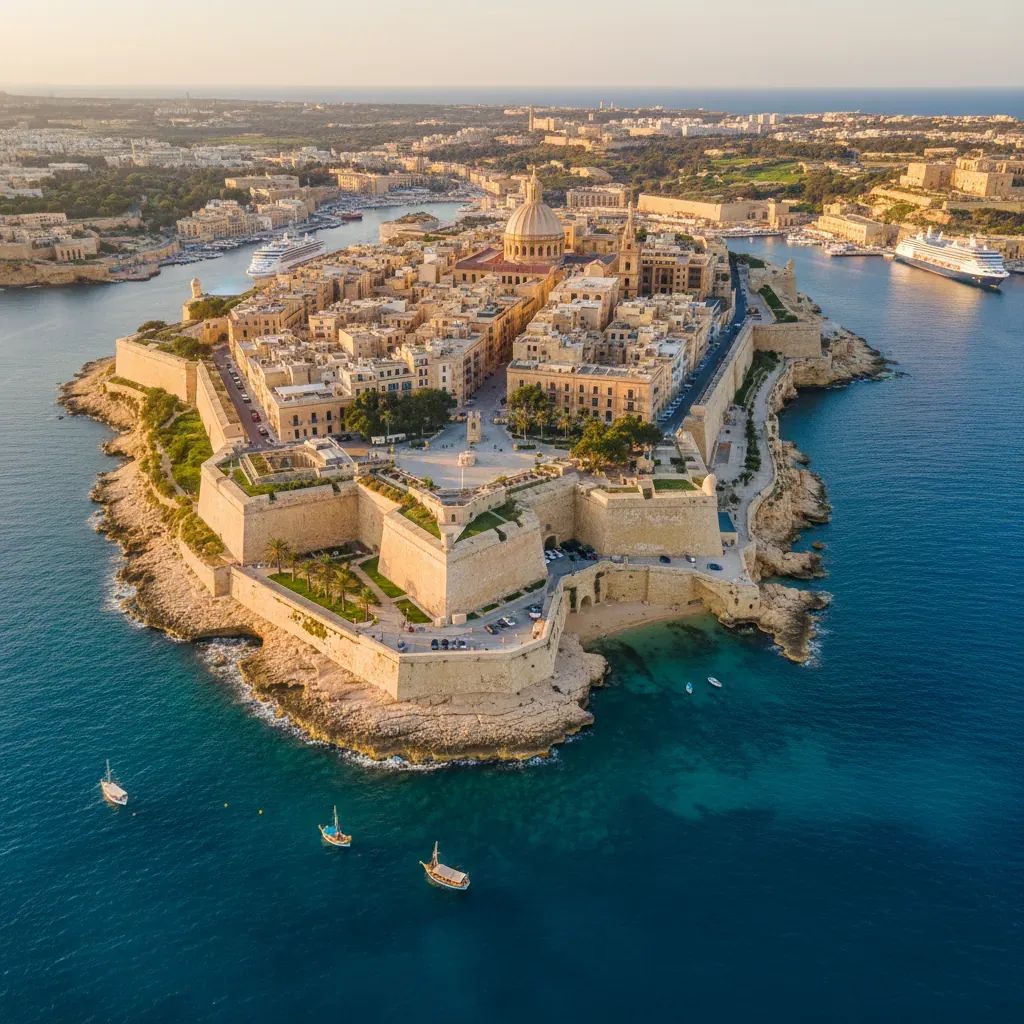
The Malta Planning Authority has brought a sudden halt to padel court construction on Manoel Island, a move that exposes the tension between private sporting development and the government's stated ambition to transform the historic site into a national park. Overhead drone imagery released this week reveals the full extent of the unauthorized works—a near-complete padel complex erected by Gżira United Football Club despite the absence of formal planning approval.
Why This Matters:
• Illegal construction exposed: The football club built extensively on the island while planning application PA/07995/25 remained stuck in early screening, with no permit issued.
• National park vision at risk: Over 29,000 residents signed a petition calling for Manoel Island to become a public nature and heritage park, free from commercial interests.
• Enforcement questions linger: Activists warn that without decisive action, retroactive sanctioning of illegal works could set a dangerous precedent for Malta's planning system.
• Fort Manoel and the historic Lazzaretto are part of the island's rich past, now central to its protected future.
What Happened on the Ground
Activists from Moviment Graffitti and the "Manoel Island – Post Għalina" campaign first flagged the irregularities in early March 2026. Their reports prompted enforcement officers from the Planning Authority to inspect the site, where they found padel courts nearing completion on land occupied by Gżira United FC under a long-standing concession. The club had converted its traditional football pitch, the Nicholl Ground, into a commercial-grade padel complex—all while the relevant application sat in preliminary review.
Prime Minister Robert Abela confirmed publicly that the works had been stopped, stressing that all construction must comply with the law, regardless of existing land-use agreements. Yet the halt order has done little to ease concerns among environmental and heritage groups, who point out that the club has since filed a new application seeking retroactive sanction for the already-built facilities.
The controversy comes at a delicate moment for Manoel Island, a 10-hectare site in Marsamxett Harbour between Sliema and Gżira. After decades of contested development proposals, the Maltese government struck a landmark settlement with developer MIDI plc in 2025, reclaiming the island for public use and pledging to establish it as a protected national park. The padel court saga threatens to muddy those plans.
Why Manoel Island Is More Than Just Real Estate
To understand the uproar, it helps to grasp what makes Manoel Island such a prize. This is not just another parcel of land; it is one of Malta's most layered historical and ecological assets.
The island's Fort Manoel, a star-shaped bastion completed in 1733 under Portuguese Grand Master António Manoel de Vilhena, is a textbook example of 18th-century Baroque military engineering. It has been on Malta's UNESCO World Heritage tentative list since 1998. Nearby stands the Lazzaretto, a quarantine hospital built by the Order of Saint John in the 17th century, which served Malta for over 250 years during plague and cholera outbreaks. British forces used the island as a naval base through both world wars; during World War II, it housed the 10th Submarine Flotilla and absorbed heavy Luftwaffe bombing.
Environmentally, the island functions as a rare green lung in one of Malta's most densely urbanized zones. Native and endemic species planted there support local biodiversity in a region classified as a climate change and biodiversity hotspot by Mediterranean ecologists. Protected marine species, including the Maltese top shell (Steromphala nivosa), inhabit the surrounding waters, making any construction work ecologically sensitive.
Public campaigns have long argued that the island should serve the collective good—offering space for walking, swimming, and cultural events—rather than private profit. The "Manoel Island: Post Għalina" petition, backed by thousands, explicitly called for a non-commercial identity, with heritage buildings repurposed for community use, art studios, or social clubs, and minimal new construction.
The Legal and Planning Maze
The padel court debacle is a case study in Malta's often-fraught planning enforcement regime. Gżira United FC occupies part of the island under a historical concession, but that does not exempt it from standard Planning Authority procedures. Application PA/07995/25, filed to legitimize the padel complex, was still in its initial screening phase when construction crews moved in. A previous 2023 application by MIDI plc for similar facilities had failed to secure approval, yet no public permit existed to justify the new works.
Moviment Graffitti argues that allowing the club to retroactively sanction the development would gut the credibility of Malta's planning system. The NGO also flagged a potential conflict of interest: the Gżira FC president is reportedly involved in a private padel business that has promoted the new complex. The group contends that any development on the island must align with the broader masterplan for a national park, not be approved piecemeal to serve narrow commercial interests.
The Planning Authority has yet to issue a final ruling on whether the completed works can be sanctioned or must be dismantled. Activists fear that bureaucratic delay could allow the fait accompli to stand.
What This Means for Residents
For people living in Sliema, Gżira, and the wider central harbor region, the outcome of this dispute will shape access to one of Malta's last remaining open spaces. If the padel courts remain, the island's transformation into a car-free, pedestrian-priority park with restored heritage buildings and indigenous planting becomes harder to deliver. If they are removed, it sends a strong signal that Malta's planning rules apply equally to all actors, including established sports clubs and concession holders.
The broader question is whether Manoel Island will serve as a model for balancing heritage preservation, ecological restoration, and low-impact recreation—or whether incremental commercial encroachment will hollow out the national park vision before it has a chance to take root.
For the tens of thousands who signed the petition, the island represents more than a policy debate. It is a test of whether Malta can protect its limited green and cultural assets against the pressures of urbanization and private development, especially in a region where every square meter of open land is contested.
The Road Ahead
Moviment Graffitti and allied groups are calling on the government to make good on its commitment to a community-led masterplan for the island, one that prioritizes public access, heritage conservation, and ecological resilience. They want to see clear enforcement action, not just a temporary halt order, and a formal commitment that no further private sporting or commercial infrastructure will be approved on Manoel Island outside the national park framework.
The Malta Planning Authority is expected to rule on the PA/07995/25 application in the coming months. Until then, the padel courts—half-finished, unauthorized, and politically charged—stand as a reminder of the gap between Malta's planning aspirations and its enforcement reality.