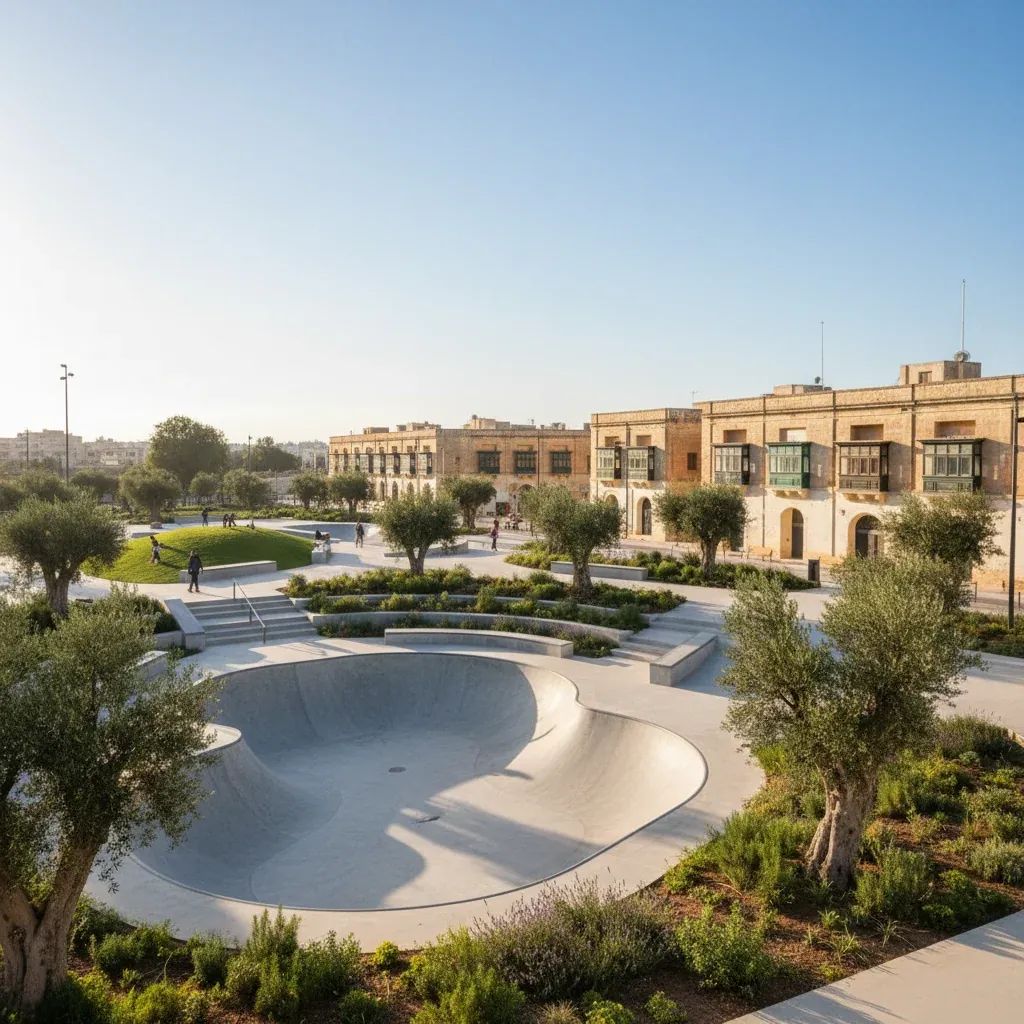
The Paola local council, in partnership with Malta's Infrastructure and Environment ministries, has opened a €1.2M public space named after Tony Bezzina, the legendary Hibernians FC president who died in 2021 after 43 years at the helm of the club. The 2,600 m² complex—equipped with a European-standard skatepark, underground water cistern, and solar canopy—finally welcomed the public on the evening of March 14, 2026, resolving significant delays triggered by the discovery of a World War II air-raid shelter beneath the site.
Why This Matters
• Rare urban green space: One of few recreational zones in densely built Paola, offering families a skatepark, playground, and tree-shaded pathways within walking distance of residential neighbourhoods.
• Historical preservation: The preserved WWII shelter will eventually open to visitors, adding a heritage layer to what would otherwise be a standard municipal park.
• Solar-powered operations: The integrated photovoltaic panels reduce grid dependence, aligning with Malta's renewable energy targets and cutting long-term operating costs for the council.
The Man Behind the Name
Anthony Bezzina served as president of Hibernians FC from June 1978 until his death in October 2021, a tenure that remains the longest in Maltese football history. Under his stewardship, the club collected 21 major honours, including nine Premier League titles and seven FA Trophies, transforming Hibernians from a modest parish outfit into a perennial championship contender. Born and raised in Paola, Bezzina also worked in his family's ship-repair business and served as honorary president of the De Paule Band Club, earning the state honour Ġieħ ir-Repubblika in 2019 for his contributions to local sport and community cohesion. The Tony Bezzina Stadium in Paola already bears his name; the new garden adds a second public memorial in the town he never left.
What Delayed the Opening
Excavation crews struck a rock-cut WWII shelter during the 2023 groundwork phase, halting construction while archaeologists assessed the structure's integrity and historical value. Malta endured some of the heaviest aerial bombardment per square kilometre of any territory during the Second World War, and Paola—adjacent to the Grand Harbour and Corradino headland—sat directly beneath bomber flight paths. Thousands of residents sheltered in similar chambers carved from limestone, many of which remain undocumented.
Rather than demolish or seal the find, the Malta Environment Ministry instructed contractors to preserve the shelter in situ and build a dedicated access corridor. The intervention extended the project timeline considerably, with the skatepark itself completed in 2024 but kept fenced off until perimeter landscaping, lighting, and the shelter passageway were finalised. Although the skatepark itself was finished last year, safety protocols kept it fenced off until perimeter landscaping, lighting, and the shelter passageway were complete.
Vigilante archaeologist Conrad Neil Gatt, who has monitored multiple Paola excavations, confirmed that the shelter's depth and reinforced ceiling suggest it was designed to withstand direct hits—a feature that saved countless lives when the island's civilian death toll climbed above 1,500 during the 1942 siege. The preserved chamber will eventually function as a small interpretive site, with plans for informational plaques and guided weekend tours managed by the Paola local council.
Facility Breakdown
The Tony Bezzina Garden occupies a wedge-shaped plot near the Corradino Correctional Facility, bounded by residential blocks on three sides. Key features include:
• Skatepark: Concrete bowls and rails built to EN 14974 European safety standards, covering approximately 600 m² and designed for intermediate riders. Local skate collectives lobbied for years to secure public ramps after informal street spots were repeatedly demolished.
• Playground: Rubberised surface with climbing frames, swings, and accessible equipment for children aged 3–12.
• Underground cistern: A 40,000-litre reservoir collects rainwater from paved surfaces, feeding drip irrigation for the planted zones and reducing reliance on desalinated mains water.
• Solar canopy: A 25 kWp photovoltaic array mounted on shade structures generates enough electricity to power LED path lighting and a small maintenance depot, with surplus fed back to the grid under Malta's net-metering scheme.
• Native planting: The Environment Ministry specified drought-tolerant species including Tetraclinis articulata (Arar), Ceratonia siliqua (carob), and Olea europaea (olive), avoiding high-maintenance ornamentals that strain municipal budgets.
A bronze bust of Tony Bezzina, sculpted by Pawlu Carbonaro, stands near the main entrance, facing south toward the Hibernians stadium two streets away.
What This Means for Residents
Paola ranks among Malta's most densely populated localities, with fewer than 0.8 m² of public green space per capita—well below the 9 m² WHO benchmark. The new garden raises that figure marginally but offers a disproportionate quality-of-life gain for families in the immediate catchment, who previously travelled to Ħal Far or Żabbar for comparable amenities.
The skatepark addresses a persistent gap in youth infrastructure. Malta has only four public skateparks—Xemxija, Pembroke, Birżebbuġa, and now Paola—forcing enthusiasts in the southern harbour region to rely on private facilities or makeshift street spots that draw police complaints. The new ramps are expected to pull skaters and BMX riders from as far as Żejtun, Tarxien, and Fgura, easing pressure on school playgrounds that have tolerated informal sessions after hours.
For older residents, the pedestrian loop and benches create a rare car-free zone suitable for morning walks and evening socialising, a feature especially valued in towns where narrow streets and parked vehicles make pavement strolling hazardous.
Broader Infrastructure Push
Infrastructure Minister Chris Bonett, who attended the ribbon-cutting alongside Environment Minister Miriam Dalli, confirmed that similar hybrid park projects are in the pipeline for Żebbuġ, Siġġiewi, and Mellieħa. The ministry's 2026 workplan prioritises secondary-road widening and junction upgrades, but a growing share of capital is earmarked for green corridors and pedestrian linkages—part of a broader pivot toward active mobility and urban cooling.
The Msida Creek Project, scheduled for completion in 2027, exemplifies the scaled-up model: 1.6 km of cycling lanes, 214 mature trees, and 17,000 shrubs, with 60% of the redeveloped area reserved for non-vehicular use. Meanwhile, Project Green—the government's dedicated parks agency—is finishing a 50,000 m² park in Fgura and will break ground on the Pinetum in Floriana later this year, injecting roughly €8M into recreational infrastructure across the island.
Critics note that Malta still lags EU peers in per-capita green space, and that headline park openings often mask a net loss of informal open land to residential development. Yet for families within a ten-minute walk of the Tony Bezzina Garden, the wait for an accessible, purpose-built recreational zone is finally over—and the buried wartime shelter beneath their feet serves as a stark reminder of how dramatically Paola's daily reality has shifted in the span of eight decades.