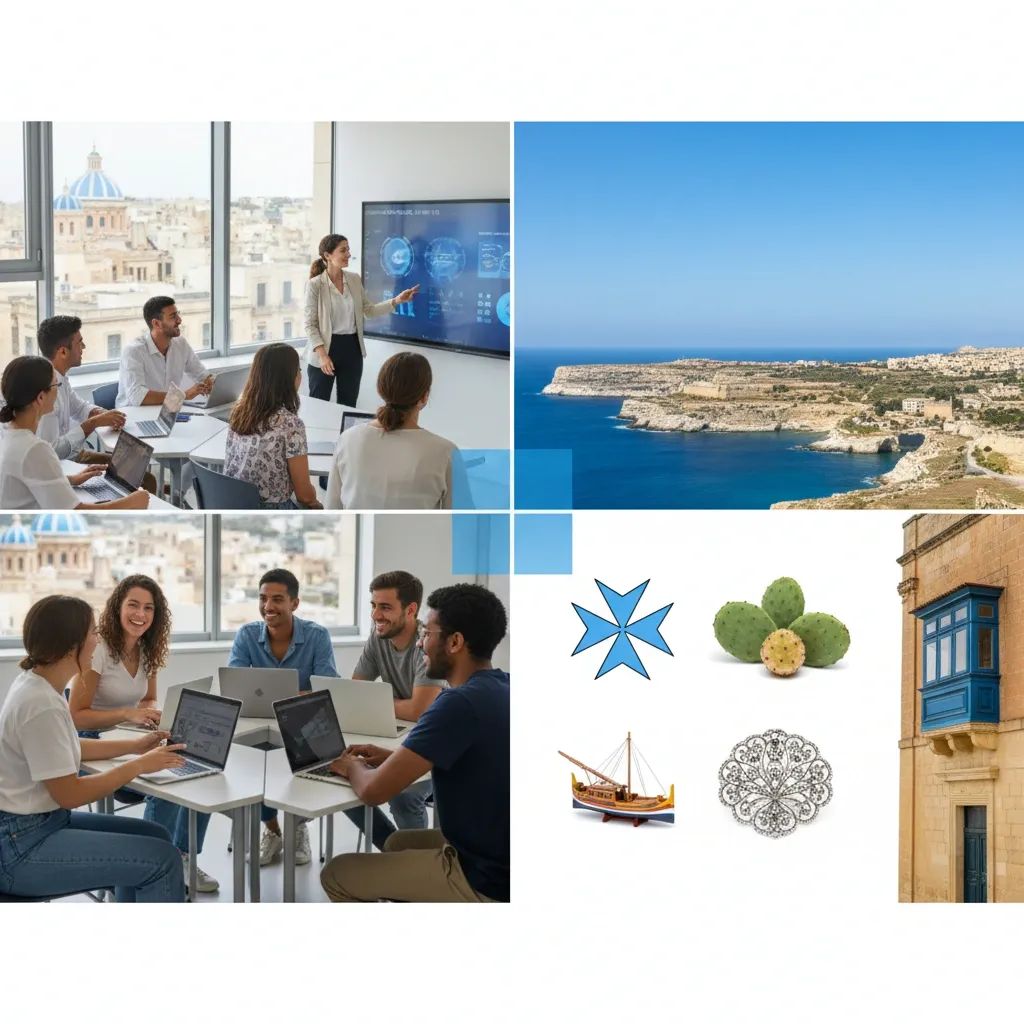
The Malta National Council for the Maltese Language faces mounting pressure to address what linguists are calling a generational language shift: nearly a quarter of Maltese children under 10 now identify English as their main language, according to 2021 census data—a development that has sparked renewed debate over whether the country's native tongue is being relegated to secondary status in its own nation.
Why This Matters
• Language shift accelerating: 37.2% of Maltese residents aged 16-25 now use both English and Maltese interchangeably, with English dominance rising sharply in affluent coastal areas like Swieqi (37.7%) and Sliema.
• New integration rules: As of March 2026, non-EU workers must complete Maltese language and culture courses and pass an exam to qualify for longer-term employment contract renewals—a policy designed to reverse English-only workplace trends.
• Education gap widens: The University of Malta conducts most lectures and assessments exclusively in English, with textbooks rarely available in Maltese, reinforcing the perception that the national language lacks academic legitimacy.
The Colonial Legacy That Won't Fade
Malta's linguistic hierarchy isn't new—it's a holdover from 150 years of British rule (1814–1964), when English became the language of law, commerce, and upward mobility. Even after independence, that association between English and professional success persisted. Today, the question isn't whether Maltese will disappear—94.6% of residents over 10 still speak it fluently—but whether it will remain a language of genuine power or devolve into what experts call a "kitchen language," reserved for home use while English dominates every formal sphere.
The data reveals a troubling divide. In state schools, Maltese remains the primary language of instruction, with English taught as a separate subject. But in independent and Church-run schools—the choice of Malta's wealthier families—English is the default, and Maltese becomes the add-on. This educational divide mirrors a broader socioeconomic split: proficiency in English unlocks better university pathways, international career opportunities, and higher-paying jobs. For many parents, choosing English alongside Maltese for their children isn't snobbery—it's a pragmatic strategy for navigating an increasingly English-dominant job market.
Where Maltese Loses Ground Every Day
The erosion happens in subtle, systematic ways. Government ministries draft policy documents in English first, then translate them into Maltese—often producing stilted, literal renderings stripped of native idioms. Public consultation papers appear in English only. ATM screens default to English. Official emails from state agencies arrive in English. The message, intentional or not, is clear: English is the language of serious business.
Higher education compounds the problem. While universities in France, Germany, and Spain maintain their native languages even for international students, the University of Malta operates almost exclusively in English. Students absorb the unspoken lesson: their mother tongue isn't suited for intellectual work. This perception—that foreign equals superior, local equals merely adequate—persists across digital platforms too. Young people in Malta consume content on TikTok, YouTube, and Netflix in English, making the language feel "cooler and more familiar," according to linguistic research. Maltese characters like 'għ' get dropped in text messages because keyboards don't accommodate them easily. Rather than adapting technology to the language, speakers bend the language to fit the technology.
With non-Maltese residents making up a growing share of Malta's population, English has become the default lingua franca in many workplaces and public spaces, further marginalizing Maltese in everyday interactions and formal settings.
What the Government Is Actually Doing
The Malta Ministry for Education has deployed a multilayered strategy to defend Maltese, with mixed results.
Current Language Courses and Requirements
The National Council for the Maltese Language, established in 2005, oversees orthography updates, curriculum integration, and digital adaptation projects—including a Maltese speech synthesizer and a language resource server. In March 2026, the Directorate for Lifelong Learning and Employability, partnering with the Ministry for Foreign Affairs and Tourism, launched Maltese as a Foreign Language courses (MQF Level 1 and 2) for diaspora members. The Malta Cabinet adopted a requirement for Third-Country Nationals to complete Maltese language and culture courses and pass an examination to secure longer-term work permits.
Starting in January, Malta implemented a mandatory Pre-Departure Course for all non-EU workers applying for a Single Permit, covering living conditions, work rights, and English proficiency. An integration course for foreign nationals already residing in Malta now includes modules on Maltese culture, traditions, and basic language instruction.
What Non-EU Workers Need to Know
From March 2026, non-EU workers seeking to renew employment contracts for longer-term stays must complete Maltese language and culture courses and pass an examination. Specific details on course duration, location, costs, and whether employers are required to provide support or paid leave for participation remain to be finalized by the relevant authorities. Workers should contact the Directorate for Lifelong Learning and Employability or their employer's HR department for current information on course enrollment, fees, and timelines.
Long-term Policy Commitments
The National Curriculum Framework (2012) and the National Literacy Strategy (2014–2024) officially promote bilingualism and biliteracy. The government's Malta AI Strategy (2020) pledges to incorporate language technology into e-services. However, critics note that Malta Vision 2050—the country's long-term development blueprint—contains no explicit language protection roadmap, suggesting that political will lags behind policy rhetoric.
What This Means for Residents and Employers
For parents in Malta—whether Maltese-born or expatriates—the linguistic landscape is complex. Raising children primarily in Maltese can limit their access to certain educational materials and international opportunities. Raising them in English risks weakening their connection to Maltese cultural identity and community. The 37.2% of young adults who use both languages represent a pragmatic approach, though it reflects a generation navigating an environment where neither language feels fully dominant or sufficient.
For employers in Malta, the new integration requirements mean adjusting recruitment timelines and potentially considering course costs for foreign hires. For local workers, the policy could level a playing field that has increasingly favored English-speaking expatriates in sectors like iGaming, finance, and tech.
For educators, the challenge is acute: 70% of early childhood teachers already code-switch between Maltese and English to create bilingual environments, yet English books outnumber Maltese ones in most homes and classrooms. Survey data shows Maltese is considered easier to speak and understand, but English is perceived as easier to read and write—a literacy gap that begins before age 7.
The European Comparison
Malta isn't alone in grappling with language hierarchy. Spain's autonomous regions use Basque, Catalan, and Galician as co-official languages in schools and public administration, with government funding for university programs. Finland's Sámi Language Act guarantees education and municipal services in Sámi within designated home districts, backed by national budget allocations. Ireland's Official Languages Act (2003, amended 2021) aims for 20% of public servants to be competent in Irish by 2030, with citizens entitled to receive government replies in Irish when they initiate contact in that language.
The key difference: those countries treat their native languages as assets worth protecting through enforceable legislation, not just symbolic gestures. The Council of Europe's European Charter for Regional or Minority Languages, ratified by 25 EU Member States, commits signatories to concrete actions in education, justice, administration, and media. Malta, however, faces the paradox of protecting a national language rather than a minority one—yet the symptoms of marginalization look remarkably similar.
The Unfinished Debate
A national conference in May 2025 identified urgent priorities: standardizing orthography and terminology, coordinating advocacy efforts, increasing public awareness, and promoting Maltese in digital spaces. But implementation remains patchy. The perception that lapses in written Maltese are excusable while English errors warrant correction reveals a double standard that undermines the language's prestige.
The central tension isn't whether Malta should choose English or Maltese—the country's economic integration and tourism industry make bilingualism non-negotiable. The question is whether the Malta government will invest the resources, political capital, and enforcement mechanisms necessary to ensure Maltese retains functional parity with English in the spheres that shape life outcomes: higher education, professional advancement, and civic participation. Without that commitment, the language risks becoming a heritage artifact rather than a living tool—spoken at home, celebrated in folklore, but absent from the rooms where decisions get made.