
Why This Matters
• A Sacred Dialogue runs through Holy Week at the Sacred Heart Major Seminary in Victoria, Gozo, offering Malta's largest faith community an unconventional encounter with contemporary spiritual inquiry.
• The exhibition presents suffering as an endpoint rather than a waystation—a fundamental break from centuries of European religious art tradition that promises redemption.
• For visitors seeking engagement beyond processions and liturgy, the show provides an introspective counterweight to Malta's public devotional culture.
Two Artists, No Compromise
Maltese sculptor Mario Sammut and painter Christopher Saliba share exhibition space but not artistic language. Their collaboration—curated by Joseph Calleja—deliberately resists consensus. Where Saliba dissolves and suggests, Sammut anchors and grounds. The effect is not harmony but productive friction, the kind that forces genuine contemplation rather than comfortable affirmation.
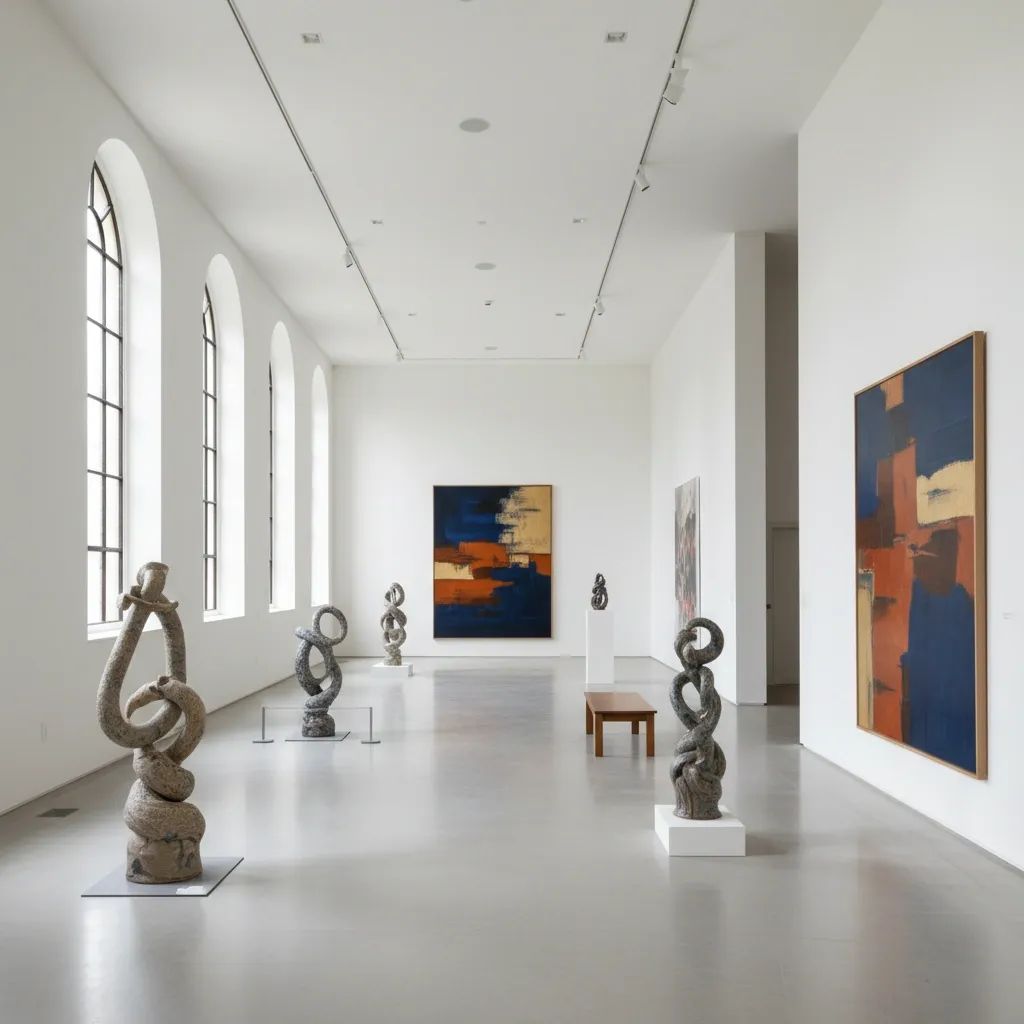
Sammut's ceramic sculptures occupy physical space with the weight of intention. His forms don't gesture toward transcendence; they sit, they endure, they demand attention. The tactile surfaces invite contact—museum guards notwithstanding—creating an intimacy most religious art actively discourages. His work embodies waiting, the slow accumulation of presence. There's an almost liturgical quality to this restraint, though one with no payoff, no promised arrival. Grief here becomes a form of attention, not a temporary station.
Saliba's paintings operate at the opposite register entirely. His canvases fracture and obscure where they might have narrated. Light enters cautiously, often unsuccessfully. Figures emerge incompletely from shadow, their gestures unresolved. He treats Christological moments—the Passion, moments of abandonment—through atmospheric dissolution rather than dramatic rendering. Where Renaissance masters delivered coherent suffering narratives culminating in redemption, Saliba suggests that meaning might reside within the suffering itself, unresolved and untranslatable into comfort.
The strength of this pairing lies precisely in its refusal to synthesize. A visitor moving between gallery spaces experiences not evolution but contradiction. Sammut's monumentality then Saliba's abstraction. Sculpture grounding, painting dissolving. The exhibition asks: which approach tells the deeper truth about faith? The answer appears to be: both, neither, and something still unnamed.
The Broader Artistic Landscape
The global art world in 2026 experiences what critics term a "spiritual turn"—but this requires immediate qualification. This is not nostalgia or religious revival. Rather, artists across continents are mining mysticism, ancient frameworks, and metaphysical inquiry as urgent responses to techno-capitalist materialism and collective existential fatigue.
The Museum of the Bible in Washington commissioned contemporary Christian and Jewish artists to reinterpret Ezekiel 37, focusing on renewal rather than doctrine. Ghosts: Visualising the Supernatural at Basel's Kunstmuseum centered Indigenous and diasporic artists exploring spirituality as kinship and survival. The 2026 Engage Art Contest invited global submissions of scripture-inspired work, attracting thousands of artists seeking to deepen engagement with sacred texts through visual means. Colombian artist Christian Abusaid incorporates patterns from ancient rock paintings into abstract geometric compositions, signaling universal sacred geometry accessible across cultural boundaries.
These exhibitions and initiatives share a refusal to choose between belief and skepticism. They don't aim to restore faith or confirm doctrine. Instead, they treat the spiritual dimension of human experience—the hunger for transcendence, the encounter with suffering, the search for pattern and meaning—as legitimate contemporary artistic terrain. None involves fundamentalist retreat. All involve rigorous formal experimentation.
Malta's position within this conversation proves distinctive. The archipelago remains approximately 98% Catholic by identification, yet active church attendance among younger cohorts continues declining measurably. The islands' cultural DNA flows from faith—Baroque churches dominate skylines, Holy Week processions empty villages into streets, religious iconography saturates public space. Yet contemporary Maltese artists have struggled to inhabit this inheritance without either deferring obsequiously to tradition or rejecting it outright. A Sacred Dialogue occupies that difficult gap: a seminary hosting work that interrogates rather than confirms, explores rather than celebrates.
Suffering Unresolved
Traditional European religious art operates through a specific narrative architecture: suffering contains meaning because it leads toward redemption. Michelangelo's Pietà radiates peace despite devastation. Grünewald's Isenheim Altarpiece depicts graphic agony but gestures toward transcendence. Even surrealist depictions like Dalí's Christ of Saint John of the Cross redirect focus from pain to salvation. The trajectory always ascends.
Saliba's work refutes this arc categorically. His figures don't promise resurrection. They suggest instead that integrity might exist within suffering itself rather than beyond it—a radical departure from centuries of European visual tradition. His use of color functions as emotional architecture rather than decoration, with shadow dominating his compositions. When light appears, it arrives tentatively, unreliably. The work offers no consolation, no covenant that suffering will eventually resolve into meaning.
Sammut's sculptures extend this refusal through material presence. Grief here materializes as stillness, embodied in ceramic form. His pieces don't transcend or abstract suffering into spirituality. They render it as weight, precision, the absolute attention required to carve deliberately through resistant material. For viewers accustomed to religious art that transforms suffering into spiritual narrative, this approach registers as almost transgressive—grief treated as sufficient unto itself, requiring no redemptive justification.
Both artists share an essential conviction: the search for meaning need not conclude with certainty. This distinction separates contemporary spiritual inquiry from both devotional practice and secular skepticism. It permits engagement with faith's central preoccupations—mortality, loss, transcendence, the presence of absence—without requiring doctrinal adhesion or offering false comfort.
Practical Implications for Island Residents
For Gozitans and Maltese visitors navigating faith's complications within a predominantly Catholic culture, A Sacred Dialogue offers something rare: permission to sit with ambiguity without apology. Holy Week in Malta operates through structural publicity—processions dominate street rhythms, liturgical space saturates temporal experience, collective ritual absorbs individual complexity. This exhibition inverts that equation. It privileges slow looking over public witnessing, inward listening over communal chanting.
The timing amplifies this countercultural positioning. As streets fill with processions and churches experience peak attendance, the seminary remains quiet, its chapel temporarily repurposed as gallery space. The ferry crossing to Gozo becomes pilgrimage; the gallery becomes destination; the encounter with artwork becomes spiritual practice—one requiring introspection rather than spectacle, questions rather than affirmations.
For expats and international residents less versed in Catholicism's particulars, the exhibition translates faith's central preoccupations into visual language transcending doctrine: suffering, loss, the search for meaning amid absence. The works demand only willingness to contemplate what grief feels like when represented in paint and ceramic, without requiring catechism or theological background.
The show also punctures a persistent myth about contemporary art in Malta: that serious artistic practice occurs primarily in Valletta's established gallery circuit. A Sacred Dialogue demonstrates that meaningful artistic interrogation happens at unexpected sites—seminary chapels, island peripheries, institutional spaces typically resistant to provocation. The Malta Biennale's international programming and residual infrastructure from Valletta's 2018 Capital of Culture designation have created conditions for this kind of work. But the decision to hold this exhibition in Victoria, a town often overlooked by Valletta-centric cultural discourse, signals a deliberate decentralization of artistic gravity.
Individual Artistic Trajectories
Christopher Saliba's practice has consistently pushed Maltese visual culture toward discomfort and complexity. His willingness to combine painting and ceramic art at exhibition scale remains unusual in local practice, signaling an artist uninterested in disciplinary boundaries or institutional expectations. In A Sacred Dialogue, his work emphasizes psychological tension and atmospheric ambiguity as spiritual categories. His Christ figures don't teach; they radiate confusion and questioning. Color functions as emotional register—not decoration but the architecture through which viewers navigate inner states.
Mario Sammut's sculptural practice has long engaged memory and embodiment as primary concerns. His ceramics achieve what few contemporary sculptors accomplish: monumentality scaled to intimacy. The pieces invite tactile confirmation despite institutional prohibition. His surfaces refuse the high-gloss perfection typical of religious sculpture. Instead, carving marks remain visible, evidence of the artist's deliberate labor. This precision suggests that contemplation requires absolute attention, not casual encounter. Stillness becomes active; silence becomes action.
The joint presentation forces a question neither artist answers individually: must spiritual practice culminate in certainty? Can faith—or its contemporary equivalent, the search for meaning—sustain itself in perpetual questioning? The exhibition suggests: perhaps.
Critical Reception and Viewer Experience
Since opening on March 28, 2026, A Sacred Dialogue has received consistent critical praise for its refusal of easy devotional comfort. Times of Malta critic Louis Laganà highlighted how the exhibition invites contemplation of suffering, doubt, redemption, and spiritual hope—particularly charged during Holy Week's liturgical intensity. The "subtle interplay of material and meaning," as critics describe it, creates space for what one reviewer called "slow looking and inward listening" rather than passive consumption of sacred imagery.
Visitor response, while not exhaustively documented, suggests the exhibition attracts a specific audience: people for whom traditional Holy Week observance feels insufficient, those seeking engagement with faith's existential dimensions without requiring doctrinal confirmation. The seminary's architectural gravity—its reverent spaces designed for prayer—functions deliberately, creating cognitive friction between institutional purpose and contemporary artistic practice. This juxtaposition is not accidental. It amplifies the exhibition's central argument: that sacred space can accommodate doubt and questioning without losing its essential character.
What Endures
As Holy Week proceeds across Malta and Gozo with pageantry and public devotion, A Sacred Dialogue remains open—a quiet argument unfolding inside seminary walls. It's not a destination for those seeking doctrinal confirmation or aesthetic beauty alone. It's an invitation to encounter art that thinks seriously about faith without offering faith itself, that holds suffering seriously without promising deliverance, that suggests meaning might be something we construct through sustained attention rather than something we receive whole from tradition. For an island where the vast majority identify as Catholic yet increasingly find themselves navigating faith's complications individually, this work occupies vital cultural terrain. It permits engagement with sacred traditions while refusing to be bound by them.


