
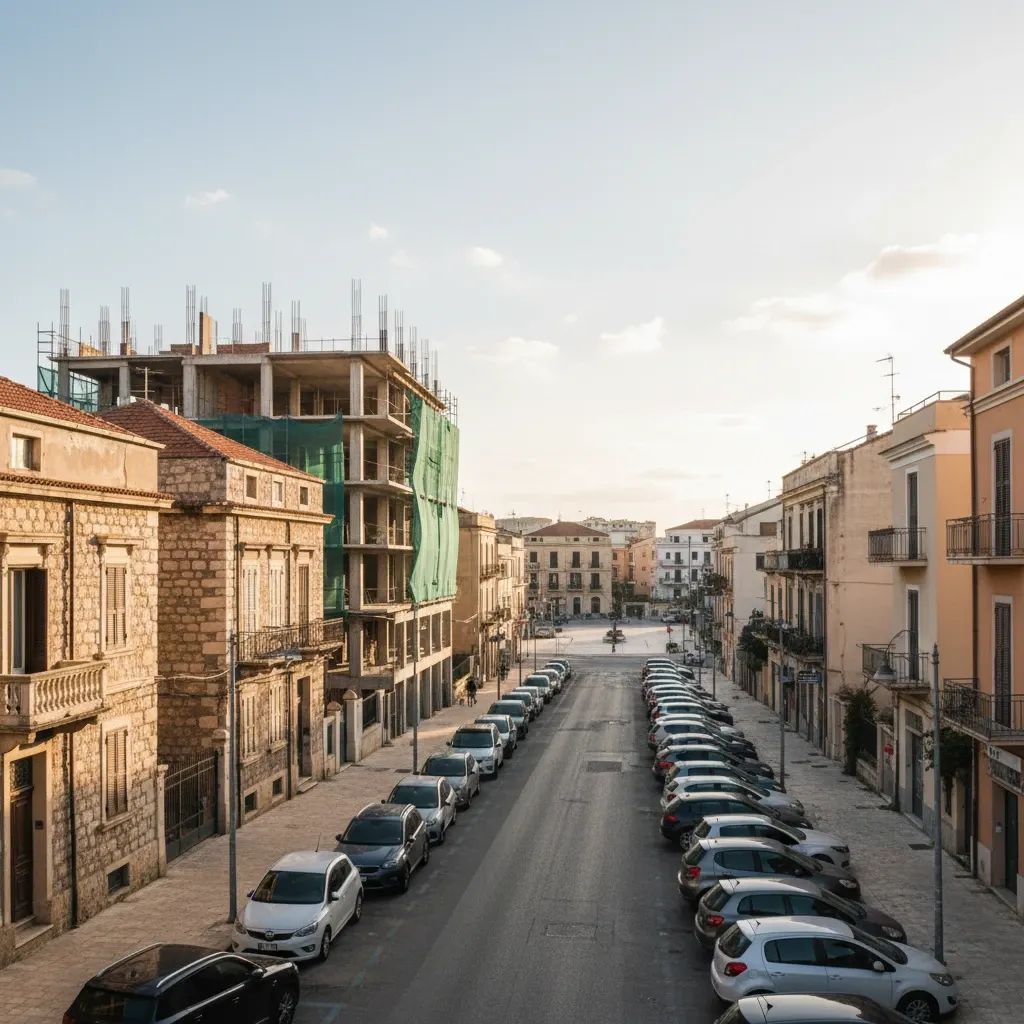
St Julian's residents watched yet another residential street disappear into the tourism economy this month when the Malta Planning Authority greenlit a 30-room guesthouse on Triq Ta' Giorni—a decision that replaces two modest homes with a six-storey commercial structure that will more than double the surrounding streetscape. Despite 30 neighbors formally objecting, the approval signals a pattern now difficult to ignore: community opposition rarely checks the conversion of residential zones into tourism infrastructure.
Why This Matters
• Scale and character shift: A six-storey building inserting 60 guest beds into a two-storey street fundamentally alters neighborhood rhythm, parking dynamics, and noise profiles compared to family households.
• Policy clash with European practice: While EU Regulation 2024/1028 (effective May 20, 2026) mandates transparency for short-term rentals, Malta's approval framework lacks cumulative impact assessment—a safeguard now standard across Vienna, Amsterdam, and Barcelona.
• The acceleration effect: Successive approvals in St Julian's suggest that each green light licenses another developer to pursue similar conversions, compounding neighborhood saturation without regulatory brakes.
How a Single Building Illustrates a Larger Breakdown
The Planning Authority signed off on application PA/03786/25 in early February, allowing developer Christian Cacciattolo and architect Michael Anastasi to demolish the terraced properties and construct what gets officially classified as a "Class 3A" guesthouse. On paper, zoning permits such uses in residential areas. In practice, the 60-bed facility appears to exceed the Tourism Accommodation Regulations 2025, which cap new guesthouses at 20 rooms and 40 beds—thresholds this project doubles.
Residents articulated concrete friction points: rental cars queuing at odd hours, taxis idling on narrow streets already strangled by parking shortages, cleaning crews arriving before dawn, pool activity spilling past midnight. They framed the street's future candidly: a transition from domestic quietude to "chaotic and noisy commercial zone." The phrase resonates because it describes what overtourism does to residential neighborhoods—a metabolic shift from people who sleep there to people who consume there.
The case officer's approval rationale leaned heavily on the observation that guesthouses are "generally permitted" in residential zones. The word "generally" did considerable work: it acknowledged exceptions exist, then declined to explore whether they applied here. It's a technical move that outsources accountability to policy language rather than neighborhood reality.
What St Julian's Looks Like After Two Years of Accelerated Approvals
This isn't an isolated green light. The neighborhood has absorbed multiple high-density approvals in rapid succession, each individually reasonable under existing policy, collectively reshaping what St Julian's is.
In the same February decision window, the PA approved a 10-storey hotel replacing the former HSBC branch despite the case officer's initial recommendation for refusal and objections from heritage group Din l-Art Ħelwa. The developer secured the blessing of the original architect Richard England, a legitimacy move that tilted the negotiation. Months prior, in November 2025, an eight-storey mixed-use tower near the Regional Road cleared on an 8-1 Planning Authority vote using the DC15 policy—a technical classification that measures height in meters rather than storeys, effectively allowing taller buildings than residents believed their zoning caps permitted.
A pending outline application (PA/8237/25) by AMIR Ltd proposes a hotel and two residential blocks within a historic garden with documented WWII counter-intelligence connections. The Superintendence of Cultural Heritage, conservation NGO Flimkien għal Ambjent Aħjar, former St Julian's mayor and current MP Albert Buttigieg, and dozens of residents submitted objections before the February 2 deadline. A decision remains pending—but the pattern is familiar: objections lodge symbolic weight while the planning machinery proceeds on separate logic.
Smaller resident victories exist but read more as exceptions proving the rule. A 60-apartment block proposal was downsized to 10 terraced houses following backlash in November 2025. The Environment and Planning Review Tribunal revoked the Sirdar House hotel permit in July 2025, determining that the local plan didn't authorize a hotel on that site. These decisions matter, but they're scattered across a landscape tilting decisively toward density and commercialization.
How European Cities Handle What Malta Approves Casually
Across the continent, urban authorities have recognized that converting residential units into revolving-door guesthouses erodes neighborhood cohesion and prices out long-term renters. Their regulatory response has shifted from permissive to restrictive.
Vienna caps apartment rentals at 90 days annually without special permits—a mechanism that preserves residential character by throttling the annual rental window. Amsterdam enforces a 30-night annual cap for primary residences, with further tightening in additional zones starting April 2026. Berlin restricts short-term rentals to three months yearly. Florence banned new short-term rentals in its historic center outright. Barcelona is revoking over 10,000 tourist apartment licenses by November 2028, explicitly prioritizing long-term housing stock over visitor accommodation.
These aren't theoretical restrictions. They reflect a hardened policy consensus that neighborhoods absorbing wave after wave of tourism conversions experience measurable deterioration in livability and housing affordability. The EU Regulation 2024/1028 (May 20, 2026) creates the infrastructure for enforcement—requiring standardized registration, data-sharing between booking platforms and national authorities, and transparent listing verification. But crucially, the regulation doesn't impose EU-wide bans or night caps; it enables local enforcement of existing rules. The actual guardrails remain national and municipal decisions.
Malta's Tourism Accommodation Regulations 2025 specify that guesthouses should locate in Urban Conservation Areas or buildings with special architectural character, and they impose a ceiling of 20 bedrooms and 40 beds maximum. The Triq Ta' Giorni project—30 rooms, 60 beds—overruns that threshold by half. Questions about whether a different classification or stricter review should have applied went unasked at the Planning Authority level.
Immediate Consequences for St Julian's Residents
The approved guesthouse will inject operational complexity into daily life. Sixty guest beds translate to:
Chronic parking and traffic friction. Rental car fleets, taxi pickups, shuttle services, and delivery vans servicing a 30-room facility circulate continuously. St Julian's already struggles with vehicle management; adding transient accommodation infrastructure worsens congestion for residents navigating their own street.
24/7 operational activity. Guest arrivals at unpredictable hours, pool use during summer evenings, cleaning crews moving through at dawn—tourism infrastructure operates on a rhythm incompatible with residential sleep schedules. This friction doesn't diminish; it persists as a background condition.
Precedent multiplication. Approvals license others. If Triq Ta' Giorni accepts 30 rooms, why not the adjacent street? Why not the corner property? Each individual approval seems reasonable until the cumulative transformation is undeniable. The Malta Planning Authority evaluates applications in isolation, systematically excluding cumulative impact analysis from its framework.
For residents committed to long-term settlement, the underlying message is stark: organized objection influences tone but rarely alters outcomes. The Planning Authority's methodology assesses applications against existing policy classifications without modeling neighborhood saturation, infrastructure capacity thresholds, or whether the aggregate effect of multiple tourism conversions fundamentally redefines a place's character.
The Structural Policy Gap Malta Hasn't Closed
Urban planners and conservation advocates have long flagged a critical absence in Malta's planning framework: it lacks mechanisms for assessing cumulative impact, infrastructure limits, or neighborhood character preservation when evaluating tourism conversions in residential areas.
Applications are evaluated discretely. PA/03786/25 was assessed on its own merits against zoning classifications, never cross-referenced with existing short-lets, other approved guesthouses, or pending applications in the same street. This isolation-based approach contradicts how European cities now regulate housing. Vienna, Amsterdam, and Barcelona explicitly model aggregate demand, neighborhood saturation, and livability consequences. Malta hasn't adopted that analytical framework—not yet.
As St Julian's absorbs successive tourism density approvals, policymakers and residents face an unresolved question: Will Malta evolve its safeguards toward European standards, or accept that residential neighborhoods are conversion zones for tourism capital?
How Residents Can Monitor and Respond
The Malta Planning Authority website (pa.org.mt) provides an advanced search tool filtering by locality and street, with records back to 1992. The Planning MT mobile app offers on-the-go access to the same database. A third-party platform, app.permess.mt, presents a more user-friendly interface and includes email alert functionality for specified areas, allowing residents to identify applications before decisions are finalized.
Public objection windows typically run 21 days from publication. For residents concerned about future projects, this period remains the formal mechanism to lodge concerns on the public record—though the Triq Ta' Giorni outcome demonstrates that numerous, reasoned objections do not guarantee policy responsiveness.
The Unresolved Narrative
The six-storey guesthouse on Triq Ta' Giorni marks one decision in an ongoing story about whether Malta's planning system prioritizes residential stability or tourism intensification. The recent trajectory suggests the answer, though the residents now living on that street—and others monitoring similar applications—might prefer a different outcome entirely.


