
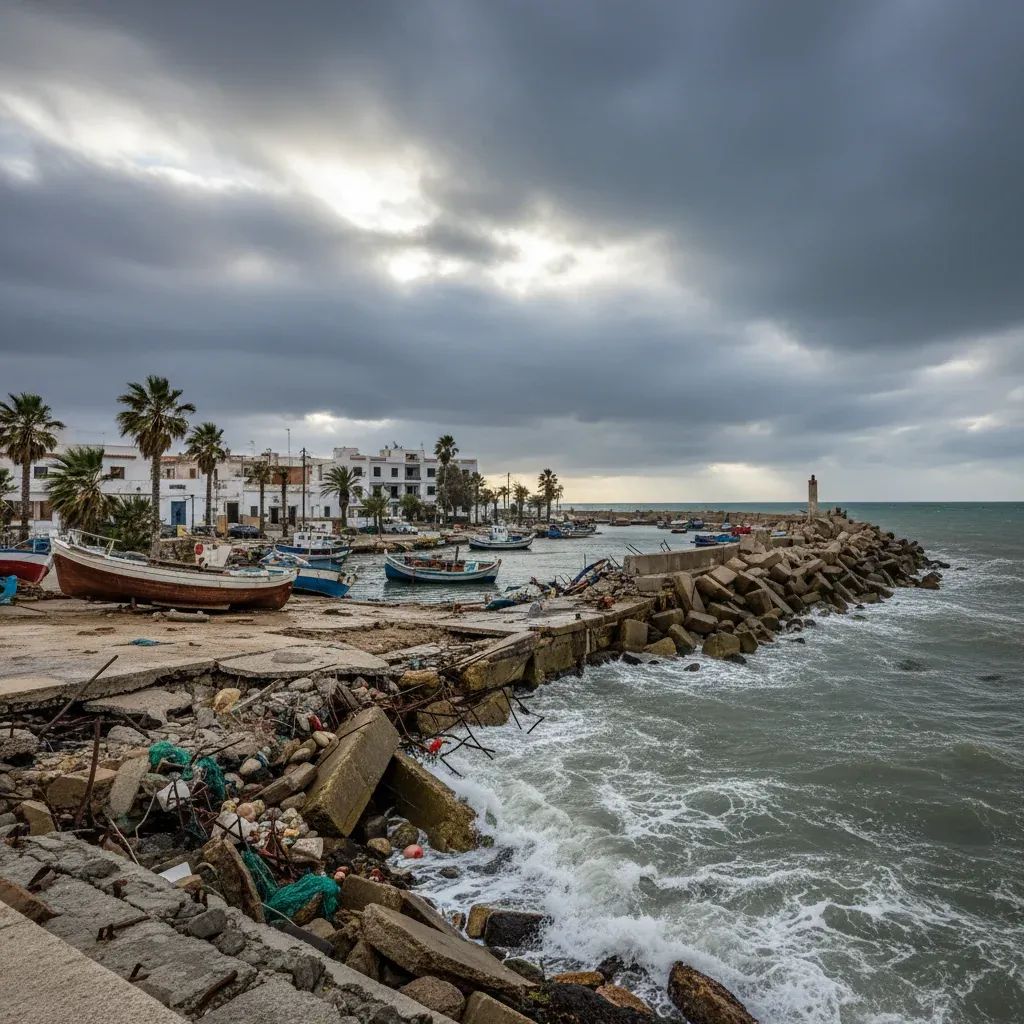
Coastal Malta is waiting. Following Storm Harry's mid-January devastation of fishing villages and resort towns across the island's shoreline, the government submitted a €128 million damage claim to the European Union on April 13, seeking assistance under the bloc's main emergency relief mechanism. The question isn't whether help will arrive—it's how much, and how long Malta must wait.
Why This Matters
• Narrow qualification margin: The claim of €128 million clears the EUSF threshold by only €7 million, leaving limited room for technical disputes over cost categorization or reclassification of damages.
• Immediate coastal reconstruction depends on it: Harbors, fishing infrastructure, tourism facilities, and residential areas cannot begin systematic repair until funding certainty arrives—a process that historically takes between three and eight months.
• Malta's largest EUSF application: This application represents by far Malta's largest emergency relief claim—over 130 times the €960,000 received for 2003 flooding, reflecting both the scale of damage and changing patterns of Mediterranean weather events.
When the Wind Came
Between January 19 and 22, Storm Harry—an extratropical cyclone—tracked directly across Malta with winds consistently above 95 kilometers per hour and gusts exceeding 100 km/h. Offshore, wave heights peaked at 13.14 meters. For a small island where most populated areas sit within 5 kilometers of the coast, few events deliver such immediate, concentrated destruction.
Coastal communities across the south bore the system's full force. According to initial damage assessments, fishing settlements and waterfront infrastructure absorbed particularly severe impacts. Concrete boat slipways and harbor facilities relied upon by local operators sustained damage. Coastal promenades and seawalls reported significant deterioration. Benches, railings, and public infrastructure in exposed areas sustained damage from storm surge and wave action.
The destruction radiated inland from the coast. Across Malta and Gozo, 228 trees fell nationwide—including significant specimens in agricultural and urban areas. Agricultural operations reported greenhouses crushed under wind pressure and crops obliterated. But the deepest economic scars appeared along the harbors.
In Birżebbuġa and Marsaxlokk, the twin anchoring points of Malta's fishing industry, pontoons broke loose from their moorings. Fishing boats either sank completely or were hurled onto shore by waves. Storage facilities packed with nets, traps, and seasonal equipment flooded. Small-scale operators lost inventory they had no insurance to replace. The maritime sector, which directly employs roughly 1,200 people in Malta and sustains coastal communities financially, absorbed perhaps the heaviest blow.
The Mathematics Problem
The European Union Solidarity Fund was designed to support member states facing truly exceptional disasters—events occurring perhaps once per decade or generation. Countries trigger eligibility once documented damage reaches a threshold scaled to their economic size. For Malta, that floor stands at €121 million. According to the Ministry for EU Funds, the government's damage assessment—compiled with input from government ministries, fishing cooperatives, port authorities, local councils, and affected businesses—totaled €128 million.
That represents a 6% cushion above the minimum requirement. It's not comfortable.
During evaluation, the European Commission's technical reviewers may reclassify certain cost categories. Perhaps they determine that specific property losses predate the storm or fall outside Fund criteria. Perhaps they dispute whether particular infrastructure damage qualifies as emergency-related or represents deferred maintenance. Each reclassification chips away at the total. Should accumulated reductions drop the claim below €121 million, Malta forfeits assistance entirely—no partial funding, no consolation sum.
This structural vulnerability prompted Maltese MEPs David Casa and Alex Agius Saliba to petition EU leadership in February 2026, three weeks into the damage assessment process. Their argument was straightforward: absolute euro thresholds inherently disadvantage geographically small, economically concentrated member states. They called for reformed criteria that account for proportional economic impact—a storm destroying 2% of national infrastructure would matter more for Malta than for Germany, yet the rigid threshold system treats both identically.
The bloc's Commissioner for Cohesion and Reforms tacitly acknowledged the tension. In early 2026 correspondence, the Commissioner signaled plans for a revised integrated climate resilience framework to accompany the existing solidarity mechanism. The language was diplomatic, but the meaning was plain: Mediterranean cyclones are intensifying, small nations need more adaptive support structures, and the current system wasn't designed for the new baseline of extreme weather frequency.
How the Rest of the Mediterranean Is Weathering the Storm
Malta is navigating this bureaucratic labyrinth alongside other Mediterranean nations grappling with intensifying storm activity.
According to EU Commission reports, Spain secured substantial assistance in 2025 for flooding that devastated Valencia in October 2024, with advance payments enabling early reconstruction mobilization. France obtained approvals for overseas territories affected by cyclones, with advance payments facilitating repair work. Both countries demonstrate that established procedural relationships and thorough documentation can accelerate funding timelines.
Italy is assessing damage from Storm Harry's impact on Sicily, Sardinia, and Calabria, with formal application expected in coming months. Officials anticipate a lengthy evaluation process given the scale and sectoral complexity.
Portugal faces significant timeline pressure following multiple storms in late January and early February 2026, with preliminary damage estimates substantially exceeding regional GDP thresholds. For a country with Portugal's economic footprint, even a prolonged wait is manageable. For Malta, delay threatens immediate reconstruction credibility.
The pattern reveals both the Fund's utility and its limitations. What were once anomalies—catastrophic storms requiring emergency relief mobilization—now occur with unsettling regularity across the Mediterranean basin. The EUSF, conceived in 2002 as a mechanism for rare, truly exceptional disasters, is evolving into something closer to a quasi-permanent seasonal instrument. That shift has political implications. Smaller member states increasingly argue the framework no longer serves its intended purpose.
What Malta's Residents Actually Need to Know
For property owners in affected coastal areas, fishing cooperatives operating from damaged harbors, hoteliers assessing structural damage, and municipal administrators planning reconstruction budgets, the EUSF outcome shapes everything tangible about recovery timelines and available resources.
The Fund reimburses specific, documented costs: emergency response operations, temporary infrastructure repairs, debris removal, and restoration work directly traceable to storm impact. It does not cover private insurance claims, routine maintenance backlogs, or speculative business losses disconnected from physical destruction. A fishing cooperative claiming damaged storage facilities must demonstrate the damage would not have occurred absent the storm.
Expected processing window: The European Commission typically requires three to six months for technical compliance assessment. Applications from larger member states with established EU procedural relationships have moved through final approval within six to eight months from submission. Malta's application was submitted April 13, placing realistic approval sometime between July and December 2026—assuming no technical complications emerge.
However, advance payments, if authorized, could begin reaching Malta's treasury within three to four months. Larger member states have received advance disbursements while full evaluation proceeded. The Maltese government is seeking similar consideration, though making no public guarantees.
Sectoral distribution likelihood: Public infrastructure—harbors, coastal defenses, roads, municipal facilities—historically receives the bulk of EUSF allocations because damage is quantifiable and directly attributable to government assets. Hospitality businesses and fishing cooperatives may qualify if their losses stem from communal infrastructure damage rather than standalone commercial property. Agricultural operations can claim if greenhouse or field damage is demonstrable and sectoral.
The verification process: The Commission reserves the right to challenge cost categorization. Technical reviewers will demand receipts, contractor estimates, photographs dated during and immediately after the storm, and expert assessments that damage truly resulted from storm impact rather than structural deficiency or deferred maintenance. Thorough documentation becomes essential. Any inconsistency invites deeper scrutiny and potential cost reclassification downward.
The 2003 Precedent and What It Reveals
In September 2003, severe storms and flooding battered Malta. Damage was initially estimated at €30.17 million. The government submitted an EUSF claim. The final assistance: €960,000. That's a reimbursement rate of roughly 3%—a gap between total damage and actual assistance that reflects both the historical scarcity of Maltese claims and the Fund's strict eligibility criteria.
Two decades later, the Storm Harry claim represents a substantial shift in scale. Approval at even modest reimbursement rates would exceed the entire history of EUSF assistance to Malta by significant margins. Success would also strengthen Malta's negotiating position in broader EU climate adaptation discussions, demonstrating that smaller member states can navigate complex EU procedures.
More pressingly, reconstruction timelines for fishing infrastructure, coastal promenades, harbors across the south coast, and dozens of affected properties hinge substantially on EU funding arriving within a reasonable window. For a tourism-dependent economy where coastal infrastructure directly translates to visitor revenue and local employment, funding timelines matter directly—the difference between recovery beginning in summer 2026 or extending into 2027.
The European Commission's decision, expected sometime in the second half of 2026, will test whether the EU's solidarity mechanism can genuinely serve smaller member states or whether structural design flaws continue to favor large-economy claimants whose damage inherently exceeds eligibility thresholds. For Malta, waiting is the only option remaining.


