
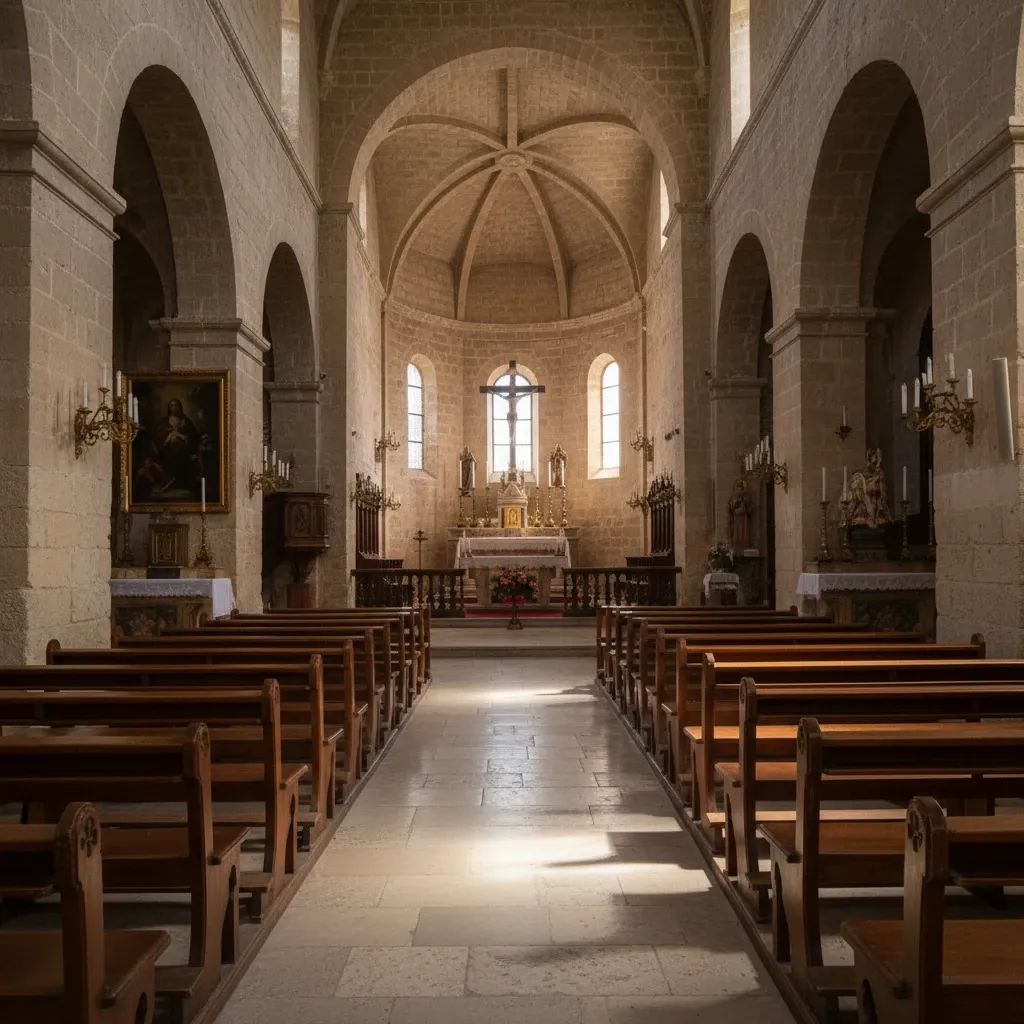
Exactly 100 years ago, the cupola crowning Rabat's St Paul's Collegiate Basilica vanished in a single catastrophic night. On November 19, 1924, stone and timber collapsed inward through the church's roof, obliterating altars, crushing ornate frescoes, and burying the sanctuary under debris that resembled the wreckage of wartime bombardment. Yet when dawn broke over the ruins, parishioners discovered something that deepened their faith: not a single worshipper had died, because the disaster struck at midnight, when the basilica stood empty. For a community already devoted to St Paul's miraculous survival of his shipwreck on these same shores nearly 2,000 years prior, the timing felt providential.
The basilica sits in Rabat, the town adjacent to Malta's medieval capital Mdina in the island's interior—approximately 20 minutes by car from Valletta and accessible via regular bus routes from major residential areas including Sliema and St. Julian's. For residents exploring Malta's heritage, this location remains one of the island's most historically significant sites, making it a natural destination for those seeking to understand Malta's early Christian history.
Why This Matters
• Ancient faith, modern fragility: The basilica sits atop the grotto where St Paul sheltered after his 60 AD shipwreck, making it Christianity's oldest landmark in Malta—yet three domes have failed here in 350 years.
• Engineering lessons persist: The 1924 collapse exposed design flaws from 1664 that remained invisible for 260 years; modern builders in Rabat's dense historic core now face similar challenges balancing preservation with structural reality.
• Reconstruction was lightning-fast: Architect Robert V. Galea rebuilt the basilica's dome from rubble to completion in just 2 years—a feat of coordination that would be remarkable even today.
The Dome That Should Never Have Held
The architectural troubles began the moment Lorenzo Gafà took the contract in 1664 to complete Francesco Buonamico's half-finished basilica. Gafà was skilled—his work elsewhere in Malta demonstrated genuine talent—but this dome proved problematic from inception. Within a century, officials had grown alarmed. By 1753, the Knights of St John's engineers produced a scathing technical assessment warning that the cupola's days were numbered. The massive stone lantern originally crowning the dome was stripped away sometime around this period, a desperate measure to reduce the crushing weight bearing down on stone walls never designed to support it. Gafà died in 1703, never knowing his dome would haunt builders for generations.
The structure persisted through the 1700s and 1800s in a state of fragile compromise, its underlying flaw dormant but never resolved. Then, in 1919, architect Carmelo Micallef proposed what seemed like an elegant solution: rather than demolish Gafà's compromise, he would construct an entirely new cupola around it—an encasement strategy that would add aesthetic refinement while theoretically protecting the weakened core beneath. Micallef's dome featured a new lantern and completed installation by 1920. The design looked graceful. Contemporary accounts praised it as a triumph of modern craftsmanship.
The respite lasted four years.
When Geology and Time Aligned Against Stone
An earthquake shook the Maltese archipelago in September 1923. The tremor propagated through ancient limestone foundations, reverberating through Rabat's closely packed streets. The basilica's cupola—now bearing both Micallef's new weight and the burden of Gafà's flawed original structure—absorbed damage that repair crews attempted to correct over the following months. But geological violence had loosened what centuries of static pressure had already weakened. The dome existed in a state of provisional stability, held together by hope and routine maintenance.
November 1924 brought a severe storm to Rabat. Wind and rain battered the church during the night of the 19th. The accumulated stresses—Gafà's inherent design flaw, the earthquake's damage, Micallef's added weight, the storm's force—converged into a single moment of structural failure. The dome collapsed inward. The basilica's interior ceilings fell through. Altars shattered. A celebrated fresco by Giuseppe Calì, one of Malta's most accomplished painters, was destroyed in the rubble. The sanctuary became a tomb of broken ornamentation and crushed woodwork.
Photographers arrived quickly, documenting devastation that would later evoke World War II bombing damage that ravaged this same town two decades forward. The images became postcards—disaster as commercial product. Yet the unnamed publishers left no credit lines, and today attribution remains impossible.
Community Mobilization and Galea's Vision
The rubble-clearing began immediately. Rabat's parishioners mobilized with the kind of collective urgency that emerges when a community's spiritual center lies destroyed. Architect Robert V. Galea, who would later serve as a university professor of engineering and architecture, received the commission to design the third dome. Unlike Micallef's encasement strategy, Galea chose to build anew, learning from both previous failures: the original design flaw and the fatal weight problem introduced by attempting to preserve what should not have been preserved.
Galea's reconstruction was completed around 1926—precisely 100 years from today. The new cupola balanced aesthetic ambition with structural parsimony. A lantern returned to crown it, but designed with proportions informed by hard experience. The dome did not merely replicate lost beauty; it embodied lessons etched in stone collapse and parishioner memory. The speed of this reconstruction—from total ruin to completed basilica in roughly 24 months—remains striking in any era.
What This Reveals About Malta's Built Environment
The basilica's trilogy of domes encapsulates a recurring tension in Malta's approach to historic preservation and urban development. The original mistake was Gafà's—a design that looked coherent on paper but couldn't bear its own weight. The second mistake was institutional: for 260 years, engineers acknowledged the problem but never acted definitively, instead making incremental compromises. The third phase was Micallef's modern gamble: applying 20th-century engineering confidence to a fundamentally compromised structure, with catastrophic results.
Today, planners wrestling with Rabat's construction boom face analogous decisions. Dense new residential blocks climb above historic cores. Multi-story commercial developments share foundations with 400-year-old residences. Seismic activity, rare but consequential, remains a consideration in a Mediterranean basin where stability cannot be assumed. The basilica's three domes sit as an advertisement for structural clarity: sometimes demolition serves preservation better than preservation itself.
When Fortune and Faith Intersect
The miracle interpretation that surrounded the 1924 collapse reflected both genuine relief and theological meaning. The basilica had suffered near-total interior destruction. Yet the moment of catastrophic failure—midnight, when the sanctuary was empty—meant that no one stood beneath the falling stone. For a faith community already centered on a saint who survived a maritime shipwreck against odds, the timing seemed calibrated by something beyond mere chance.
The statue of the Immaculate Conception that typically stood in the shrine had been removed for maintenance and survived undamaged. Contemporary chroniclers noted this alongside the absence of deaths, weaving both facts into a narrative of protective intercession. Whether one interprets this as divine grace or fortunate logistics, the parishioners' rapid rebuilding proceeded with renewed conviction that the site deserved restoration.
The Centennial Dome
A century after Galea completed his work, the basilica continues as Rabat's primary pilgrimage destination and heritage site. The dome attracts both devout Catholics and heritage tourists seeking connection to the earliest chapter of Maltese Christianity. The basilica remains open to visitors and welcomes those interested in exploring one of Malta's most significant religious monuments. Currently, the basilica is undergoing routine restoration work to maintain its structure and preserve its historical integrity for future generations, with access generally maintained during these works.
The 1924 collapse offers Rabat residents and Malta more broadly a cautionary narrative about structural confidence. What seems permanent can fail. What appears fixed may be compromised. And what emerges from catastrophe, if rebuilt with humility rather than certainty, can endure more faithfully than the original.


