
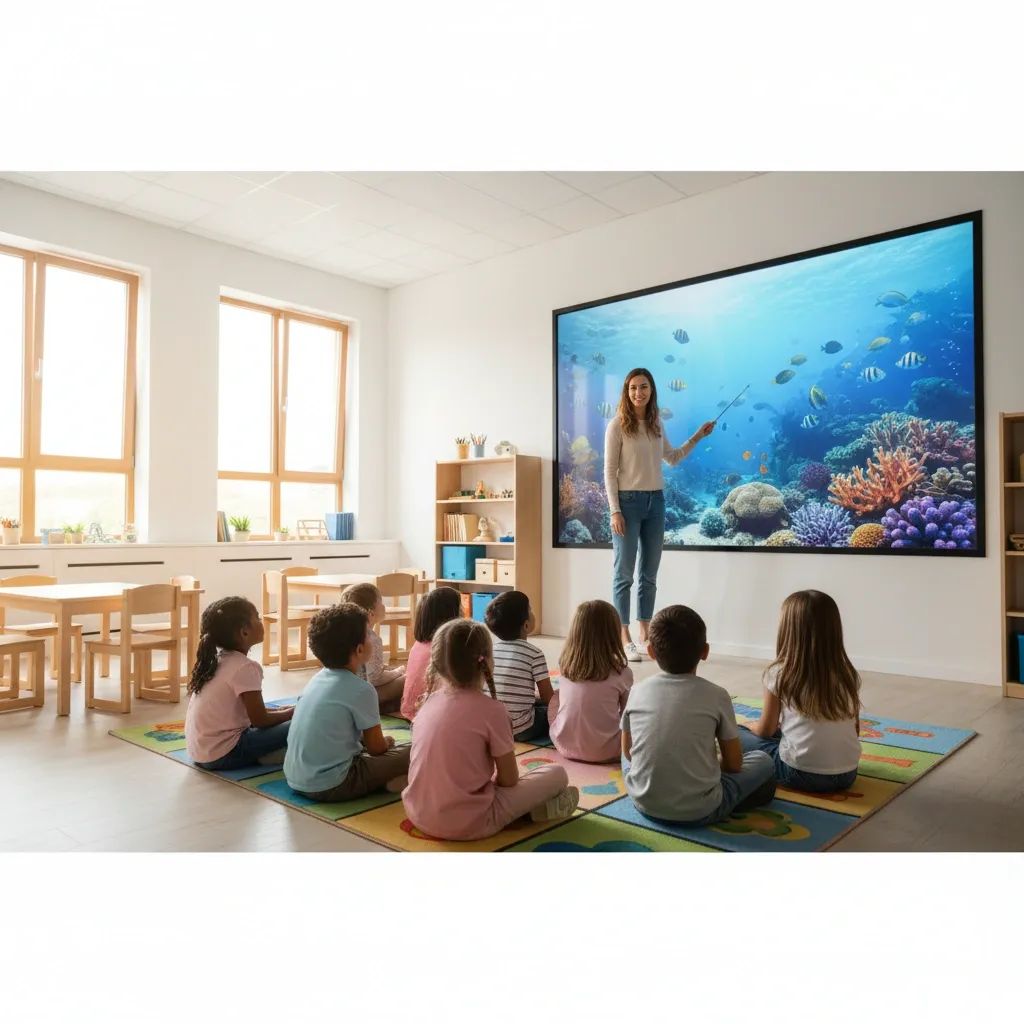
Teaching the Sea: How Malta's Educators Are Getting AI Help to Reach Kindergarteners
Malta is testing an AI platform designed to help early childhood teachers translate ocean science into activities that actually hold a 5-year-old's attention. The setup is simple enough: kindergarten instructors feed questions about marine life into a system that pulls answers from a vetted library rather than the chaotic expanse of the internet. What sounds straightforward on paper represents a quiet shift in how this island nation approaches workforce development—by seeding environmental curiosity before children even enter primary school.
Why This Matters
• Pilot wrapping in May: The SELBI project concludes its testing phase at MCAST on May 5, 2026, with findings and live demonstrations open to educators.
• Vetted answers only: Rather than generic AI outputs, responses draw from a curated knowledge base tailored to Malta's marine ecosystems and national curriculum standards—no hallucinated facts.
• Jobs downstream: Malta's maritime sectors (shipping, aquaculture, tourism) account for roughly 12% of GDP, yet the island has struggled to attract young talent into blue-collar marine careers. Early environmental literacy is seen as the long-game solution.
• Locally hosted: Data never leaves Maltese servers, sidestepping cloud storage privacy concerns common with multinational EdTech platforms.
The Workforce Problem Nobody Talks About
Visit any fishing harbor in Marsaxlokk or walk past the shipyards in Valletta, and you'll see a pattern: aging workforce, limited pipeline of younger recruits willing to pursue marine trades. The Malta Vision 2050 strategy openly acknowledges this. The archipelago's economy depends on sea-based industries, yet school leavers rarely gravitate toward aquaculture management, maritime engineering, or coastal resource management. The theory underpinning the SELBI initiative is that interest begins early—before career stereotypes harden. If you can make octopuses and underwater caves compelling to a 6-year-old, you're planting a seed that might bloom into serious academic study by age 16.
A nationwide survey conducted by MCAST's Applied Research and Innovation Centre in 2025 tested this hypothesis informally. Kindergarten 1 through Year 2 educators across Malta were asked about their comfort teaching marine topics. Roughly two-thirds reported feeling underprepared, not because they lacked passion but because their own training gaps made lesson planning stressful. A typical response: "I love the beach, but I don't know how to explain why we shouldn't collect shells from protected areas without sounding like a killjoy to six-year-olds." That friction point is where SELBI steps in.
The Technical Trick: Why This Isn't ChatGPT for Teachers
The platform uses something called Retrieval-Augmented Generation, or RAG—essentially a hybrid system that anchors AI creativity to a pre-built library of approved content. Think of it less as an oracle and more as a well-organized filing cabinet with an intelligent assistant. When a Year 1 teacher queries the system for activities about Mediterranean sea urchins, the AI doesn't generate novel content probabilistically. Instead, it retrieves relevant material from the knowledge base, synthesizes it into classroom-ready suggestions, and flags the source documents so educators know where information came from.
This architecture matters because early childhood is not a space for surprises from AI. A mainstream platform like Gemini or Copilot might suggest an "exciting dissection activity" suitable for advanced learners—developmentally inappropriate for 5-year-olds. SELBI's curated base was assembled by marine biologists and early childhood specialists working against Malta's official curriculum frameworks and cross-referenced with Mediterranean marine science. An activity on plastic pollution in Maltese harbors might include a case study of the 2023 cleanup effort at Balluta Bay, suggested vocabulary aligned with the Early Years Learning Framework, and discussion prompts designed to foster curiosity rather than eco-anxiety.
The distinction is ethical as much as technical. Consumer AI tools are built for scale and speed—generic outputs optimized for broad audiences. SELBI's architecture is deliberately narrow: it solves one problem (helping early childhood educators plan marine sustainability lessons) in one place (Malta) for one age group (3 to 7 years). That constraint is its strength. There's no chatbot personality, no incentive to dazzle with novelty, no surveillance built into the backend.
What Educators Found During Testing
The pilot involved 14 educators testing the platform across Malta's schools. Feedback from these trials reveals predictable friction alongside genuine utility. One Kindergarten 2 teacher in Ħamrun estimated she saved about 30% of her lesson preparation time—a tangible win for someone juggling multiple planning demands. Other educators found the interface clunky; some queries required reframing to produce usable outputs. The platform's learning curve is real.
For educators newer to Malta—a significant portion of the island's teaching workforce—the platform also serves as an introduction to local marine ecosystems and environmental priorities. This feature particularly strengthens SELBI's value proposition for the diverse early childhood educator population across the islands.
More philosophically, a few veteran instructors raised eyebrows about whether AI-mediated pedagogy fundamentally changes teaching. One Year 1 educator from Gozo noted during a feedback session that SELBI's suggestions, though scientifically sound and pedagogically appropriate, sometimes lacked what she called "rough edges"—the unpredictability that makes teaching human. When a child mentions his grandfather's fishing boat during a lesson on sustainable seafood, that tangent isn't in the AI's knowledge base. It's not part of the curriculum matrix. Yet those moments often stay with learners long after the official lesson ends.
The SELBI team accepts this critique. They've framed the platform explicitly as a "starting point, not a script"—a cognitive scaffold that removes knowledge barriers but preserves space for improvisation. In academic language, they're applying a framework called TPACK (Technological Pedagogical and Content Knowledge), which attempts to marry technical capability with subject expertise and teaching craft. An AI platform without teachers remains inert. Teachers without tools often teach what they know, not what they need to teach.
Why Global Comparisons Matter—But Aren't Directly Transferable
Other countries have rolled out AI platforms for early childhood educators. Australia's LoveHeart converts teacher observations into narrative learning stories, cutting documentation time by hours weekly. Estonia's DigiLa aligns child development monitoring to national curriculum frameworks. India's Rocket Learning aims to democratize early childhood support in Anganwadi centers across rural regions. The UK's Oak National Academy received £2 million in government funding to expand AI-powered lesson planning.
Each reflects different priorities and constraints. Australia's platforms target administrative burden—teachers in wealthy systems often drown in paperwork. India's solutions address equity gaps—bringing specialist pedagogical support to areas without trained educators. Estonia and the UK focus on curriculum alignment and workload efficiency. SELBI's design philosophy sits at the intersection: it lightens administrative load and bridges knowledge gaps and ensures cultural and geographic specificity.
The key distinction: SELBI is purpose-built for one island's ecological context and economic structure. An Australian platform fine-tuned for Aboriginal reconciliation frameworks won't translate directly to Malta without substantial reworking. That localization—designing for the Mediterranean Sea, Maltese maritime policy, and local environmental challenges—is why SELBI demanded a dedicated research team rather than licensing an off-the-shelf solution.
What Scaling Actually Means
If the Malta Ministry for Education, Sport, Youth, Research and Innovation decides to adopt SELBI beyond the pilot, real-world obstacles emerge. The current platform is funded through June 2026 by a Xjenza Malta research grant. Maintenance, technical support, and updates require ongoing resources. The six-person MCAST team led by Dr. Shirley Ann Gauci (principal investigator) includes experts across AI, marine science, and early childhood education—a rare combination unlikely to be assembled on a shoestring budget.
One plausible pathway: integration into the National Curriculum Framework review, scheduled for completion in 2027. If marine sustainability becomes a mandated cross-curricular theme in early years settings, SELBI's platform could graduate from research project to departmental tool. Another option: open-source portions of the knowledge base, allowing educators in neighboring Mediterranean countries to adapt material for local contexts. Sicily, southern Italy, and Greece face similar marine workforce shortages and could benefit from a shared knowledge repository.
Politically, the optics are favorable. SELBI directly supports Malta Vision 2050—the government's flagship strategic document—which emphasizes environmental literacy as foundational to economic resilience. The blue economy is projected to need roughly 4,000 additional skilled workers by 2050. If SELBI and similar initiatives can cultivate marine curiosity in children now, Malta might see a cohort entering secondary school in 2030 with foundational ocean literacy—students more likely to pursue advanced study in marine engineering, sustainable aquaculture, or environmental policy.
The Governance Question: Privacy and Digital Sovereignty
SELBI's architecture—locally hosted, not reliant on cloud infrastructure—sidesteps a gnawing concern in EU policy circles: where does sensitive data actually live? A platform that routes teacher interactions through servers in California or Ireland immediately triggers GDPR scrutiny. SELBI processes no student information (teachers query the system; children never directly interface with it), so it falls outside the strictest Article 8 provisions (which govern consent for minors' personal data). Still, the team consulted the Office of the Information and Data Protection Commissioner to ensure full compliance—a prudent step that may simplify future public procurement if the government seeks licensing.
For a small EU member state watching Big Tech's influence expand, data geography carries weight. A locally hosted platform becomes a political asset, not just a technical choice. It signals commitment to digital self-determination, particularly in education—a domain where parental anxiety about surveillance runs high.
The Research Legacy
Beyond the pilot, SELBI's value lies in establishing a template for domain-specific, ethics-reviewed AI in early childhood pedagogy. The team has already submitted academic work to EduLearn 2026 (an IATED conference) titled "A More Knowledgeable Other for Blue Skills Pedagogy: Internal Validation of a TPACK-Aligned RAG Platform for Early Childhood Educators." This positioning—framing the tool within established educational psychology (the "more knowledgeable other" is Vygotskian language for scaffolded learning) rather than as AI hype—will likely influence how other institutions design similar tools.
The model could extend beyond marine education. Civic education, Maltese history, agricultural sustainability—subjects where teacher expertise varies wildly—could benefit from similar RAG-based platforms built against national curriculum standards. Each would require localized knowledge bases and validation. Each would demand time and funding. But the proof of concept is SELBI.
The May Event and What Comes After
May 5, 2026, the ARIC Conference Room at MCAST will host the project's closure and dissemination event. Educators across the island can watch live demonstrations, hear research findings, and explore whether SELBI fits their classroom workflow. The team will likely announce whether portions of the knowledge base will be open-sourced—a decision that signals confidence in the platform's robustness and intent to support educators beyond Malta's borders.
Beyond the public event, the platform's future depends on decisions made outside the conference room. Government adoption conversations happen in budget meetings and ministry offices, away from public view. But signals are encouraging. The fact that SELBI aligned itself explicitly with Malta Vision 2050 and national curriculum frameworks from the project's outset suggests political buy-in at least at the advisory level. The involvement of six MCAST researchers signals institutional commitment. The funding through Xjenza Malta—a quasi-governmental research council—implies some level of official backing.
For educators interested in exploring the platform before May, selbi.education and the associated Facebook and LinkedIn pages provide documentation and sample outputs. The platform isn't yet publicly accessible, but the May event will likely determine whether it transitions from research curiosity to classroom fixture—a shift that could reshape how Malta's youngest citizens learn about the water that defines their island.


