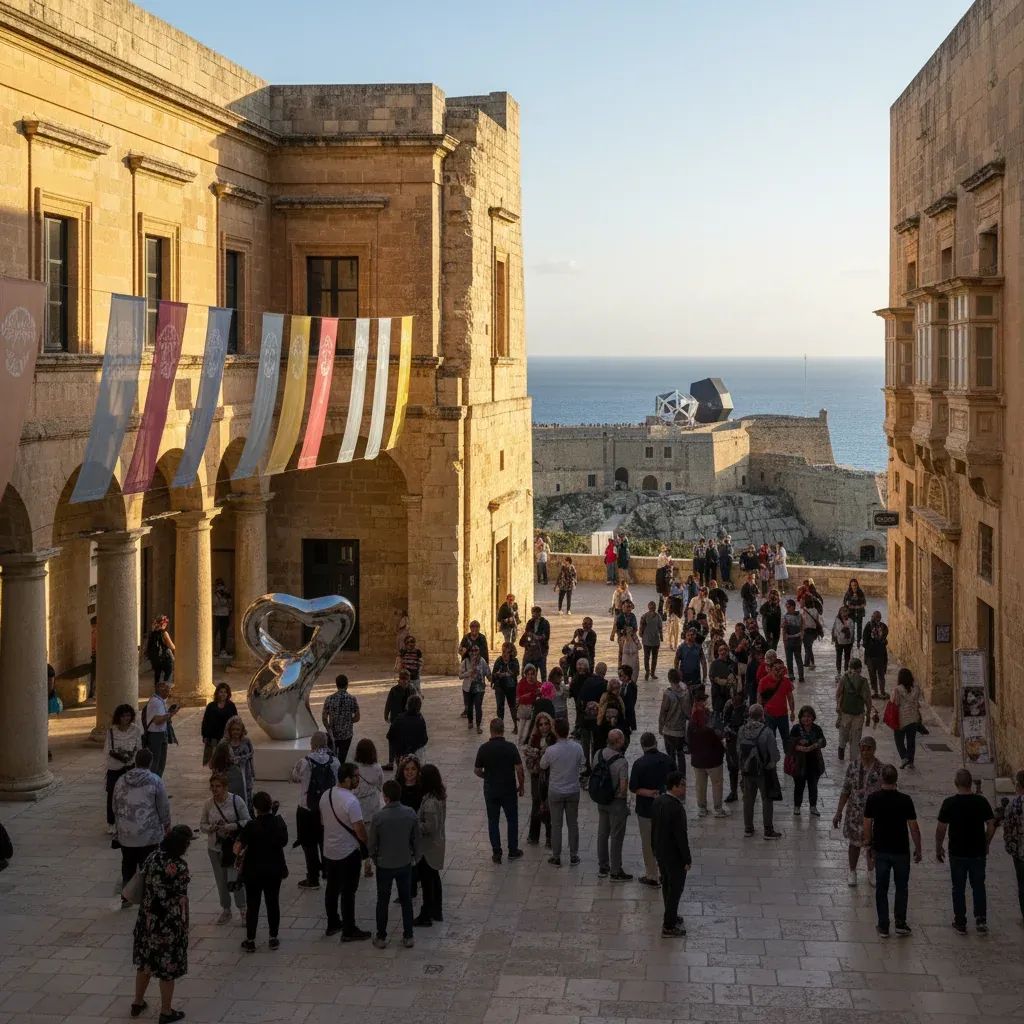
Valletta's cultural conversation is about to shift. On May 14, Valletta Contemporary welcomes an evening of readings and dialogue that tests an increasingly urgent hypothesis across Mediterranean cities: whether poets and novelists can articulate environmental crisis in ways that government strategies and climate reports simply cannot. Two writers—one examining ecological loss through American landscapes, the other processing Malta's own territorial pressures through fiction—will occupy the same room to explore what happens when storytelling meets planetary urgency.
Why This Matters
• Free admission and open to all, with readings beginning at 5:30 PM. Arrive early; seating is finite and no pre-registration required
• Heather Bourbeau, a US poet currently embedded in Malta as an artist-in-residence, brings a perspective shaped by mapping conservation across Western American territories; David Samuel Hudson, Malta's acclaimed novelist, returns to themes of local identity and development pressure through his debut work
• This dialogue carries practical value for residents: a chance to witness how writers across different geographies interpret identical planetary threats—water depletion, overdevelopment, marine ecosystem collapse
How Two Writers Approach the Same Crisis Differently
Heather Bourbeau's method diverges sharply from traditional nature writing. Rather than celebrating wilderness, her poetry in Monarch excavates what the American West has lost: erased histories, abandoned landscapes, the material traces of decisions that weren't consciously made so much as permitted. She pairs this textual work with something rarer—an interactive digital archive mapping protected lands across the United States. The tool functions as a counterargument: here is what we managed to preserve, set against here is what we didn't. For Maltese readers, the exercise becomes instructive. It models a way of thinking about one's own territory: what has Valletta preserved? What has the Dingli Cliffs region lost? What does the story we tell about development reveal about what we value?
David Samuel Hudson operates closer to home. His 2024 novel M represents a deliberate choice to write the island's ecological and social turbulence not through reportage but through experimental narrative structures that force readers to experience fragmentation the way residents experience their landscape—fractured, contradictory, difficult to hold in a single coherent frame. This approach matters precisely because it avoids didacticism. Hudson isn't arguing about Malta's pressures; he's enacting them linguistically. When the two writers occupy the same stage, the audience witnesses not consensus but productive tension: the American surveying loss from temporal distance, the Maltese novelist narrating pressure in real time.
Malta's Growing Investment in Stories as Environmental Witness
The decision to host this event didn't emerge from cultural improvisation. Over the past 18 months, educational and cultural institutions across Malta have quietly begun experimenting with how narrative and storytelling function as tools for environmental consciousness—not as alternatives to policy or science, but as complements to them.
Schools initiated the pivot. In April 2024, the National Readathon distributed more than 10,000 copies of The Land of Fairy Fails, a locally-authored fairy tale by Benjamin Portelli, to primary students. The book doesn't flatten environmental urgency into child-friendly moralizing. Instead, it constructs a narrative where the protagonist "Wizard Willy" confronts specific, recognizable threats: marine plastic in Maltese waters, air quality deterioration in densely built areas, transport systems overwhelmed by cars. Children absorbing this story internalize environmental anxiety not as abstract future catastrophe but as immediate, named reality. The effectiveness lies partly in specificity—readers recognize their own streets, their own seacoast.
Nature Trust–FEE Malta operates a parallel initiative through Il-Ballottra, a series that weaves environmental content throughout fictional narratives, games, and competitions. Characters like Lumina and Kolombu the frog recur, transforming individual stories into an ongoing conversation about ecological responsibility. Neville the Shark, now translated into Maltese, uses illustration to teach younger and older readers how ocean waste damages marine systems and how waste itself can be economically reinvented through reuse.
What unites these initiatives is a fundamental recognition: fiction and poetry access cognitive and emotional territories that spreadsheets and policy briefs cannot reach. A child reading about Wizard Willy builds internal models of environmental consequence through narrative identification. An adult hearing Hudson read about cultural dissolution or Bourbeau recite about erased landscapes experiences something neurologically distinct from abstract climate data. This isn't sentimentality; neuroscience has documented how narrative structure activates different brain regions than factual information does.
What Residents Should Expect—and What They Might Ask
Wednesday's format isn't a lecture delivered to passive audiences. After readings from both writers, the evening shifts into moderated discussion and direct questions. This creates space for practical exchange. Residents can ask Hudson directly: how does fiction process the tension between Malta's economic model—built substantially on density and tourism—and its ecological limits? Does narrative offer solutions, or does it primarily help us articulate contradictions we're living but unable to speak aloud? For Bourbeau, the questions might probe whether mapping conservation efforts changes political behavior or merely documents loss. Can art affect policy, or does it function chiefly as witness?
For expats and long-term residents, the comparison between American and Maltese environmental storytelling reveals deeper cultural fractures: what kinds of loss different societies choose to memorialize, whose ecological anxieties receive literary voice, how geography shapes which stories get told and by whom.
There's a secondary utility operating here as well. Valletta Contemporary has positioned itself as a venue for addressing urgent social and environmental questions, not primarily as a heritage repository. For anyone working in the intersection of arts, policy, environmental advocacy, or cultural development in Malta, such events function as informal professional spaces. Conversations extend beyond the moderated discussion; connections form; collaborations occasionally emerge from these informal exchanges. On a small island, these moments compound disproportionately.
The Larger Mediterranean Reality: Why This Event Happens Now
The Mediterranean basin is experiencing accelerating climate disruption. Rising sea levels, intensifying heat waves, collapsing groundwater systems, rapid biodiversity loss—these aren't future abstractions for island nations. They're present material reality reshaping infrastructure, agriculture, and tourism economies simultaneously. Malta, densely populated and hydrologically stressed, experiences these pressures acutely. When Valletta Contemporary programs an evening around eco-fiction, the choice reflects institutional recognition that cultural institutions must engage urgent contemporary crises, not retreat into heritage conservation.
The decision to host Bourbeau as an artist-in-residence further clarifies institutional priorities. Malta, like many small nations, has deliberately invested in cultural exchange programming that brings international artists and writers to collaborate with local creators and audiences. This model serves multiple functions: it exposes residents to global conversations about shared crises without requiring travel; it creates cross-pollination between artistic traditions; it generates new work informed by geographic specificity. Bourbeau spending months on Malta, thinking through local ecological pressures alongside American conservation lessons, then sharing that synthesis with a Valletta audience represents cultural exchange functioning as substantive dialogue rather than superficial tourism.
The Uncertain Aftermath
Whether "New Words for a Changing World" catalyzes ongoing programming around environmental literature, or remains a singular event, depends partly on attendance and partly on institutional capacity. What's certain is that Valletta Contemporary is testing whether literature functions as a meaningful tool for environmental engagement in Malta's specific context. Strong audience response signals sustainability for future similar events.
For now, the evening represents what it is: a deliberate cultural act wherein two writers—one international, one deeply local—explore whether language and narrative illuminate dimensions of ecological crisis that policy analysis often obscures. Not solutions necessarily, but frameworks for different thinking. Stories that ask questions rather than impose answers. The chance, in other words, to hear environmental crisis articulated in voices that sound human.
May 14, 5:30 PM at Valletta Contemporary. Come with a question prepared.